Famous for its great food, laid-back atmosphere, and stunning Mekong views, we’d been meaning to visit Chiang Khan for years. The problem had always been finding an opportunity. It’s not especially close to anything, making it hard to plan a visit.
Our chance finally came during a two-week road trip through Isan. After making our way north through Phetchabun and Uttaradit, we’d swing east into Isan proper, with Chiang Khan as our first stop.
Jump Ahead
- Watch the Whole Journey on YouTube
- Getting to Chiang Khan from the North
- Arriving in Chiang Khan
- Chiang Khan Night Market: One of Thailand’s Best
- Khao Piak Sen: Chiang Khan’s Best Breakfast
- Wat Phra Phutthabat Phu Khwai Ngoen: Chiang Khan’s Rabbit Temple
- Biking along the Mekong on the Chiang Khan Promenade
- Eating and Drinking in Chiang Khan
- Plan Your Trip
Our journey to began high in the mountains of Phu Soi Dao National Park. After the coldest night we’d ever experienced in Thailand (still not really that cold), we awoke to find the pine meadows shrouded in mist. Such a magical way to start the day.
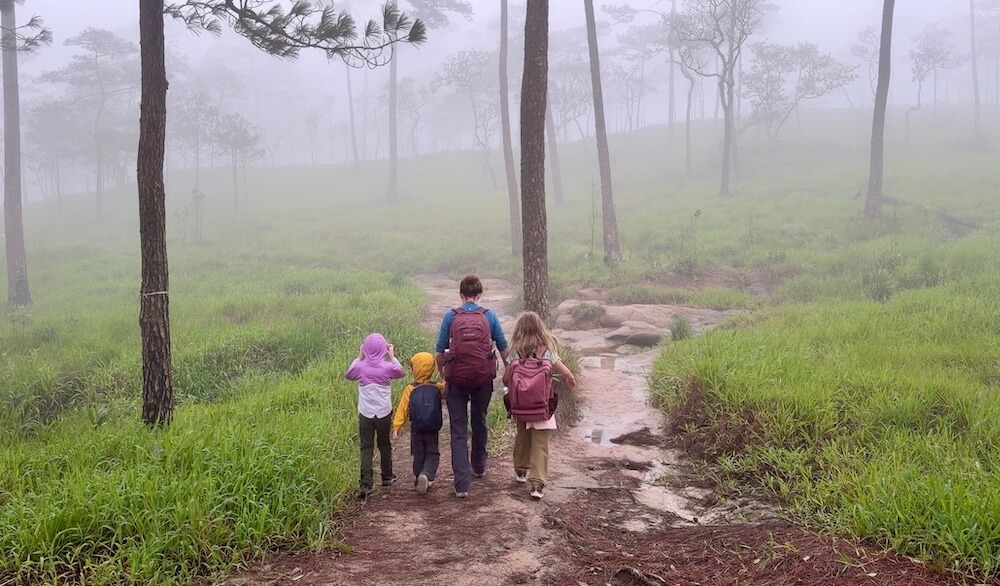
But we were on top of a mountain and had a long hike ahead of us. We began walking through a light fog which gradually cleared as we climbed lower. The descent was, both in terms of altitude and emotion, a comedown. After a few hours, though, we were back in the car, driving to Chiang Khan.
Prefer to watch the journey? Join our family in charming Chiang Khan on the Touch GrassTour YouTube channel.
Driving to Chiang Khan from the North
It’s a short distance as the crow flies, but we had a mountain range and a big corner of Laos blocking our route. So, we wound through forested hills and small but efficient farms – any slope less than 60 degrees had something planted on it.
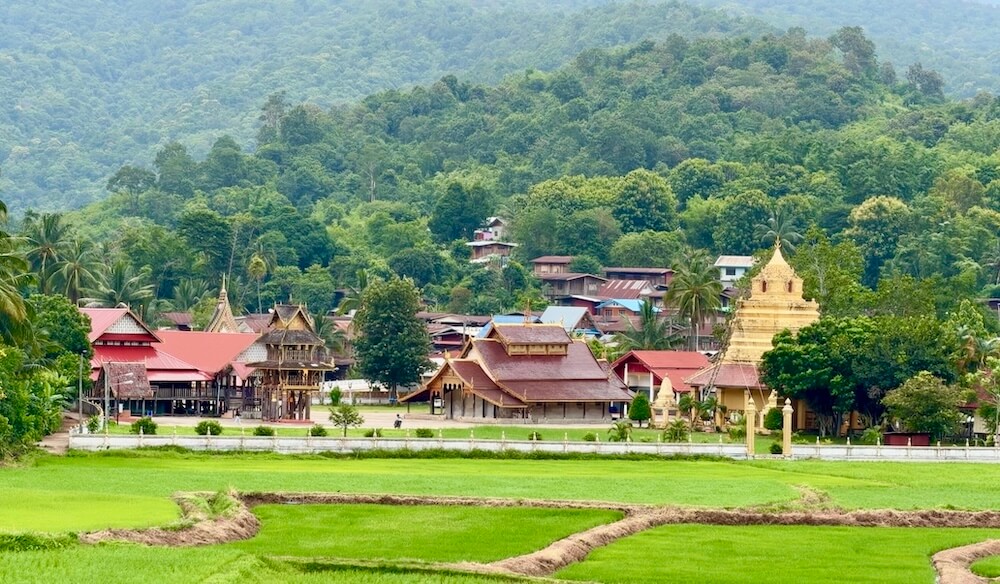
Eager to arrive in Chiang Khan, we didn’t make many stops. The one exception was an overlook with a view of Wat Sri Pho Chai, one of the oldest temples in Northern Thailand. Across acres of bright green new rice, the glinting gold of the chedi was particularly striking.
Another stop was meant to be the Chiang Khan Skywalk, a glass-bottomed promenade that towers above the Mekong. It’s a relatively new addition and it reminded me of dozens of similar sites we’d seen over our years traveling around China.
We wouldn’t see this one, though. We arrived to a desolate scene: boarded up shops and ticket office doors bound tightly with thick chain. The place looked as though it had been abandoned years earlier. When we finally tracked down someone who could tell us what had happened, though, we learned it had only been a day.
The skywalk was closed for a week of maintenance. Not terribly surprising, since it was the low season, but there was no warning of it anywhere, including on the official website. You basically just have to drive up and hope for better luck than we had. Ninety-nine times out of a hundred, you probably will.
Arriving in Chiang Khan
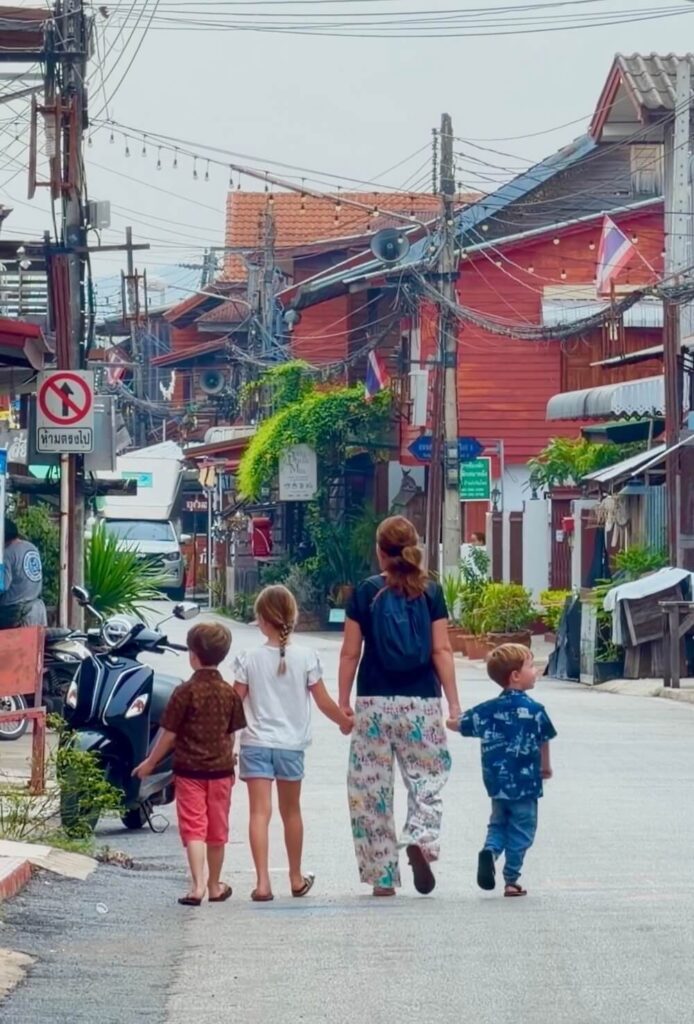
There is an inverse relationship between how charming a town is and how easy it is to navigate by car. As the Kia crawled in the wrong direction up one-way streets and strayed into the occasional pedestrian-only zone, I knew we were going to like this town.
Once I’d safely parked the car within the grounds of a wat near our hotel, I was free to enjoy just how correct my hunch was.
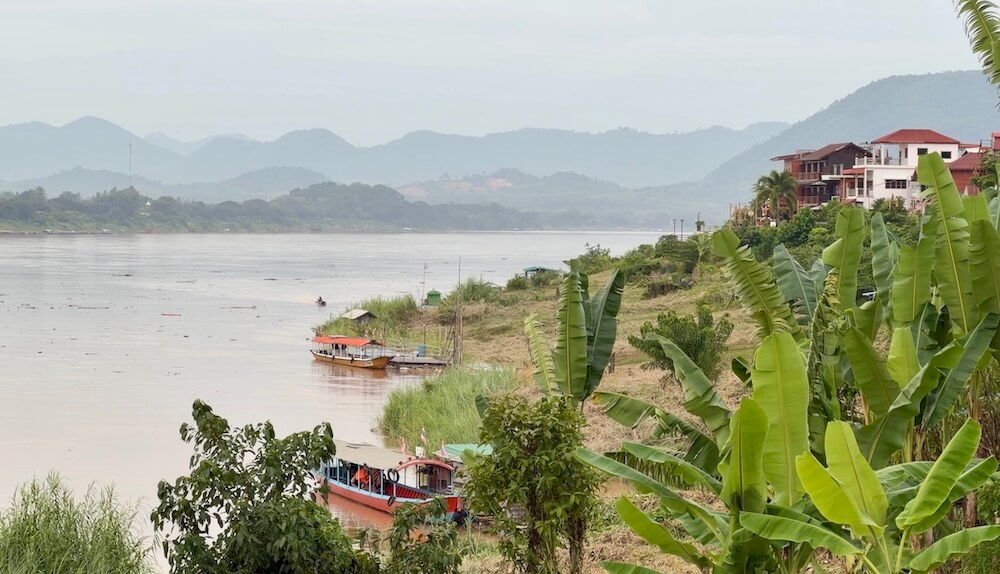
Rows of two- and three-story wooden buildings line the main promenade, which is also where the city’s famed night market takes place each evening. The buildings along the north side of the street also face the river, offering views across the Mekong and into Laos.
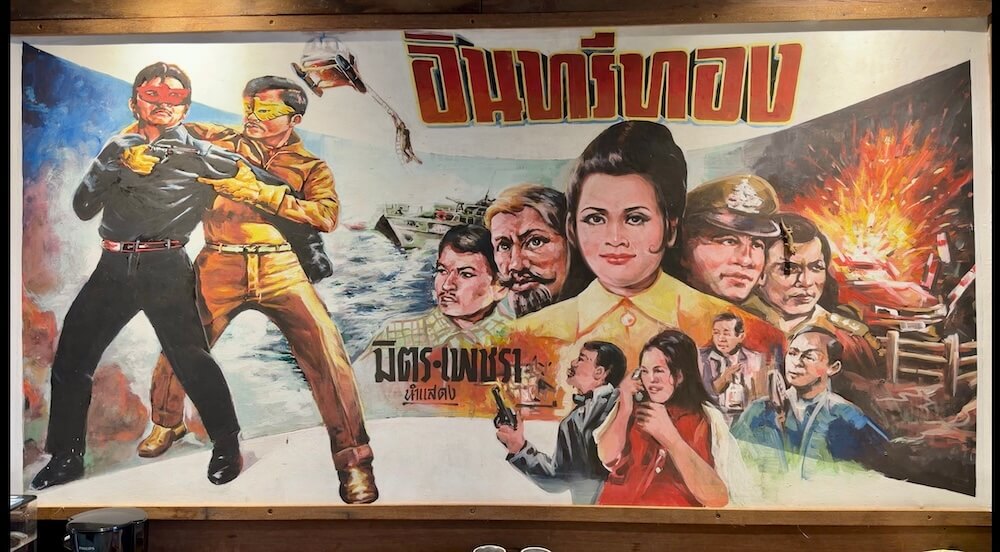
The Suneta Hotel (there are two, mind you, but they’re related and both are great) is one of those river-facing hotels and we loved it, both for its views, and for the quirky, retro style of its decor. The walls in the common room are covered in vintage Thai movie posters and promotional photos of Thai movie star Mitr Chaibancha.
Chiang Khan Night Market: One of Thailand’s Best
Set between charming multistory wooden shops that run the full length of Chai Kong Road, Chiang Khan’s walking street reminded me of Lampang’s night market, one of my favorites in the country.
Like at Lampang, it is directed primarily at locals and Thai tourists, so there’s not only a huge range of things to eat, but a broader range of souvenirs specific to Chiang Khan. Small Mekong prawns on a stick are a popular specialty, though I initially hadn’t the least idea where they might be sourced from.
Pa thong ko, a “stuffed” version of the fried dough that’s popular across much of East Asia, was high on my list of things to eat. The fillings can be sweet or savory, but even on a Sunday night, there were none to be found. I even continued my search the next morning, but no luck!
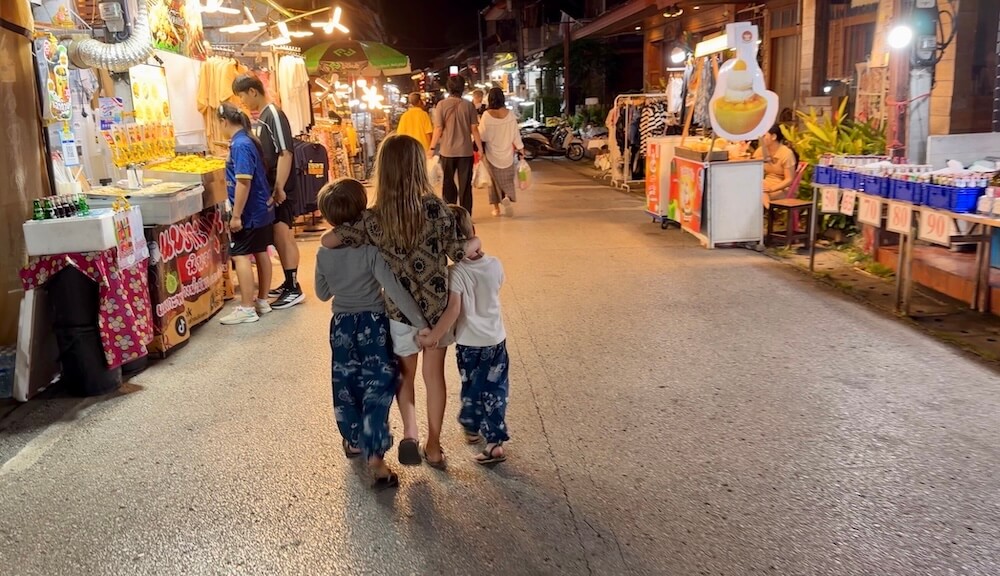
On a Sunday night during the depths of the low season, though, it was decidedly quiet. The prawn skewers sat forlornly on display at barely trafficked food stalls. We went for a sausage on the theory that cured meats are designed to last, but there was undoubtedly a certain freshness missing.
A better bet would have been one of the proper restaurants that serve food directly onto the walking street. There are dozens of appealing options with seating either along the street or under the electric lights just inside the restaurants. Unless there’s something really appealing at the stalls, it’s better to take advantage of the spots operating with a full kitchen.
Khao Piak Sen (Chewy Noodle Soup): The Better Breakfast Option
Just because it was the low season didn’t mean I was going to give up on my food goals. The next morning, at an earlier hour than they’d like, I dragged the kids out of bed to walk the deserted streets of Chiang Khan in search of stuffed pa thong ko. I finally gave up somewhere inside the wet market, while the keepers of the few open stalls watched bemusedly and surely wondered what on earth we were doing there.
Fortunately for us, our backup option was excellent. At the far eastern end of the walking street stands Soi Sao Khao Piak Sen (ร้านซอยซาว ข้าวเปียกเส้น), a Chiang Khan institution.
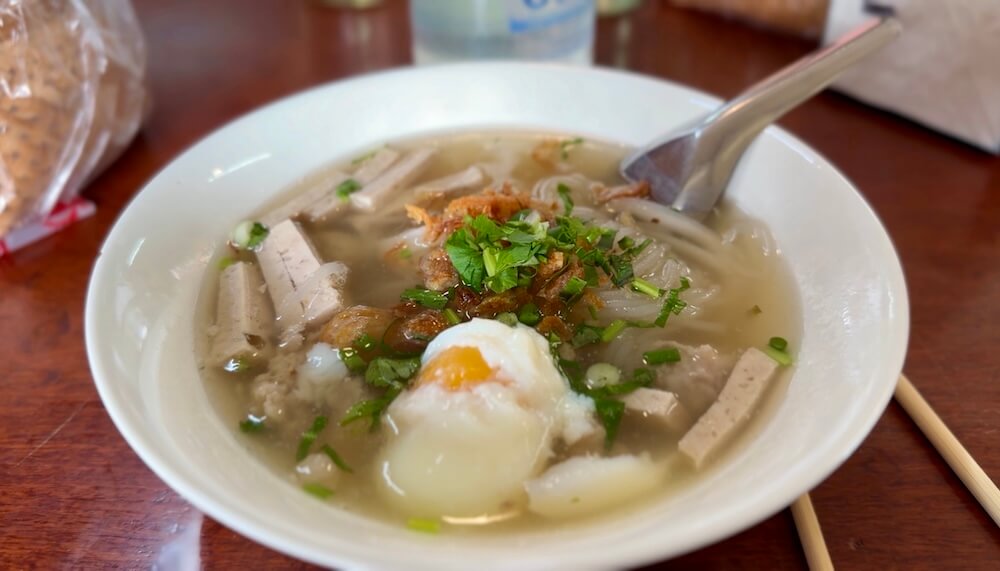
As the name suggests, they’re famous for their khao piak sen, a Vietnamese-style soup with delightfully chewy noodles, sausage, and a poached egg, all sitting in a rich broth. Honestly, I much prefer this to whatever I imagined the stuffed fried dough to be, or at least that’s what I tell myself.
Making Merit with Rabbits at Wat Phra Phutthabat Phu Khwai Ngoen
The kids can be resistant to visiting temples when the main attraction is a long history, religious significance, or obscure artistic merit. Fortunately, our earlier visit to the playful, almost Gaudi-esque Wat Pha Sorn Kaew had built up lots of credibility with the little ones. When we told them the afternoon plan was to visit a temple, the only question was whether it was on a hill.
It is, actually, on a hill, a rather steep one too. But you can drive all the way up and park near the main viharn, which houses a footprint of the Buddha. The entrance is framed by wooden doors depicting important scenes from his life.

But that’s not why we came here. Wat Phra Phutthabat Phu Khwai Ngoen is famous for something else: hundreds and hundreds of rabbits.
The idea of showing kindness to an animal to earn merit is something that will be very familiar to anyone who has spent time in Buddhist countries. From releasing caged swallows at Wat Phnom in Cambodia to setting loose fish in Thailand’s Surin Province, there are many ways to tham boon and increase your merit.
Here, for a nominal sum, you can buy bundles of greens to feed directly to the hungry little bunnies, which makes them happy and might just save your soul.

I can tell you, the kids have never earned more merit and the rabbits have never had so much food. Just when we thought the charm of feeding the rabbits through a fence had worn off, the kids discovered there was a small gate that granted access to the enclosure itself. More merit was made.
Biking Chiang Khan’s Mekong Promenade
As charming as the main walking street is, easily one of the most pleasant parts of Chiang Khan is the waterfront promenade, which runs the full length of town and beyond.
We’d already spent hours here walking along the Mekong (the views are excellent), but the corridor is also bike-friendly, so we decided to give it a try.
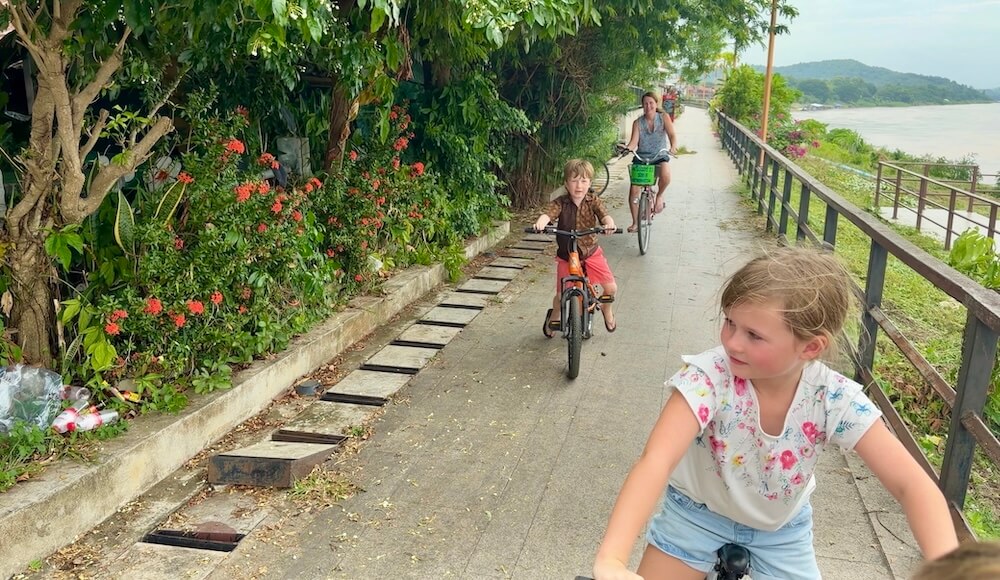
Bikes are available for rent all over town; THB 50 to 200 will easily get you a good one for the whole day. Charles is not quite ready to ride independently yet, one downside to living in central Bangkok is how rare opportunities to ride are.
The lack of experience showed with the bigger kids, too. Henry was much better at pedaling than braking, and you stopped in front of him at your own risk.
Fortunately, during the off-season, the promenade was essentially empty. Only when school let out and students began pouring onto the riverfront did anything like a crowd begin to form. This only made the ride more fun. Uniformed students waved and cheered us on, especially the little ones. It felt like an especially picturesque leg of the Tour de France.
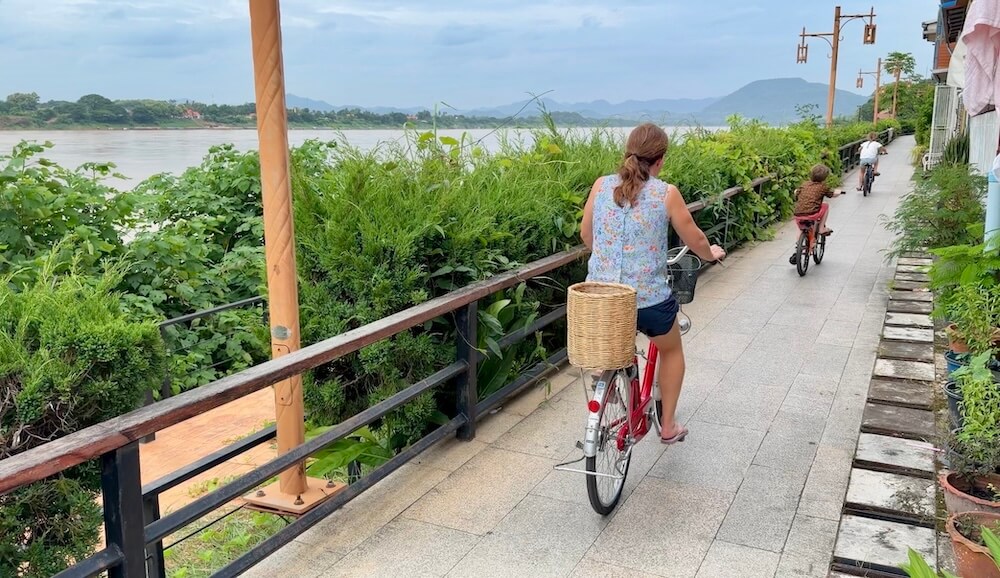
The hotels and restaurants along the promenade have planted gardens on their respective patches of river bank, and the bank sloping down to the water is covered in flowers and fruiting trees.
The opposite bank, in Laos, is far less developed. Here, large trees still stand, shading modest homes and the occasional wat. On the river between the two countries, long and narrow boats fish the Mekong or ferry passengers between the two countries.
It’s a wonderful place for a bike ride. If you happen to be without children who are a danger to themselves and others, you can follow the track much further afield. Paved lanes which are, for the most part, closed to cars, stretch all the way to Kaeng Khut Khua.
Eating and Drinking in Chiang Khan
While biking along the promenade, we’d passed a very pleasant-looking bar half-a-dozen times. As soon as they slid open their doors and set up their yellow tables right on the promenade, we parked our bikes and stopped for a drink.
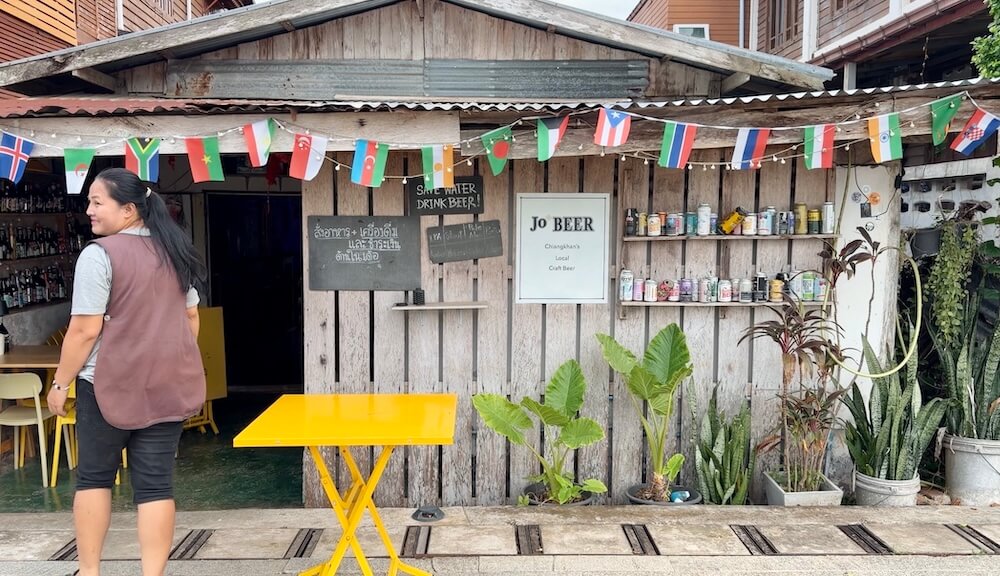
While the kids finished up their homework and wrote in their journals, Kat and I enjoyed a few locally brewed beers and watched evening settle over the river. A light haze settled over the water—smoke from small agricultural fires across the river in Laos. While such fires are a serious problem during the burning season, they were quite romantic on a Tuesday evening during the monsoon season.
After drinks, we walked the short distance to Huen Luang Prabang, which is something of a Chiang Khan institution. The restaurant is impossible to miss, housed in a substantial stone structure amid the walking street’s wooden shops. It honestly felt a bit fancy after all the simple meals we’d been eating across Northern Thailand, but the staff were very welcoming and made us feel right at home.
The food was excellent: Laotian and Northern Thai delicacies expertly prepared and presented. We especially enjoyed the grilled pork with herbs in banana leaves. The pickled fish was the most interesting thing we ate, though I might have been the only champion of it, which left me with more of it than I could hope to eat. Interesting, but a whole plate of it is maybe a bit much.
This was, I think, what a good day in Chiang Khan looks like: an excellent breakfast, a short trip to the river or hills outside the city, and back home in time for evening drinks and dinner somewhere along the riverside. Repeat this cycle for every bit as long as you’re able.
Plan Your Trip to Chiang Khan
Some links below are affiliate links. At no extra cost to you, we earn a small commission if you make a booking, which helps us keep our family on the road. Thank you for your support!
Getting There
As noted, Chiang Khan is not especially close to anywhere else. One part of its charm is its isolation, but that does make it harder to get there.
- By Car: Driving is by far the easiest and most flexible way to reach Chiang Khan, especially if you are combining it with a road trip through Loei or Phitsanulok provinces (such as Phu Soi Dao National Park). From Loei city, the drive north along Route 201 takes about 50 minutes through scenic rural landscapes.
- By Bus & Songthaew: Regular buses run to Loei Town from Bangkok (Mo Chit) and major northeastern hubs. From Loei’s main bus station, frequent local songthaews (shared passenger trucks) depart directly for Chiang Khan, taking around an hour.
For Thailand, and indeed, much of East Asia, 12go.asia is by far your best resource for booking transportation of all kinds..
Where to Stay
Chiang Khan is defined by its atmospheric wooden boutique guesthouses lining Chai Kong Road (the walking street) and the Mekong riverfront. Booking a river-facing room is highly recommended for the balcony views into Laos.
Suneta Hostel Chiang Khan is located right on the walking street facing the Mekong, this charming wooden property offers a warm, nostalgic feel with retro décor, vintage Thai posters, and front-row views of the morning alms-giving and evening night market. Excellent for families wanting character and a central location.
For travelers seeking modern amenities, air-conditioned comforts, and private balconies directly overlooking the river, several boutique options like Chic Chiang Khan along the promenade offer quiet retreats just steps from the action.
A bit of a splurge, but a bit further off Chai Kong Road, Nachan the Antique Courtyard offers a tranquil, eco-conscious retreat right on the banks of the Mekong. With its blend of traditional wooden architecture, lush courtyard gardens, and modern amenities (including a pool overlooking the river), it’s a wonderful alternative to the town center for families looking to slow down.
When to Go
The Off-Season / Green Season (May to October): We visited during the low season. While some attractions (like the skywalk) may undergo unannounced maintenance and weeknight street markets are quieter, you’ll enjoy empty promenade bike paths, cheap room rates, and dramatic mist over the Mekong and surrounding hills.
The Cool Season (November to February): Peak season in Chiang Khan brings crisp morning temperatures, misty sunrises, and fully active walking street markets every night of the week. Be sure to book accommodations well in advance for weekends and holidays.
What It Costs
Bicycle Rentals: Standard city bikes rent for THB 50 to THB 200 per day from shops and guesthouses along Chai Kong Road.
Chiang Khan Skywalk: Entry is approximately THB 60 per person, which includes the mandatory special shoe covers and shuttle transport up the hill from the parking area.
Rabbit Temple (Wat Pra Phutthabat Phu Thok): Free entry to the temple grounds; small bundles of fresh greens to feed the rabbits cost around THB 20–30.
Local Eats & Street Food: Skewered river prawns, grilled local sausages, and snacks at the night market range from THB 20 to THB 60 per item. A hot bowl of Khao Piak Sen at local morning noodle shops costs around THB 40 to THB 60.