Escaping the Monsoon
When planning a Southeast Asia getaway during August, finding a location that escapes heavy monsoon rains can be a challenge. While much of the region experiences frequent downpours this time of year, Kuching, Sarawak, in the Malaysian part of Borneo is supposed to offer drier weather, so we decided to give it a go.
Looking forward to a break from Bangkok’s heavy skies, we hopped on an AirAsia flight which, after a brief layover in Kuala Lumpur, brought us to Kuching Airport. We had five days to explore the wildlife and national parks, with a few museums and local eateries lined up just in case the regional rain decided to pass through.
We found Kuching to be charming, safe, and relaxed, offering the perfect balance between nature and city life, delicious food, and accessible cultural activities. Its affordable prices, clean streets, and welcoming locals make it an easy place to get around. So don’t let the lack of direct flights put you off—there is plenty to do in Kuching and even better, no overwhelming crowds of tourists.
Arrival in Cat City
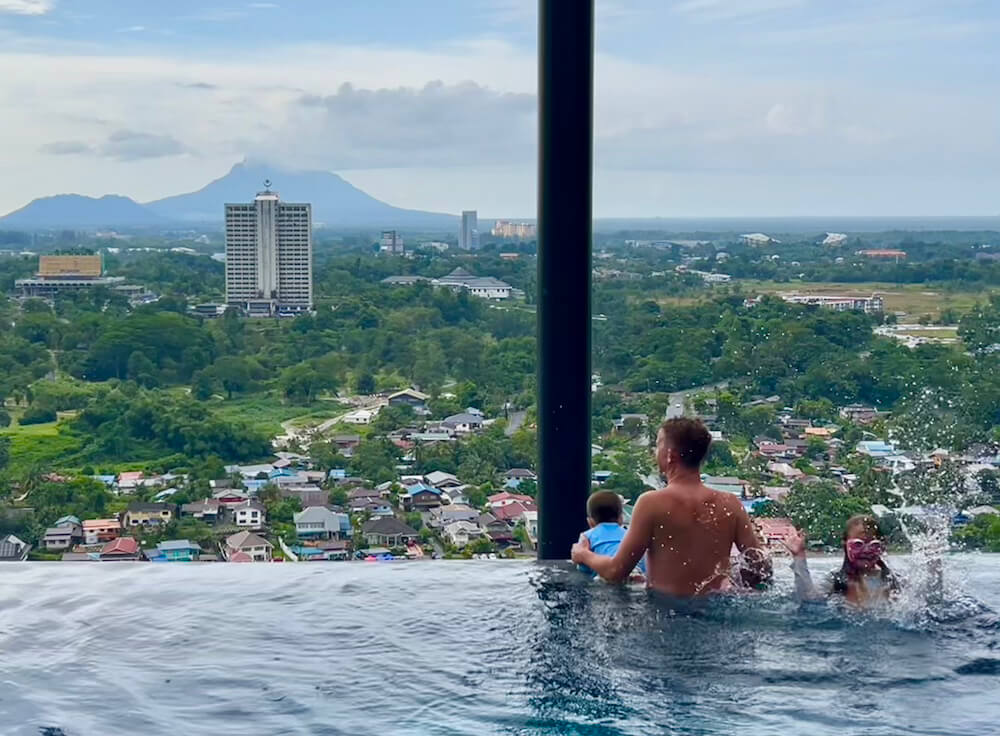
Picking up a rental car made getting into the city fairly straightforward, and we easily found our base at the Sheraton Kuching. The Sheraton is not normally our kind of scene, especially as Kuching has dozens of cute little hostels, hotels, and guesthouses to choose from, but we had points to use up and it was in a great location, so it made sense for us at the time. It offered decent views of the city, particularly from the infinity pool several floors up, and with two adjoining rooms, was very comfortable for the five of us.
Sarawakian Cuisine
For our first dinner in town, we headed to Kantin at the Granary, a lively restaurant housed inside a restored 1920s grain warehouse. It’s known for its modern take on Sarawakian cuisine, and we enjoyed their Rainforest Fried Rice, long grain rice stir-fried with jungle herbs, wild fern (midin), and local spices, though the kids picked off the meat floss on top. We also tried their crispy chicken (delicious) and Kolo Mee, an egg noodle dish tossed with minced meat and shallots.
After the meal, we sampled some of the local tuak, Sarawak’s traditional fermented rice wine. The original, tuak laki, is slightly sweet and surprisingly easy to drink, but if you want a more pronounced flavor you can try pineapple (Nanas), Tuak Tebu (sugarcane), roselle (hibiscus), Pandan Gula Melaka, or Sarawak Black Pepper tuak, which infuses the region’s famous spice into the local wine.
Riverfront Strolls
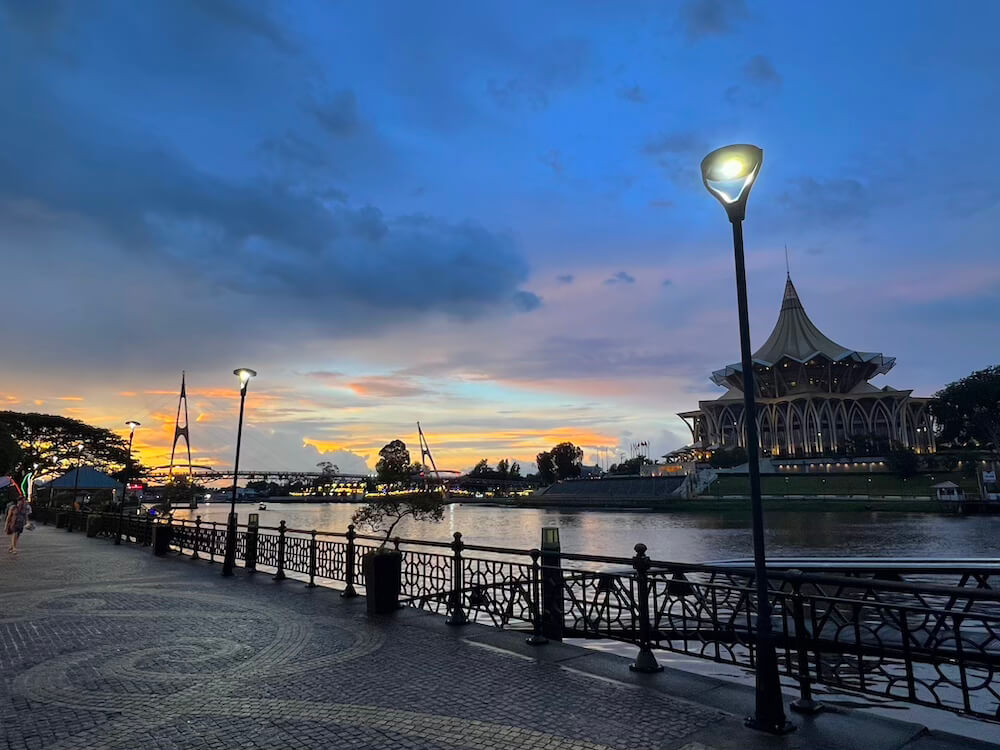
Walking along the Kuching Waterfront Esplanade is a peaceful way to end the day, and a great spot for people-watching. The 900-meter promenade follows the southern bank of the Sarawak River, which is lined with outdoor cafes, food stalls, and buildings of interest. We passed the Old Courthouse and Square Tower, and looked out across the water to the domed Astana palace and the modern Sarawak State Legislative Assembly building.
Right on the waterfront, we stopped into the Chinese History Museum, which is housed in a charming 1912 building that once served as a local court for early Chinese traders. Inside, the exhibits trace the migration waves of Chinese settlers who arrived in Sarawak. It’s quick, free, and engaging enough for the kids for 30 minutes or so.
The kids also enjoyed the S-shaped, pedestrian-only, Darul Hana Bridge, which connects the north and south banks and comes alive at sunset when multi-colored lights illuminate the walkway, the support cables, and the bridge’s hornbill inspired towers. From this vantage point, you can also watch the Darul Hana Musical Fountain show, which starts later on in the evening.
Borneo Cultures Museum
We spent several hours exploring the Borneo Cultures Museum, the second-largest museum in Southeast Asia. The museum follows Sarawak’s story through the ages, displaying 40,000-year-old archaeological finds from the Niah Caves, all the way up to modern times. One of the exhibits is devoted to detailing the unusual history of Sarawak’s time under the reign of the Brooke dynasty, known as the time of the “White Rajahs.” Starting in 1841 when British adventurer James Brooke was granted governance of the territory by the Sultan of Brunei, this British family ruled Sarawak as independent monarchs for over a century. It all ended in July 1946, when the third and final Rajah, Charles Vyner Brooke, ceded Sarawak to the British Crown, and turned it into a British colony. The kids were shocked that just a regular person could be made into a monarch. I told them not to get any ideas.
With kids aged 7, 5, and 3 we have both good times and less good times in museums, but this one was definitely a good one. They were fully engaged, wandering through longhouse replicas, trade artifacts, recordings of native languages and musical instruments, and descriptions of local mythology. Isobel and I particularly enjoyed the collection of Melanau style sunhats: conical hats woven from palm leaves or bamboo decorate with beautiful, bright colors and geometric patterns.
A Nod to the Felines
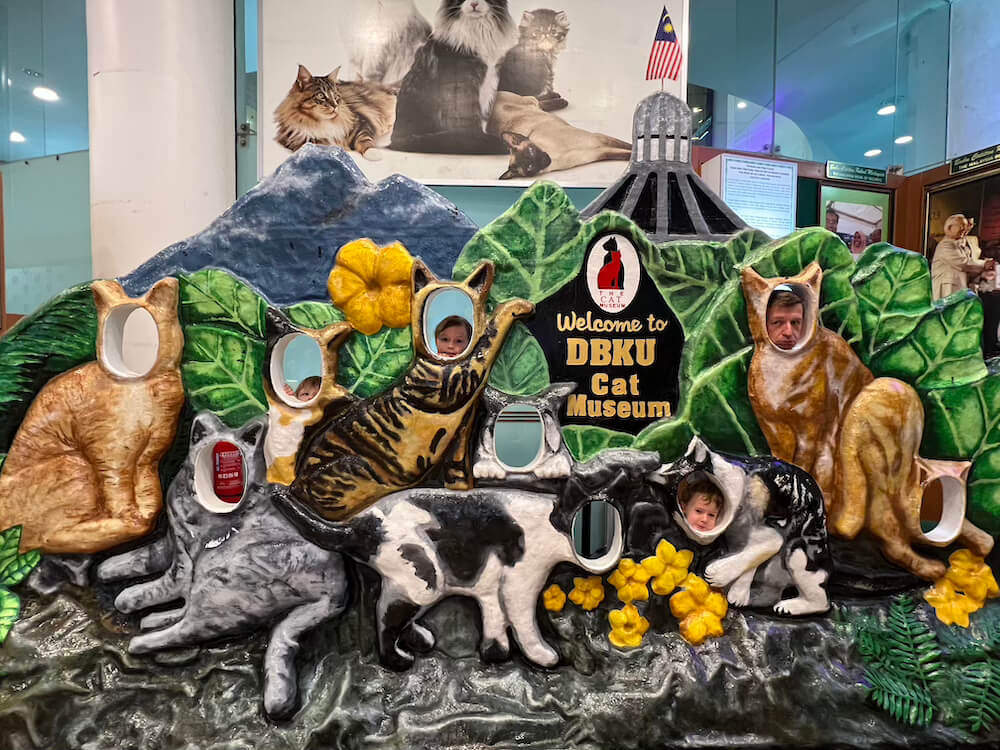
Given that Kuching translates to “cat” in Malay, no trip to the city can be complete without a visit to the Kuching Cat Museum. On the Bukit Siol hilltop inside the North Kuching City Hall building, the museum houses over 4,000 feline artifacts, statues, and historical exhibits. The kids had a fantastic time wandering through the always eccentric and frequently engaging displays, ranging from tales of ancient Egyptian mummified cats, to vintage Garfield memorabilia.
We enjoyed translations of cat lore from countries and cultures throughout the world, and though not being a cat person myself, after learning about cats for over an hour, it was easy to understand why people have found these creatures so fascinating.
Coastal Trails in Bako National Park
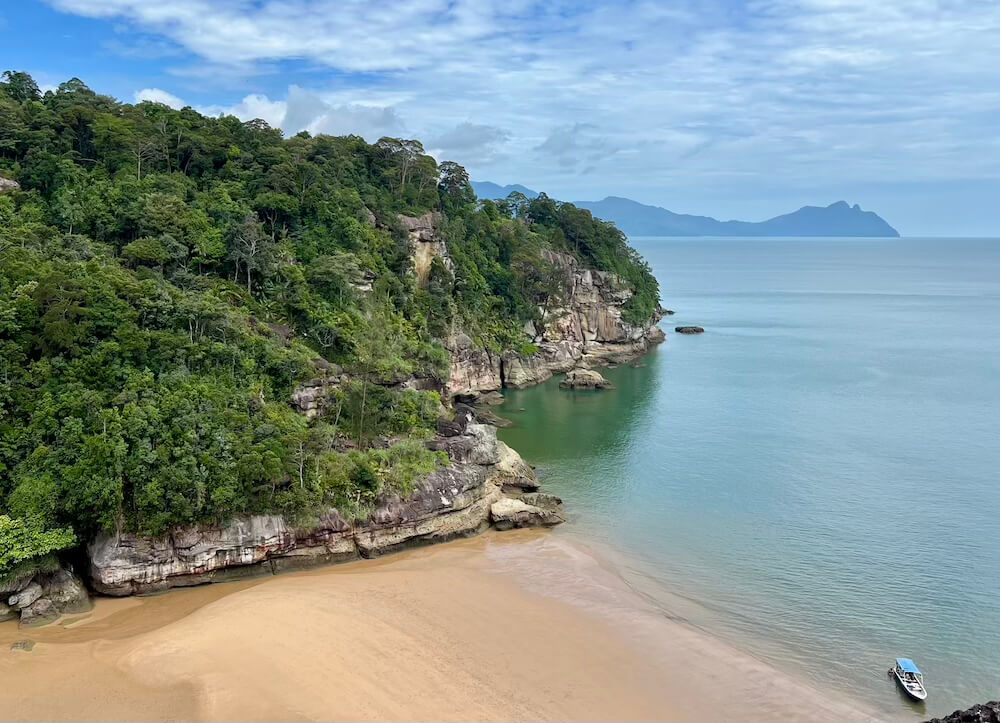
We dedicated most of a day to exploring Bako National Park, and could easily have spent more time there if we’d had better plans and bigger kids. An early morning 45-minute drive from the city brought us to the Bako Jetty, where a quick boat transfer took us to the park grounds.
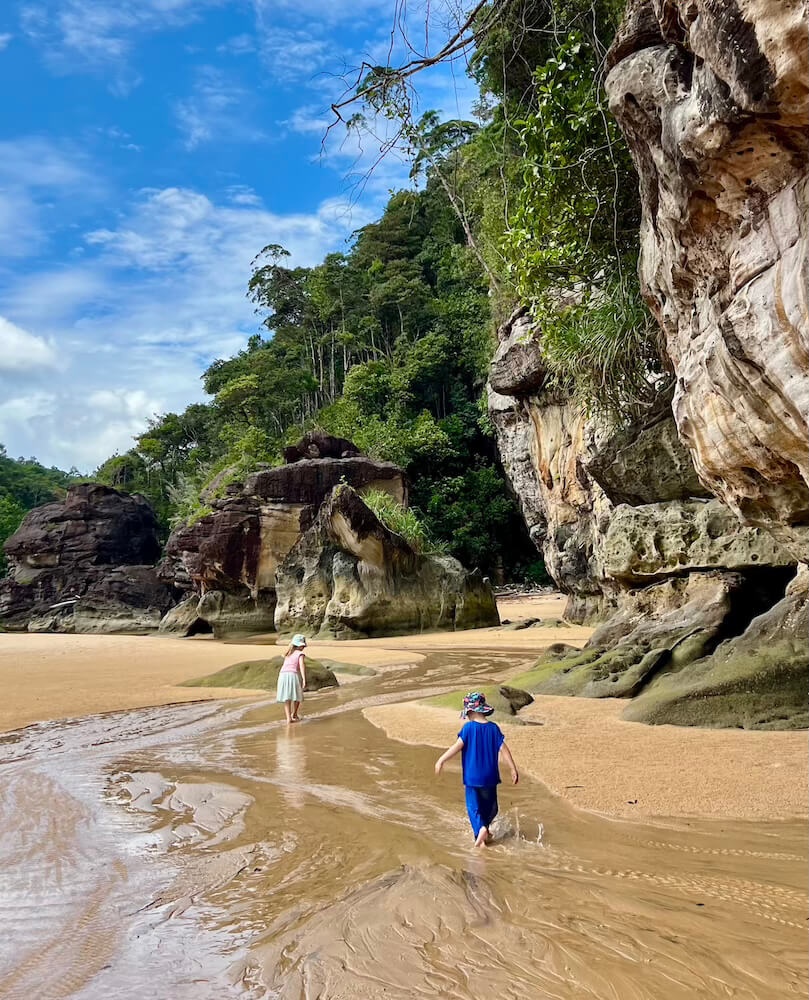
There are numerous trails to choose from, and the park rangers were extremely helpful while we decided on which one. In the end we picked the Telok Paku Trail. It is a popular, easy 1.2-kilometer hike (one-way) that takes roughly one hour each way to complete. Starting on a raised wooden boardwalk near the park headquarters, the path quickly changes into a jungle trail where our kids’ little legs navigated dense tree roots, mossy boulders, and clay paths before ending at the cliffy Telok Paku beach. We paddled in the waves, not going in too deep, as swimming is strictly forbidden due to saltwater crocodiles.
This specific route is said to be one of the best places for spotting endangered, wild proboscis monkeys and silvered leaf monkeys. We didn’t see any of these monkey species as we’d arrived a little late in the day, but we did see some macaques, one of which got a little aggressive. He was huge and hungry, and we were glad to sneak past his post on a rock when a local family distracted him with food. We hired a boat back around the coast instead of returning down the trail. It was pretty on the water, though even with kids as young as ours, returning along the land route would have also been a perfectly pleasant way to spend a bit more time.
Close to the national park restaurant, we also saw the local bearded pigs, which were quite large and every bit as bearded as their name suggests! We took some pictures, and after a late lunch, took the boat transfer back across the water.
Orangutans at Semenggoh
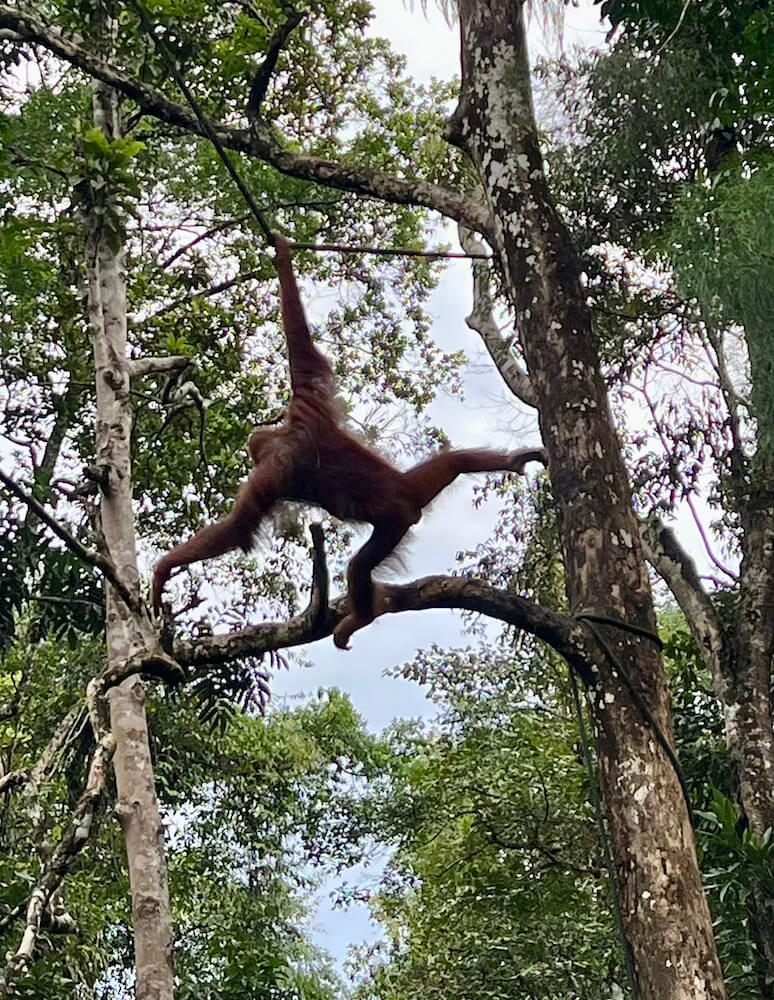
Having already visited orangutans in Sepilok and wanting more of their antics and sweet faces, we woke early to view some of Sarawak’s wildlife, starting with a morning drive south to Semenggoh Nature Reserve.
Semenggoh is a protected sanctuary where rescued and orphaned orangutans roam freely in the surrounding forest. We arrived around 8:30 AM to beat the tour buses and settle in before the 9:00 AM feeding session, when rangers lay out fruit and vegetables that supplement the apes’ wild diet. Watching a small group of young and older orangutans swing down from the high canopy was well worth the wait needed to get a place at the front of the crowd. Sightings are never guaranteed, particularly during the season when they can easily forage on their own deep in the jungle, so watching five of them come down from the trees was a real treat.
Frog Hunting in the Rainforest
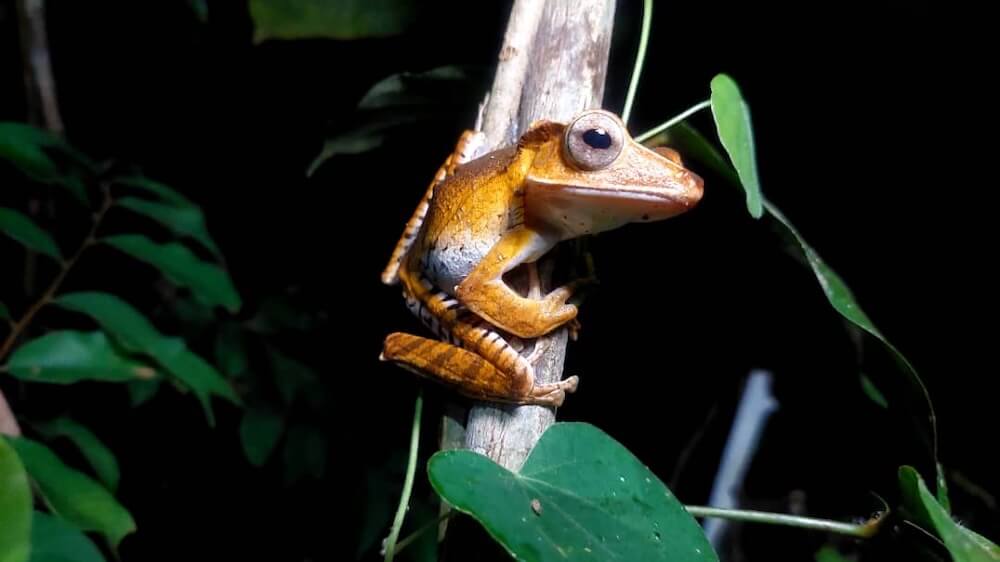
After returning to Kuching for lunch, we spent the afternoon avoiding the rain and hoping it would let up for our nighttime tour. I’d had no idea Kubah National Park was home to over 60 distinct frog species, which apparently accounts for nearly a third of all frog species found on the entire island of Borneo. I had definitely been more than a little skeptical when my husband told me he’d booked a frog tour, but it turned out to be one of the highlights of our trip.
We set out with our guide at 8:00 PM and followed him up a small road into the rainforest, torches in hand. Once the guide had taught the kids how to spot the frogs’ eyes reflecting in the torchlight, we spotted everything from tiny species resting on the undersides of leaves to horned frogs, star frogs, and bright tree frogs clinging to low branches. The kids were completely engrossed for the next three hours, making the late drive back to our hotel well worth the next day’s exhaustion.
Souvenirs and Shopping
We didn’t come to Kuching with shopping in mind, but it’s so easy to get around and there are plenty of the items to buy that you might want to take back home with you. The oldest street in the city, the Main Bazaar, is lined with little shops selling local textiles, carvings, and beadwork. There are also plenty of opportunities to pick up Sarawak black and white pepper, local tuak, or try Kek Lapis (Sarawak layer cake) as you make your way past the little shops.
While escaping a heavy downpour, we sensibly ducked into one of the city’s larger shopping centers. While visitors looking for high-end luxury stores will be disappointed, anyone seeking mid-range brands in air-conditioned comfort will find large, well-equipped malls. We picked out several shirts for the boys at extremely reasonable prices, and they still look great in them today.
All in all, with its blend of nature, culture and history, delicious food, and friendly locals, Kuching was a great spot for a family trip – giving us just another great reason to visit Borneo.
Plan Your Trip to Kuching
Some links below are affiliate links. At no extra cost to you, we earn a small commission if you make a booking, which helps us keep our family on the road. Thank you for your support!
Getting There
Kuching is the main gateway to Sarawak on the island of Borneo. While direct international flights are somewhat limited, transit through major regional hubs makes getting here very straightforward.
By Air: Fly into Kuching International Airport (KCH). Frequent direct flights operate from Kuala Lumpur (KUL) and Singapore (SIN) via AirAsia, Malaysia Airlines, and Scoot. From Bangkok or other regional capitals, a brief layover in KL is usually the easiest route.
Getting Around: Picking up a rental car at the airport gives you complete freedom to explore nearby national parks, reserves, and coastal roads at your own pace. Driving in Kuching is relaxed, clean, and straightforward. For city-center sightseeing, rideshare apps like Grab are inexpensive and widely available.
Where to Stay
Kuching offers a wide range of accommodation, from charming boutique guesthouses along the river to modern international hotels.
The Sheraton Kuching is a polished, modern option right in the city center within easy walking distance of the riverfront. Excellent panoramic city views from the rooftop infinity pool, spacious adjoining rooms for families, and a great location for exploring on foot.
Kuching Waterfront Hotels & Hostels: Staying along the south bank of the Sarawak River puts you within steps of the main promenade, historical sites, and local dining. Dozens of budget-friendly guesthouses and boutique stays line the historic shophouse streets near the Main Bazaar.
Near the National Parks: If your main focus is wildlife, consider splitting your time with a night or two at simple park chalets or eco-lodges near Bako National Park or Santubong.
Where to Eat
Kuching is a paradise for food lovers, famous for its distinct Sarawakian flavors, vibrant street food, and indigenous culinary traditions.
Modern Sarawakian (Kantin at the Granary): Located inside a converted 1920s warehouse, this lively spot serves creative takes on regional staples. Must-tries include Rainforest Fried Rice stir-fried with wild jungle fern (midin), Kolo Mee, and crispy chicken.
Tuak Tasting: Be sure to sample tuak, Sarawak’s traditional fermented rice wine brewed by indigenous communities. Try the sweet original tuak laki or flavored infusions like pineapple, sugarcane, roselle, or local black pepper.
Local Street Food & Seafood: Head to local kopitiams or the open-air food stalls along the waterfront for rich Laksa Sarawak and freshly tossed Kolo Mee. For a casual, feel-good meal, Bear Garden donates profits to local wildlife conservation while serving up local dishes and western comfort food.
When to Go
Kuching has a tropical rainforest climate, but its weather patterns offer a welcome alternative to other parts of Southeast Asia.
The Drier Season (June–August): While much of mainland Southeast Asia experiences heavy monsoon rains during northern summer months, Sarawak typically enjoys drier, sunnier weather, making August an ideal time to visit.
The Wet Season (November–February): Brings heavier rainfall as the northeast monsoon hits Borneo. National park trails can get slippery, and sea conditions for boat transfers to Bako National Park may become rough.
Orangutan Sightings: At Semenggoh Nature Reserve, sightings are excellent year-round, though during peak fruit season (typically December–February), the apes may forage deeper in the jungle rather than attending morning feedings.
What It Costs
Kuching is one of the most affordable and rewarding destinations in Malaysia.
Accommodation: City hotels, family suites, and boutique guesthouses offer exceptional value compared to larger Asian hubs.
Food & Drink: Local noodle dishes, street food, and casual restaurant meals are extremely budget-friendly.
Park Fees & Activities: Entrance fees for national parks and sanctuaries are very affordable—ranging from 10 MYR (~$2 USD) for adults at Semenggoh Nature Reserve and the Cat Museum to 20 MYR at Bako National Park. Cultural sites like the Borneo Cultures Museum cost 50 MYR for foreign adults (20 MYR for children 12 and under). Private guides for night walks at Kubah or boat transfers at Bako are also reasonably priced.