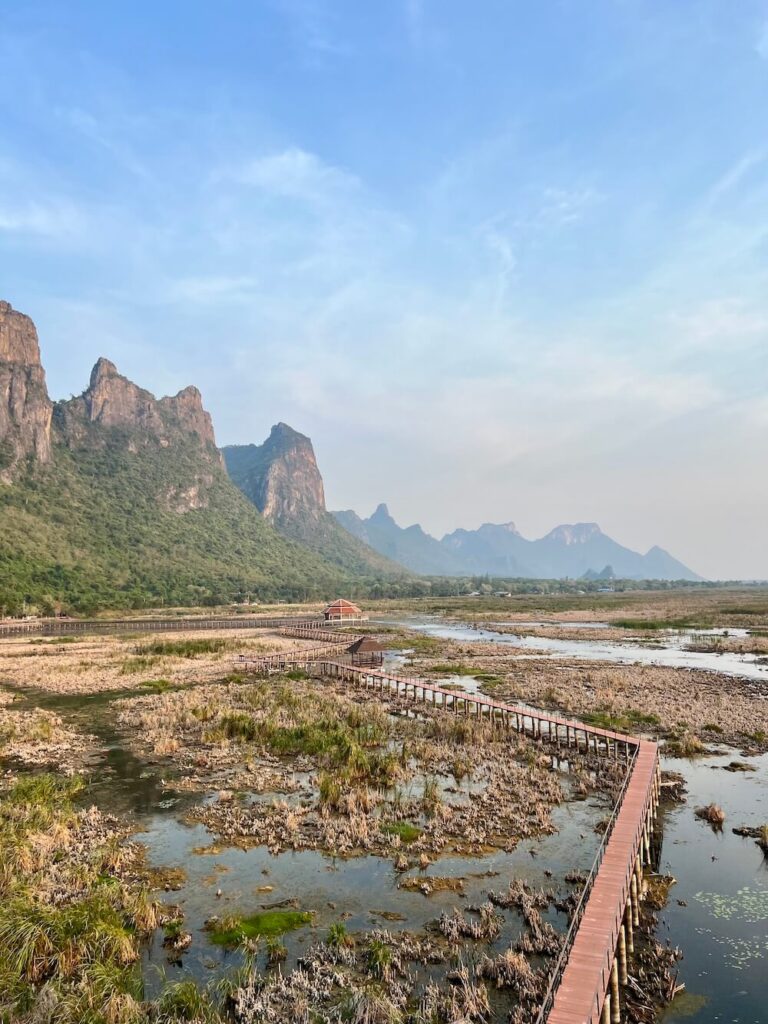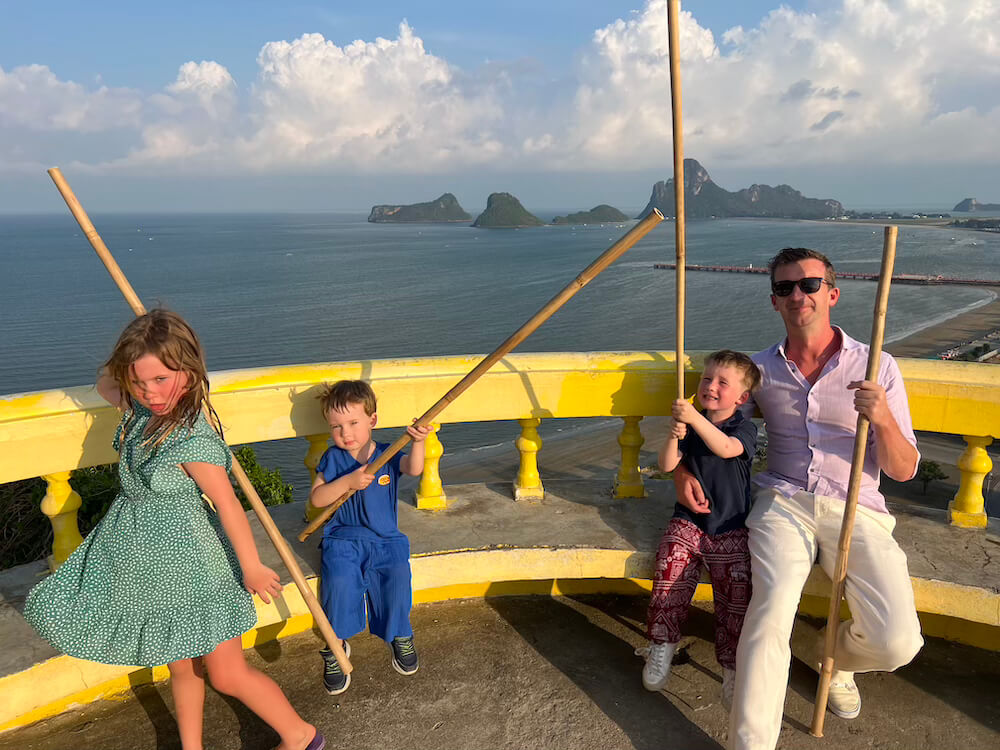
Travel writers often describe a location as “remote,” as if the benefits of that description were self-evident. At Doi Luang National Park, seclusion is not some vague selling point, but the heart of the experience. Most days, you’ll arrive at an empty trailhead, a simple parking lot with no stalls, stands, or services. You’ll enter truly wild jungle, where the only sounds are running water, bird song, and your own footsteps. At Doi Luang, “remote” means wild solitude.
Phu Khaeng Waterfall: Accessible Seclusion
Just joining the trip? This post is part of a larger 10-Day Journey across Northern Thailand from Laos to Myanmar. If you want to stay more locally, see what else there is to do in Chiang Rai City or further afield at Phu Chi Fa on the Thai-Laos border.
Just 70 kilometers south of Chiang Rai, Doi Luang is more convenient than the isolation it offers would suggest. The park has multiple access points, but we chose to explore the Phu Khaeng waterfall. More than a single cascade, Phu Kaeng (sometimes Pu Kaeng) is nine tiers of limestone pools and terraces that trace an easy path through the park’s dense forest. The trail would be manageable for our three small kids, and at less than two kilometers, easy to abandon if it rained.
Sumo, our driver, was intensely curious about our plan to visit Phu Kaeng waterfall. “What’s there? How did you hear about it?” He told us that in his many years driving across Northern Thailand, nobody had ever asked to visit. The numbers support Sumo’s surprise: Doi Luang is one of Thailand’s largest national parks but receives as many visitors annually as Chiang Mai’s Doi Inthanon sees on a busy holiday weekend.
The Lush Path to the Nine Terraces
Arriving at the trailhead’s empty parking lot did nothing to convince Sumo that ours was a sensible plan. He reconfirmed phone numbers in case something went wrong, but, of course, none of us had reception. Isobel and Henry strapped on their boots, Kat strapped on Charlie, and we began up the path.
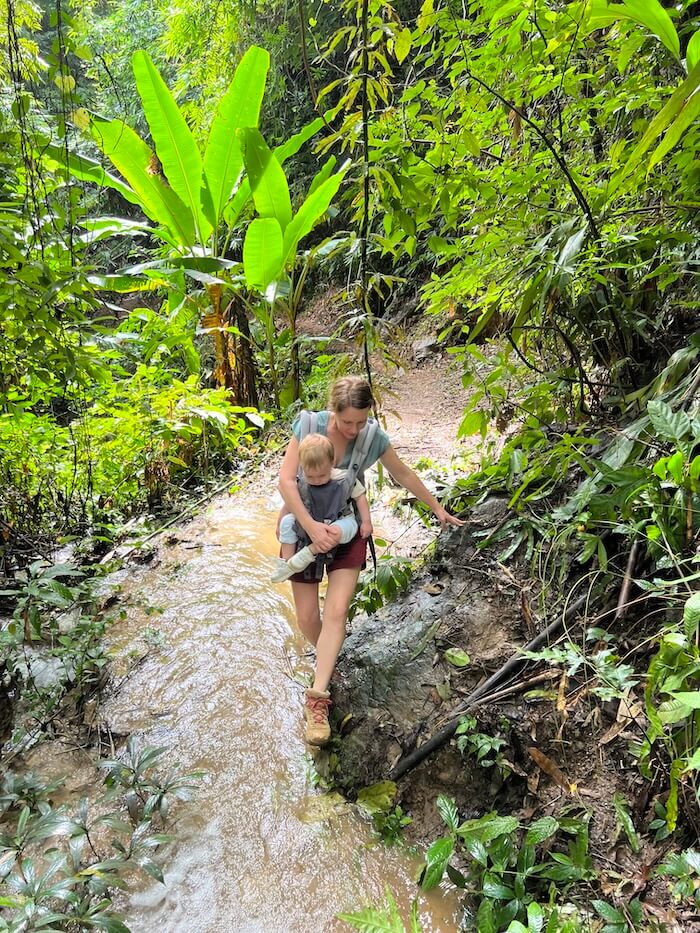
The rain held off, and the sky was clearing, but the trail was wet from overnight showers. It was late October, still at the tail end of the rainy season, and the jungle was a profusion of green. Steps fashioned from stone were covered in thick moss, and dense thickets of ferns overgrew the path. In places, trees felled by monsoon storms still lay across the path, but the kids eagerly tacked any such obstacles.
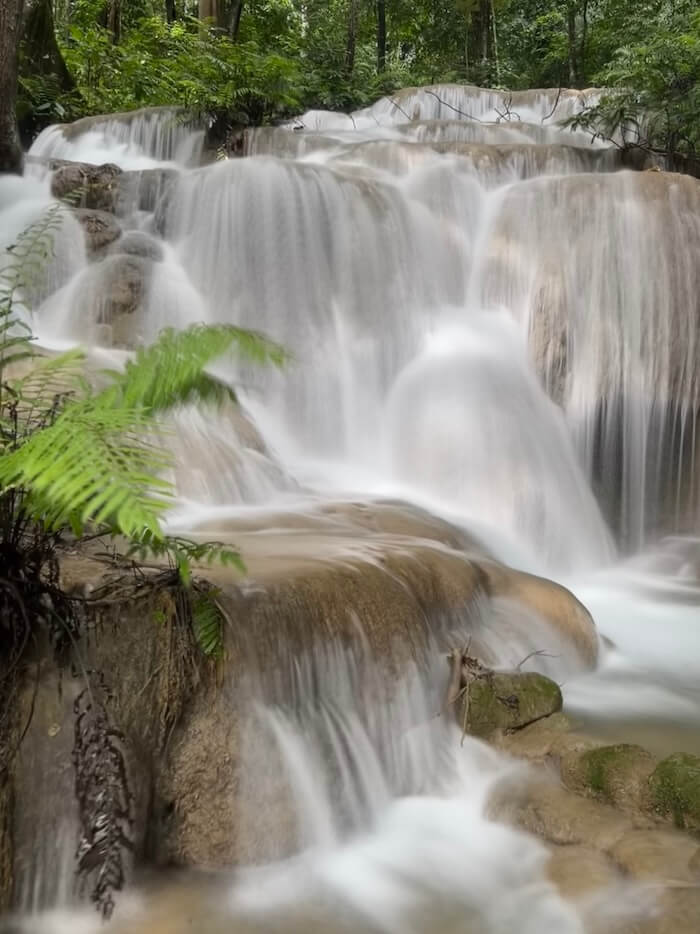
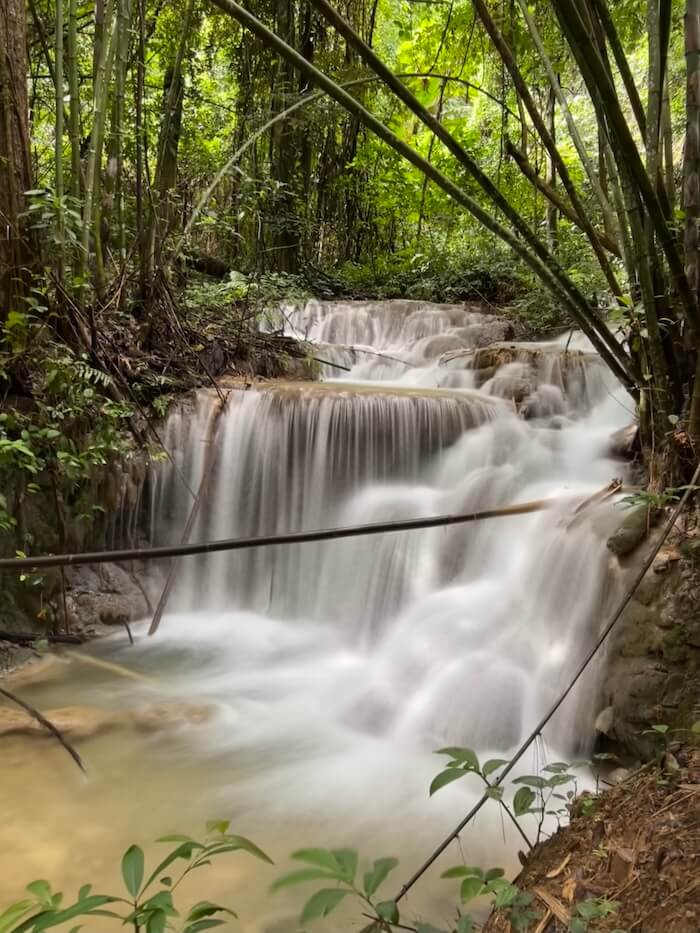
The path ran along, and sometimes in, the small stream that forms the falls. Soon, we see the first of Phu Kaeng’s nine terraces. I am captivated by these limestone pools. The deposition process keeps each rim perfectly level, so the water spills out in a perfect sheet across the entire edge. What an enchanting trick of nature.
Sharing the Trail with Pit Vipers and Whip Snakes
As we climbed higher up the falls, the forest closed in further, and we found ourselves ducking low-hanging branches. This required special care, as the canopy is prime habitat for Thailand’s pit vipers. Their vibrant green is usually the perfect camouflage, but we soon spotted one, coiled among fallen leaves, having taken refuge from the rain.

Our experience with these hikes has been that we spot one snake for every five that an experienced guide would. Isobel almost literally ran into another as she walked around a fallen tree, this time a dusky brown Oriental Whip Snake. But fear favors the near over the fatal: this harmless reptile scared her far more than the legitimately venomous pit viper.
Phu Kaeng’s Jungle Cascades
Each of Phu Kaeng’s nine terraces is absurdly photogenic: stacks of travertine basins filled to spilling with water the color of milky jade. For such a short hike, no more than a kilometer to the highest fall, the number of such vistas is happily very dense. After a final, muddy climb, we reached the highest tier. There we paused to listen to nothing more than the steady thrum of the rain-swollen cascade.
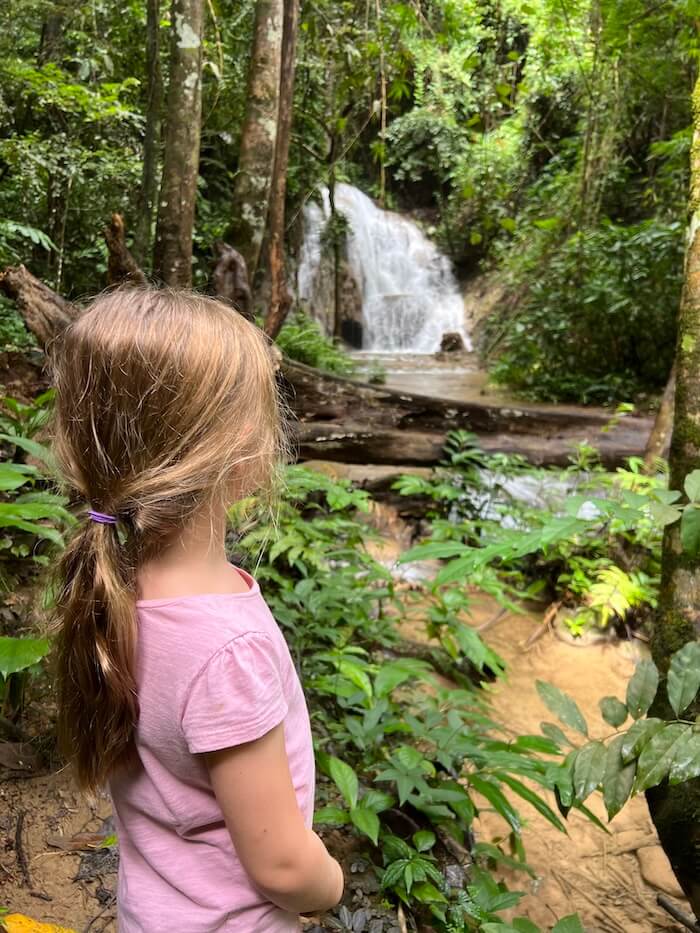
After a time, the kids’ attention shifted to scanning the jungle warily for more snakes, and we turned back. Descending the wet trail was, as is ever the case, a much more challenging affair.
On one particularly steep set of stone stairs, Kat’s feet slipped from under and she took a hard fall on her back. It wouldn’t have been so bad, but motherly instinct kicked in and she absorbed the full force of the impact. Charlie was more indignant at his interrupted ride than harmed at all.
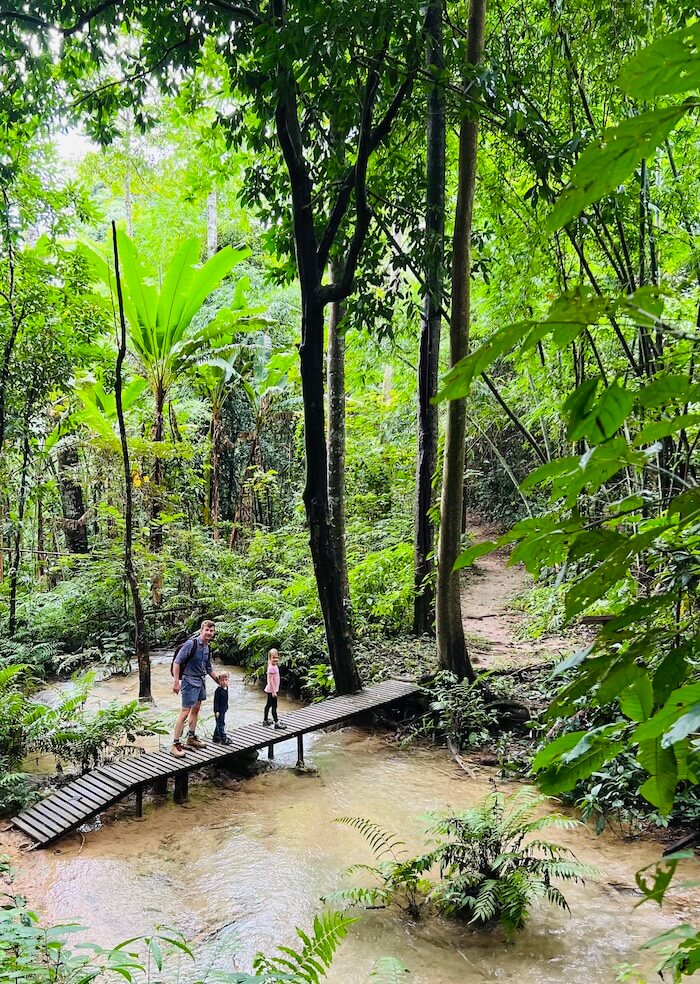
Two hours after we’d first left, we returned to the van to find Sumo visibly relieved to see us again. As we removed muddy shoes and cleaned up, I showed him some of the photos I had just taken during the walk.
“That is so beautiful, real jungle!” he said. “Why don’t more people go visit these waterfalls!”
When to Schedule a Phu Kaeng Stop and Day Trip Alternatives from Chiang Rai
Because it’s located near the main road between Chiang Mai and Chiang Rai, stopping at Doi Luang National Park to see the Phu Kaeng falls is an excellent way to break up the four-hour drive. It works equally well as a day trip from Chiang Rai, which makes the falls easier to visit without squeezing them into a transit day.
But what if you’re looking for a more manicured Chiang Rai day trip, maybe one with fewer snakes? We have you covered there as well. The area’s lush mountains are home to beautiful gardens and plantations. Our favorites include the historic gardens at Doi Tung Royal Villa and the rolling tea fields of the Choui Fong Plantation.
Mae Fah Luang Gardens and the Historic Royal Villa
The need for a jacket is your first clue to just how high the Mae Fah Luang Gardens sit on the slopes of Doi Tung mountain. At more than 1,000 meters, it is distinctly cooler than the cities in the valley below, perfect for the vibrant flowers for which the gardens are famous.
Founded by Her Royal Highness Princess Srinagarindra (the Princess Mother), the Doi Tung initiative aims to replace opium poppies with flowers whose only narcotic effect is visual. Tourism revenue, along with coffee and tea cultivation, provides dignified, sustainable incomes for hill-tribe communities
With its well-plotted paths and formal arrangement, the garden couldn’t be further from the wildness of Phu Kaeng. Letting the kids chase butterflies along serpentine paths rather than serpent paths, however, allows parents to relax their guard and simply enjoy these well-planned and perfectly pleasant gardens.
Choui Fong Tea Plantation: Trading Isolation for Instagram
The lines of tea trees that stripe the gently rolling hills at the Choui Fong Tea Plantation cover only a couple of square kilometers, but every day draw in many times Doi Luang’s visitors. The two strikingly modern twin cafés are a perfect setting to try a range of tea-based treats while admiring the stength of the workers picking tea on the hill below.
Such a setting can only be shared, and I should warn, it is very popular. Guests compete for prime seats from which to photograph dizzying arrays of matcha-based desserts. Still, if you can find a seat, this detour is rewarding and offers an excellent opportunity to sample the Choui Fong’s award-winning oolong tea. Whether you drink it or just post it is entirely up to you.
Plan Your Trip to Doi Luang and Chiang Mai’s Wild Side
Some links below are affiliate links. At no extra cost to you, we earn a small commission if you make a booking, which helps us keep our family on the road. Thank you for your support!
Getting There
Northern Thailand’s mountains are best explored on your own schedule. We highly recommend renting a car or a motorbike to fully experience the area. The three primary destinations (Doi Luang, Doi Tung, and Choui Fong) are spread across Chiang Rai Province, and public transport is sparse or requires expensive taxi transfers.
From Chiang Rai City to Phu Kaeng Waterfall at Doi Luang National Park): Approximately 1 hr 15 mins (around 67 kms) one-way. This is south of the city, making a combination with Doi Tung or Choui Fung unfeasible.
From Chiang Rai City to Doi Tung Royal Villa: Approximately 1 hr 15 mins (around 54 kms) one-way. Choui Fong is only thirty minutes away, making this a good combination visit.
From Chiang Rai City to Choui Fong Tea Plantation: Approximately 1 hr (around 40 kms) one-way. Doi Tung is only thirty minutes further north.
Where to Stay
The area is gifted with quality hotels, whether you’d like to stay in town or closer to the out-of-town attractions, you will be well-served. Unless you want to stay near Doi Luang, that is, which lacks good options nearby.
Mora Boutique Hotel This small hotel’s stylish Lanna-inspired design and central Chiang Rai City location perfectly suited our two-day stay. A deep bathtub and a lovely pool made this a perfect quiet retreat after busy days exploring.
Katiliya Mountain Resort And Spa A secluded resort nestled in the mist-shrouded hills of Chiang Rai. It offers stunning mountain views, three pools, and a full-service Spa on the Lake, providing a perfect, tranquil retreat near Choui Fong and Doi Tung.
Phu Chaisai Mountain Resort Also in the hills above Choui Fong, this hotel offers stunning views over the valley below. Just a lovely place to escape the heat and breath in the fresh air.
When to Go
The best time to visit Chiang Rai is during the Cool Season (November to February) when the weather is dry and temperatures are pleasant (daytime highs around 25 C).
Doi Luang is open daily from 8:00 a.m. – 4:30 p.m., but do note that sections of the park are closed from early July until the end of September to allow natural recovery and protect visitor safety during the rainy season. Our visit in mid-October presented no difficulties beyond a few slips.
Doi Tung (Mae Fah Luang Garden) is open daily from 8:00 a.m. – 5:00 p.m. Arrive early to enjoy the cooler air and beat the tour bus traffic, particularly during the high season. Single entry fee is THB 90 THB for foreigners.
Choui Fong Tea Plantation is open from 8:00 a.m. – 5:30 p.m. Entrance is free. The best time for photos and views is early morning (8:00–10:00 a.m.) or late afternoon (3:30–5:00 p.m.) when the light is softer. I saw no evidence that it ever quiets down much.
Booking/Tours
The best way to experience Doi Luang National Park is independently, allowing you to choose your own hiking pace and enjoy the solitude. You will rarely find pre-packaged tours that combine the remote Phu Kaeng waterfall with the more well-known Doi Tung and Choui Fong destinations.