The usual approach in travel writing is to claim you’ve uncovered some secret place that you’re now sharing with the world for the first time. This time, I’m the outsider.
In our first two years in Thailand, we treated Rayong as an easy weekend getaway when we didn’t have the time or energy for anything more ambitious. It was pleasant enough and had great food, but in my mind, it couldn’t compare to the Andaman Coast or the Thai Riviera.
So why were there so many European tourists? Who flies eleven hours to Thailand just to settle for the beaches closest to the airport? Sure, it’s cheaper, but it just made no sense to me. Did they just not realize how much more Thailand has to offer?
Turns out it was me who didn’t understand. I’ve since come to not only appreciate it but to love it. Rayong has some beautiful white-sand beaches, especially on the off-shore islands, and the freshest seafood you’ll find anywhere in Thailand.
Mea culpa. Don’t make the same mistake I did. Give Rayong a chance.
Rayong: Easiest Beach Access from Bangkok
I never doubted the advantages of Rayong’s location. Only 2-3 hours from Bangkok, most of it on a modern, elevated highway, it’s quite simply the easiest beach escape from the capital. Even if you don’t have your own car, arranging a driver is easy enough, and for stays on offshore islands like Koh Samet, many hotels will even arrange pick-up within Bangkok.
Running parallel to much of Rayong’s shoreline is Sukhumvit Road—the very same highway that begins in Bangkok and continues down Thailand’s eastern seaboard. Closer to the water, smaller highways like Route 3145 hug the shoreline, connecting a string of low-key beaches and fishing villages.
Pick a stretch of beach and there’s a highway that will take you straight to that shore. The catch is that you have to decide early (sometimes as far back as Chonburi) because the highways branch off toward different coastal pockets well before you reach the water.
We’ve explored the entire coastline over multiple trips, so rather than lay out a single itinerary, we’ll share our recommendations from Cape Liant in the west to the Phang Rat River, which forms the border with Chanthaburi.
Cape Liant and the Bight of Bangkok
We start our survey of Rayong with Cape Liant, which is actually in neighboring Chonburi province. This mountainous stretch hides some lovely beaches, but many lie within military bases and are off-limits to foreign visitors.
It wasn’t always this way. Even though it’s on a Royal Thai Marine Base, showing a passport used to be enough to access the white-sand crescent of Toey Ngam Beach.
We tried to visit in 2025, but a young marine politely but firmly turned us away. Recent reviews suggest others have had the same experience over the last few years. It’s a slightly frustrating introduction to the coast: the scenery is there, just not quite within reach.
If you’re committed to swimming in the area, Nang Ram Beach is a good option. It’s on the grounds of the Royal Thai Navy base in Sattahip, but as at Ao Manao in Prachuap Khiri Khan, guests are welcome during daylight hours.
If you want to skip the military beaches altogether, it’s time to drive east and into Rayong proper.
Laem Charoen Beach and Mae Ramphueng
As you head east from Cape Liant, the terrain flattens and rocky coves give way to long arcs of sand. These shallow beaches are great for kids, though at low tide the water recedes quite far.
Laem Charoen Beach is essentially Rayong Town’s “city beach.” It sits at the mouth of the Rayong River, protected by a breakwater, which makes it better for walking and paddling than serious swimming. The vibe here is very local: fishermen at work all day along the breakwater, families appearing in large numbers as the sun begins to drop toward the horizon.
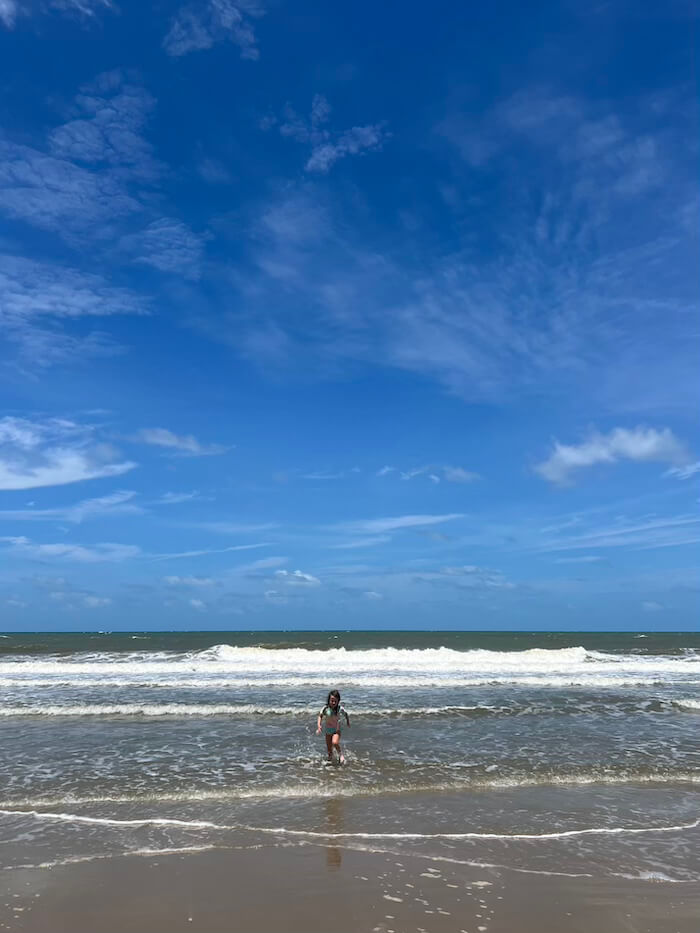
To the east, Mae Ramphueng Beach stretches for over ten kilometers and is one of Rayong’s longest mainland beaches. It’s known for soft golden sand, and there are absolute miles of it. The beach attracts crowds, but with so much of it to go around, you’d hardly notice.
The charm of both Laem Charoen and Mae Ramphueng lies in their very local vibe. These aren’t polished resort beaches; they’re places where Thai families picnic, fishermen bring in their catch, and restaurants under casuarina pines serve very fresh seafood without pretense. Even if your ultimate destination is further along, stopping at one of these for a meal, a stroll, or a quiet swim is never a bad idea.
If you’re choosing between them: Laem Charoen is closer to town and feels more like an urban beach with amenities nearby, while Mae Ramphueng is more scenic. But here’s the practical advice: don’t overthink it—find a patch of sand with a few locals enjoying the sea, choose a shaded table at a beachside restaurant, and enjoy lunch with a view.
Koh Samet: Bangkok’s Nearest Island Retreat
A friend from London once told me he hadn’t realized how special Bangkok was until one Friday, he and his girlfriend decided they needed an escape. They hired a taxi to collect them from their Sathorn office and, by early evening, they were eating dinner on a Koh Samet beach.
I’m not sure I’d be willing to pay that kind of cab fare, but it shows just how near paradise is to the megacity.
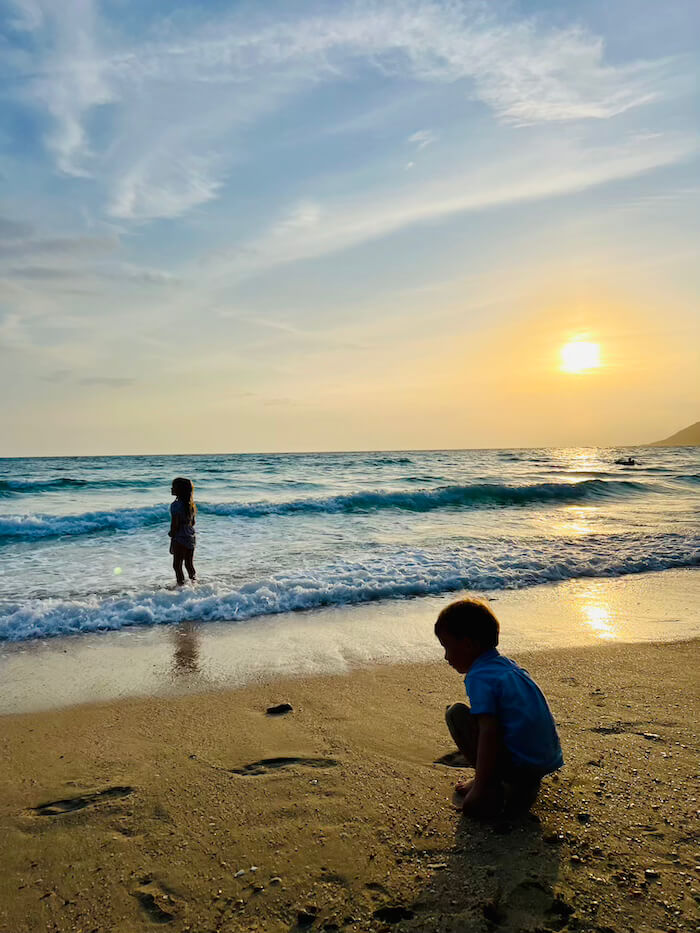
Getting to Koh Samet
To get to the island, head for Bang Phe, about three hours away from Bangkok. Here, you’ll find several piers with ferries to Koh Samet.
Nuanthip Pier is the standard drop off for many of the buses and minivans coming from Bangkok; the Ban Phe Municipal Pier (Tha Ruea Phe) is where public ferries and high-speed catamarans depart; and Sri Ban Phe Pier is a third possibility if the others are crowded.
If you’re staying at any of the hotels run by the Samed Resorts Group, you’ll depart from the Ao Prao Pier, a private and gloriously efficient operation run exclusively for their guests. Once you arrive at the pier, you won’t touch your luggage again until you’re sitting in your room.
After a trip of anywhere from 10 to 50 minutes, depending on the type of boat, you’ll usually arrive at Na Dan Pier, on the northern end of the island. From there, it’s a songthaew to your hotel.
Where to Stay
Koh Samet is large enough to offer every range of accommodation, from absolute budget backpacker to high-end luxury. Our suggestions are in the Plan Your Trip section below, but there’s enough choice to simply find what suits you.
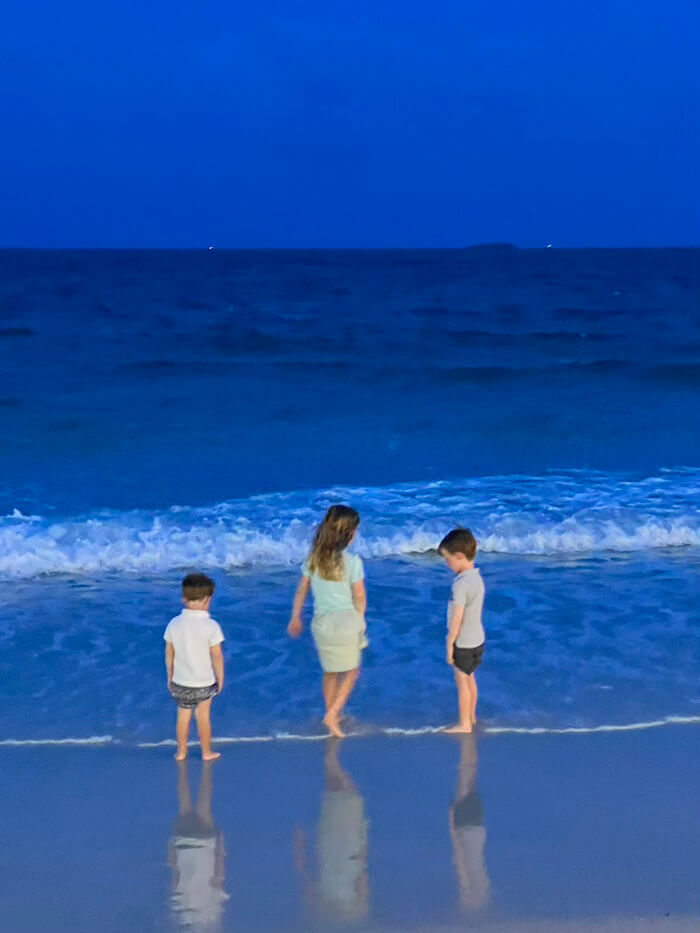
The northeastern tip of Koh Samet along Sai Kaew Beach is the most densely packed section of the island. It’s a wonderfully scenic stretch, but crowded. Ranks of bars and restaurants run the full length of the beach and, at high tide, its full width too.
Ao Wai, down at the far southern end of Koh Samet, may be the nicest beach on the island. A shallow bay of white sand is the perfect setting to illustrate the clarity of the water, which is something you don’t always get in the estuaries of mainland Rayong. There is very limited accommodation, so it’s best visited as a day trip.
We stayed at Ao Prao, where a few resorts sit at the crescent-shaped bottom of an amphitheater of jungle-covered cliffs. Though only a short songthaew away from the livelier parts of Koh Samet, it’s very easy to convince yourself that you’re much, much further away.
Chakphong Beach and Wang Kaew
Returning to the mainland and continuing east along Sukhumvit, you’ll pass signs along the road urging you to eat at places with names like “Bee Happy” and “Phons Kitchen.” I suggest you give in to those urges, drive the sandy paths under the casuarina pines, and take a break. This stretch of beach is formally known as Chakphong Beach, though I’ve not once heard that name spoken, and it is, for my money, the most pleasant in all of Rayong.
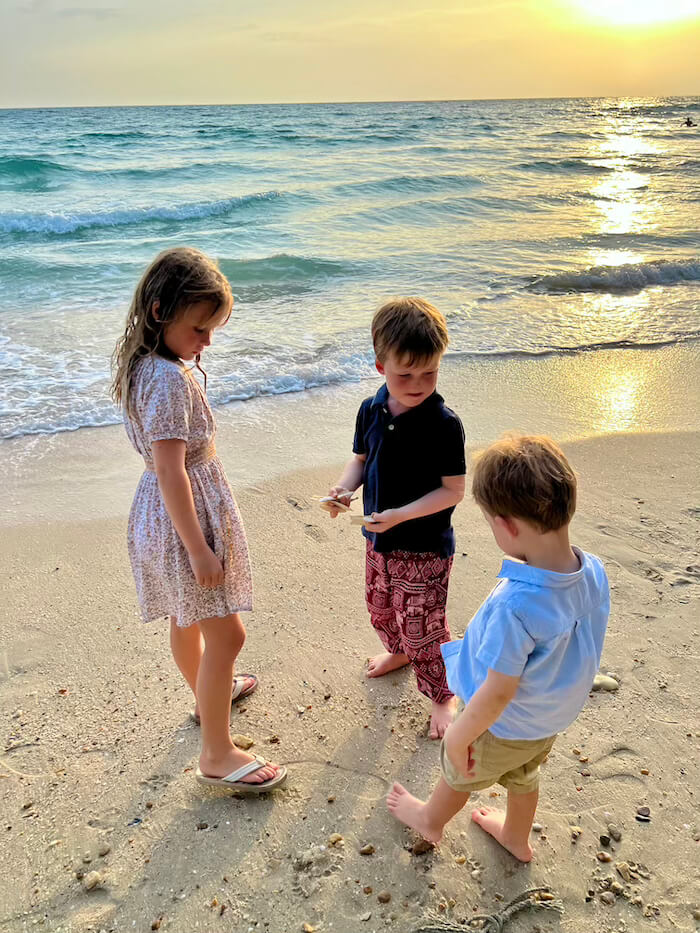
The sea breeze pushes Chakphong’s fine sand into soft white dunes that wash right up to the restaurants’ shaded tables. To sink your toes into cool sand on a hot day while you have lunch is one of life’s great pleasures.
Despite this, the restaurants are not especially crowded, nor is the beach. Credit this to the sandy drive under the pines. Chakphong just isn’t as obvious a stop as Laem Charoen or Mae Ramphueng, where you simply park on the side of the road and step onto the sand.
As much as Chakphong felt like a discovery to me, the beach is hardly a secret. It was during a late-December lunch stop at Bee Happy that I first learned how popular the region is with northern European tourists. The easternmost stretches (sometimes called Wang Kaew) have a Marriott and a Novotel, whose hotel rewards programs have long inspired Bangkokers to drive south.
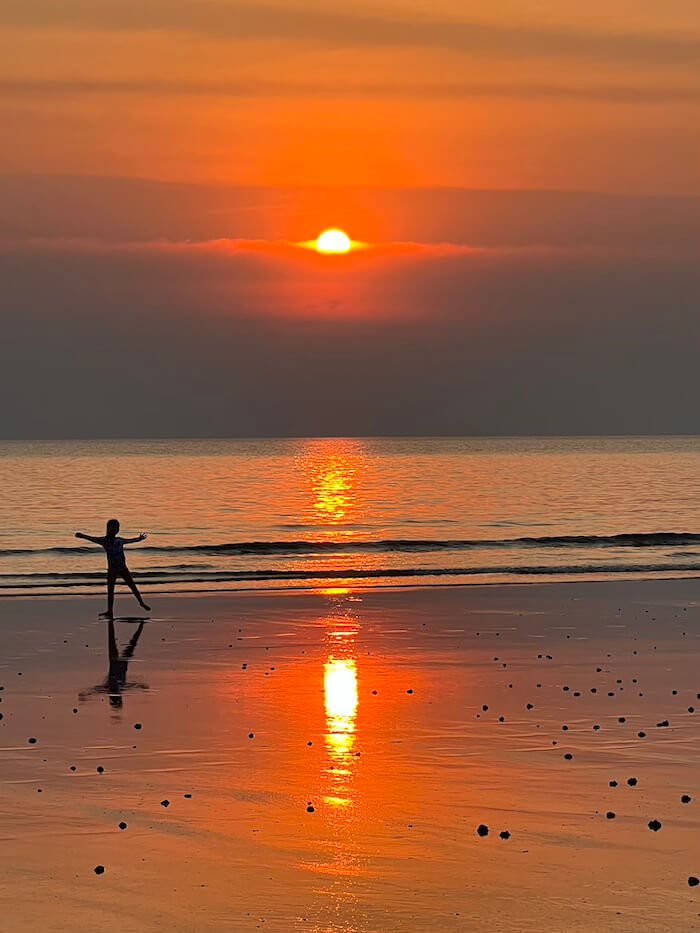
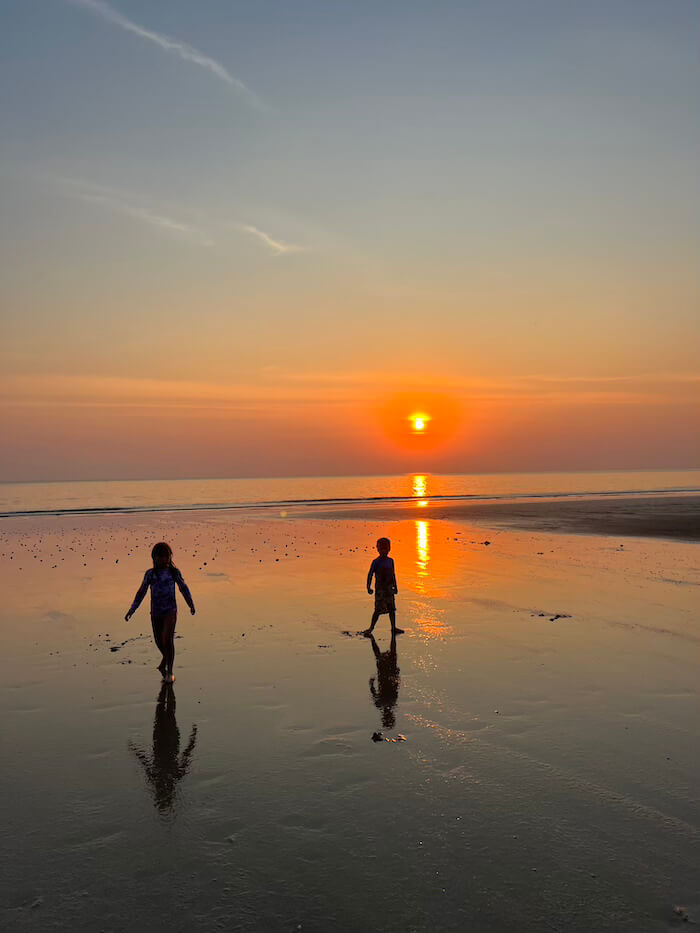
The quieter western end is more beautiful, but no matter where you are on Chakphong Beach, you’re assured of a good sunset. The aspect is ideal to let you, for an hour a day, watch the whole world catch fire.
The Promenades of Laem Mae Phim
By the time you reach Laem Mae Phim, you’re no longer just meeting tourists who have “discovered” Rayong, you’re finding those who have moved here. It’s not hard to see why: the beach is at least as pleasant as we’ve seen further west, but there’s a small seaside town vibe that is very attractive.
Laem Mae Phim feels more settled. Most restaurants sit on an embankment above the sand rather than directly on it, and your fellow diners are as likely to have walked from their own condos as from a hotel lobby.
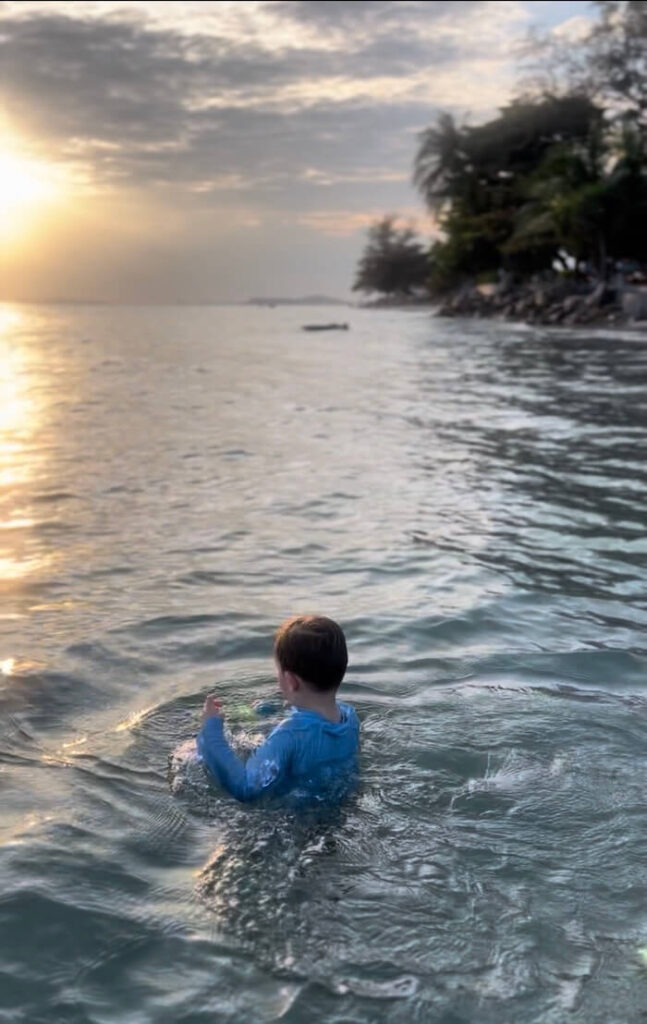
This steady foundation of residents and ‘in-the-know’ visitors supports a thriving commercial scene near a promenade. When we visited over the holidays, fairy lights spiderwebbed the trees and a somewhat disturbing animatronic Santa Claus greeted us each time we passed.
Along the same strip, a permanent restaurant scene has developed. Seafood remains the anchor (I happily celebrated a birthday dinner at Nongnuch Seafood), but you can also find fresh pasta and Italian at La Capanna, wine and small plates at Tapas Bar & Restaurant, or, if you somehow believe hot cheese belongs on a tropical beach, there’s even raclette.
There are a few traditional hotels like the Mercure, but sublets are widely available for longer stays. We stayed in a two-bedroom apartment at the Escape Condominiums, a building fronting a small beach within its own isolated cove.
The short YouTube clip at the top of this post was filmed at Laem Mae Phim, captured as the sun was sinking toward the Gulf. I’d like to believe there’s a romantic reason for the Campari redness of these Rayong sunsets—something beyond haze—but whatever the reason, they do put the ‘gold’ in golden hour.
Thung Prong Thong: The Golden Meadow
I discovered the “Golden Meadow” while scanning a map of the area near where we were staying for the night. We’ve discovered incredible, off-the-beaten-path places this way, though I’d caution that it doesn’t always work out. There are dozens of sites billing themselves as the “Grand Canyon of Thailand” out there, and they’re rarely grand and often not even canyons.
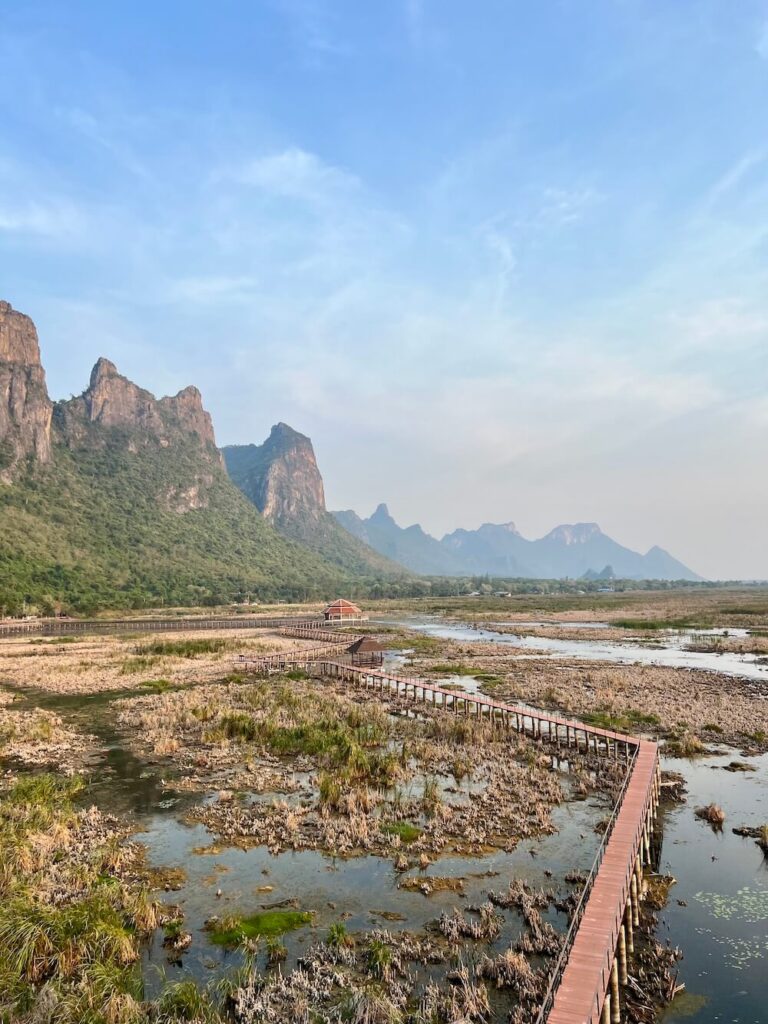
Thung Prong Thong, or the Golden Meadow, is a wooden walkway leading through the canopy of a forest of what are known locally as “Prong,” a type of mangrove famous for its bright green and yellow leaves. With the right light, the canopy is said to almost glow.
We planned our visit for late afternoon, when the light would be at its warmest. The meadow is part of the Pak Nam Prasae Mangrove Forest, and most maps guide you to a parking lot just to its north. It’s hard to miss: when we went, two women were waving passing cars into the lot with colossal pink and yellow flags.
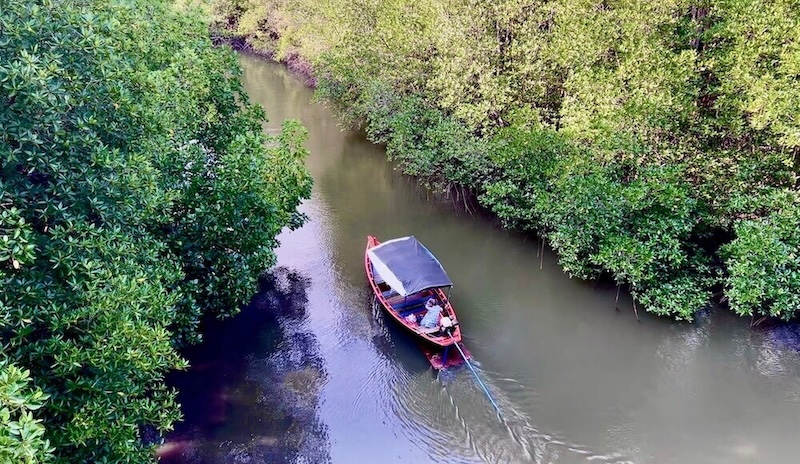
We paid THB 20 (less than $1) to park and then about twice that for a short ride in a motorized trike up the road to a small pier. From here, you can either hire a boat to take you through the mangroves or cross a small bridge onto a system of boardwalks.
Entering the Mangrove Forest
We chose the slow walk through the mangroves, slow because every dozen steps, the kids stopped to peer over the edge in search of mud crabs. The snapping pistol shrimp from our visit to Mu Ko Chumphon National Park were still fresh in their minds, so we stopped at every hint of a snap or pop.
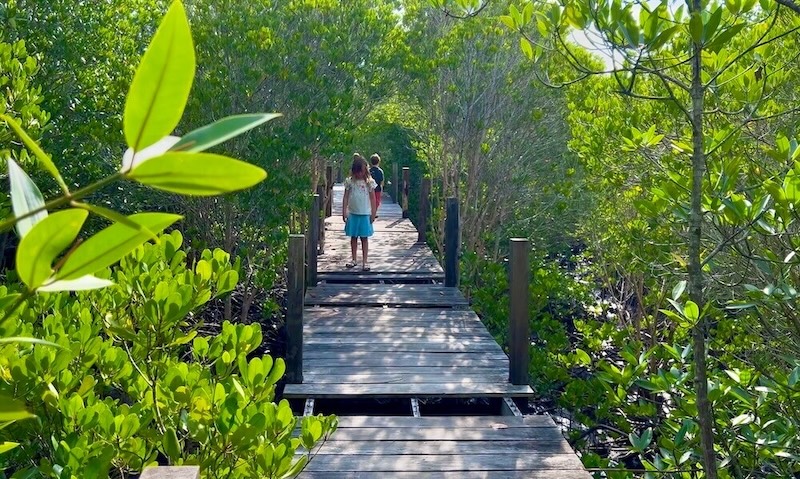
The raised path winds among the tangled roots and slender trunks of the forest. The trees are tall here and appear even taller when paired with their reflections in the still water left by the receding tide. After perhaps 15 minutes, we emerged into what was, genuinely, a golden light.

The “meadow” is a bowl-shaped depression where the trees are, for whatever reason, much shorter. This affords an expansive view across the top of the canopy, where the small leaves that top the trees do give off a golden-green light as they shiver in the breeze. The boardwalk runs directly through the foliage, forming dense walls on either side of the path. It’s an utterly charming effect.
Beyond the Golden Meadow
There are, we’re told, nearly three kilometers of boardwalk running through the mangrove forest. That number may be accurate, but there are sections of boardwalk that fail to live up to the name: some are missing quite a few boards and are not at all walkable.
There are several possible paths, leading to different destinations (we should have taken a photo of the map at the forest reserve entrance). Among them are an enormous, wide-branched mangrove and a five-or-six-story observation tower which, if it doesn’t test your fear of heights, might test your fear of lax compliance with construction safety standards.
We could have spent a couple of hours exploring, though the further the wander, the greater the chance of crashing through a rotten beam into the mud below. Even if only to visit the meadow itself, it’s well worth the detour, especially in the soft light of early morning or late evening.
Plan Your Trip to Rayong
Some links below are affiliate links. At no extra cost to you, we earn a small commission if you make a booking, which helps us keep our family on the road. Thank you for your support!
Getting There
Rayong’s biggest advantage is how easy it is to reach from Bangkok—and how flexible your options are once you’re on the road.
By Car (Recommended): The drive from Bangkok takes about 2–3 hours via the elevated motorway network, and having your own car makes a real difference. Much of Rayong’s appeal lies in moving between beaches: Laem Charoen for lunch, Chakphong for the afternoon, Laem Mae Phim for the evening, , and that’s difficult to do without your own transport.
By Private Driver / Taxi: If you don’t drive, hiring a car and driver is straightforward and relatively affordable, especially for a weekend trip. Many drivers are familiar with the coastal route and can be hired for multi-day itineraries.
By Bus or Minivan: Frequent services run from Bangkok’s Ekkamai Bus Terminal to Rayong Town and Ban Phe. From there, you’ll need a taxi or songthaew to reach the beaches.
For Thailand, and indeed, much of East Asia, 12go.asia is by far your best resource for booking transportation.
Where to Stay
Rayong works best if you choose your base depending on the kind of trip you want.
Koh Samet (Island Stay): If you want clear water and proper white sand, stay on Koh Samet. Ao Prao offers a quieter, more self-contained experience, while Sai Kaew is livelier and more built up.
Ao Prao Resort offers a quieter side of Koh Samet—crescent beach, calm water, and just enough separation from the crowds to feel like you’ve slipped somewhere further away.
Sai Kaew Beach Resort is right on Koh Samet’s busiest and best-positioned beach—lively without being overwhelming, with enough space and separation that you can dip into the energy or step back from it.
Chakphong / Wang Kaew (Our Pick): For a mainland stay, this stretch strikes the best balance. Beachfront resorts and small hotels sit under the casuarina trees, and you’re never far from a good, low-key restaurant.
Rayong Marriott Resort Big, predictable, and unmistakably a large international resort. Good beach, excellent pools for the kids, and plenty of restaurants. This can be especially fun when they hold activities like “street food night” on the big lawn.
The Season Resort is a quieter, more residential‑leaning stay on the Rayong coast, with big pools tucked under trees and rooms that feel like somewhere you might actually live for a few days. Great for families or anyone who wants space without the resort bubble.
Laem Mae Phim (Longer Stays): If you’re planning more than a couple of nights, Laem Mae Phim has a wider range of condos and apartments, plus a walkable promenade with plenty of dining options.
Escape Condominiums A cost-effective way to arrange longer-stays with more space. The apartments are small but well-laid out and provide the space to really settle in for a few days (or weeks). We booked the two-bedroom layout.
Mercure Rayong Lomtalay Villas & Resort A big hotel on Laem Mae Phim with a beach that feels wide enough to share. Rooms are comfortable and well-kept and you get easy access both to the “private” and public beaches.
Where to Eat
One of Rayong’s real strengths is how easy it is to eat well without planning much at all.
Beachfront Seafood (Everywhere):
The best approach is often the simplest: stop where you see a few local families, sit under the trees, and order whatever looks fresh. Grilled prawns, steamed fish with lime, and crab fried rice are reliably excellent.
Chakphong Beach Restaurants: Places like Bee Happy and its neighbors are exactly what you want—tables in the sand, sea breeze, and food that arrives quickly and tastes like it came straight off the boat.
Laem Mae Phim Promenade: A more varied scene: traditional seafood alongside Italian, wine bars, and the occasional European indulgence. It’s one of the few places on this coast where you might linger after dinner.
When to Go
Rayong is a year-round destination, and the Gulf of Thailand can provide great beach days even during the monsoon, but the experience shifts more than you might expect.
Weekdays vs. Weekends: If you can, go midweek. Many of the mainland beaches feel almost empty, while weekends bring Bangkok crowds, especially to Mae Ramphueng and Koh Samet.
The Cool Season (November–February): The most comfortable time to visit, with lower humidity and clearer skies. This is peak season, but Rayong rarely feels overwhelmed.
The Hot Season (March–May): Temperatures climb quickly, but the sea breeze helps. Long lunches under the trees become the main event.
The Green Season (June–October): Expect occasional heavy rain, but also fewer visitors and greener surroundings. Storms tend to pass quickly, leaving long, quiet stretches of beach.
Sunset: The west-facing coastline delivers consistently strong sunsets. Plan your day so you’re on the beach in the early evening—it’s often the highlight.
What It Costs
Rayong remains one of the better-value coastal destinations in Thailand.
Accommodation: Mainland hotels and apartments are generally more affordable than the islands. Koh Samet carries a premium, especially in high season.
Transport: Fuel, taxis, and private drivers are all reasonably priced by international standards, making it easy to explore multiple beaches in a single trip.
Food: Seafood prices vary by catch, but meals are typically excellent value for the quality and freshness.
Koh Samet Fees: There is a national park entrance fee for Koh Samet (typically around THB 200 for foreigners), collected on arrival.