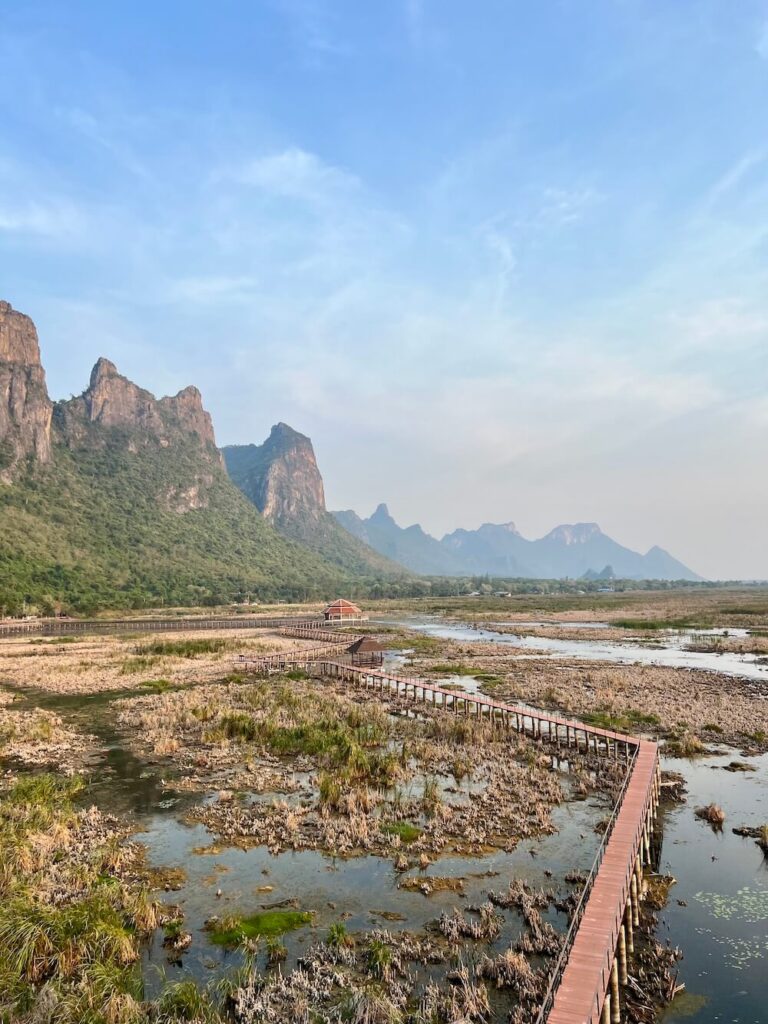
Phu Sang and Phu Chi Fa were only the first stops of our 10-Day Journey across Northern Thailand from Laos to Myanmar. Click the link to start planning your own Northern Thailand adventure..
To treat Chiang Rai as a mere day trip from Chiang Mai is a mistake and a missed opportunity. Venture beyond the city and you’ll find mountain peaks piercing seas of morning cloud, miles of multi-tiered cascades tumbling through untouched jungles, and broad rivers meandering through electric-green fields of rice.
Stay longer in the city and you can experience more deeply Chiang Rai’s modern take on traditional Lanna architecture. Its justly famous white, blue, and black temples prove this isn’t a museum but a living culture’s beating heart.
If you decide to explore the area (and you absolutely should), don’t expect to find much in the way of packaged tours or standardized itineraries. Even popular stops like Phu Chi Fa will require you to plan independently. Keep reading below for details of our experience and tips on how to organize your own trip.
Sumo and the VIP Van of Eternal Midnight
Chiang Rai is indeed worthy of a longer exploration, but it would have to wait a few days. Our first stop lay high in the Phi Pan Nam Range, the line of mountains that separates Northern Thailand from Laos. Reaching this remote range requires just under two hours’ drive from Chiang Rai.
Shortly after our early-afternoon arrival at Chiang Rai Airport, we met Sumo, the driver we had hired for the next few days through My Chiang Mai Tour. This can be a good alternative to self-drive, especially if you have any concerns about Thailand’s winding mountain roads.
Whether or not we needed a driver, Sumo and his fully tricked-out van were an instant hit with the family. My only complaint: windows so deeply tinted that it cast us into eternal twilight. Good for naps, less than ideal for enjoying the views on an otherwise stunning drive.
Phu Sang Waterfall: A Worthy Phu Chi Fa Detour
A risk of sharing detailed itineraries here is that the family might discover one day that the “stops” we make to break up drives sometimes lengthen those drives considerably. Phu Sang National Park is one of these, adding 45 minutes to what otherwise would have been a 90-minute drive.
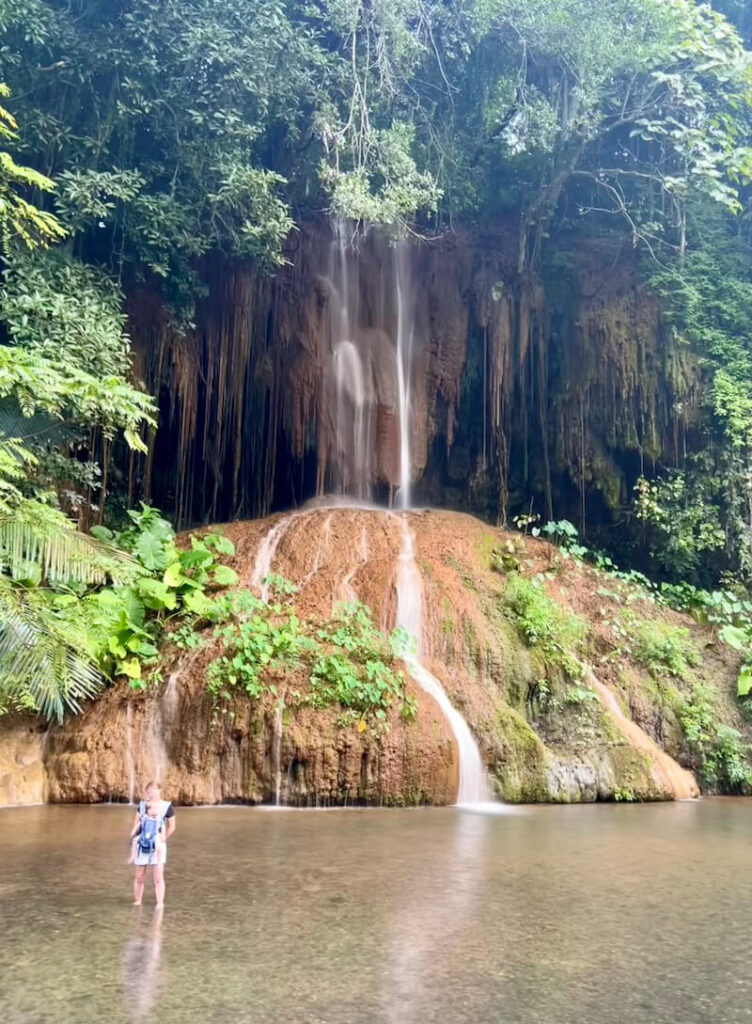
I submit that it was worth it.
From a jungle-clad limestone cliff, a cascade of warm spring-water tumbles into a crystal-clear pool. The mineral-rich water has encrusted every exposed root and vine, making the wall seem more the mouth of a cave than the side of a hill. The thermally heated river is slow-moving and only knee-deep, a perfect place for the kids to have a paddle.
Phu Sang is technically a national park, though there is little beyond the waterfall except a short nature trail. Thailand has many of these “single feature” national parks. The attraction is very often a waterfall, almost always worth visiting, and usually free to enter. At Phu Sang, a few Thai families took advantage of gratis entry to lay out rattan mat picnics on the grassy bank across from the falls.
The Mountains of the Spirits Dividing the Waters
With the light fading (or maybe it was just the windows) we continued north to Ukrist Farm, where we would spend the night before an early morning hike to watch the sun rise over the promontory of Phu Chi Fa. This is the most impressive of a series of dramatic peaks along the Phi Pan Nam mountains.
Phi Pan Nam translates to “the mountains of the spirits dividing the waters,” and divide they do. On the Thai side, the waters ultimately join the Chao Phraya River, pass through Bangkok, and empty into the Gulf of Thailand. On the Laos side, rains instead feed the mighty Mekong, which passes through Cambodia and Vietnam before emptying into the sea.
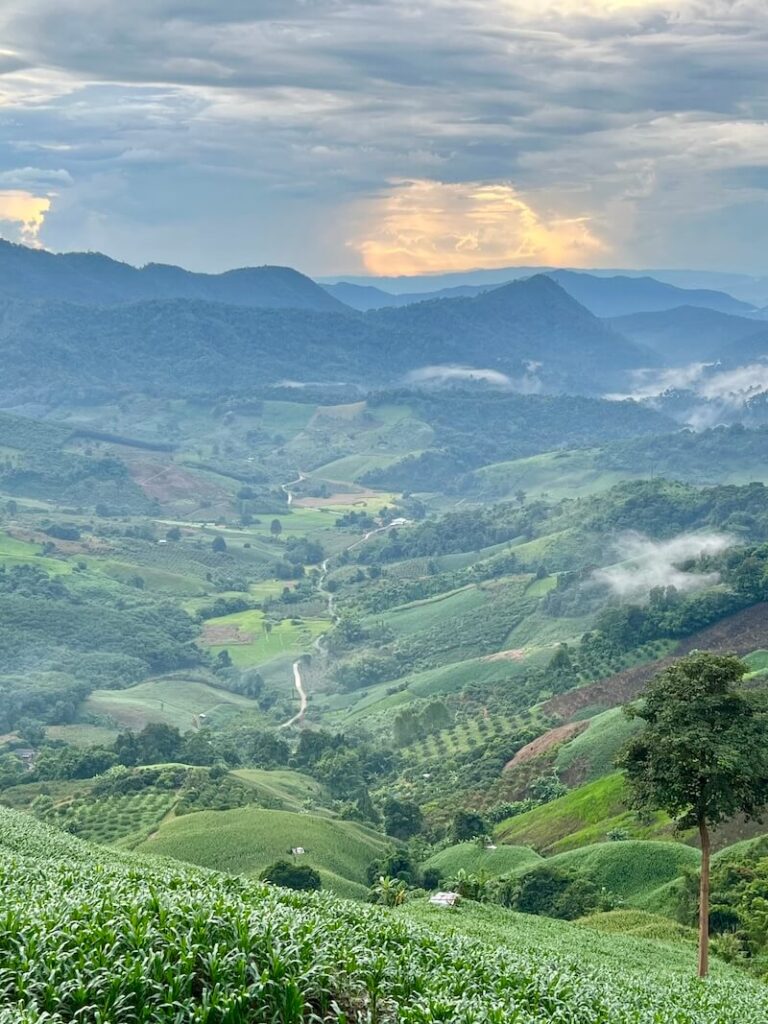
The drive is stunning. Local farmers have tamed steep mountain valleys to cultivate tea, coffee, and even orchards of peach and plum. The chill in the air reveals how it might be possible to grow stone fruit in Thailand. At elevations of 1,200-1,600 meters, it’s considerably cooler than Bangkok.
The cold is such a welcome change, but perhaps not for everyone. We seem to be the only guests during the early-October off-season. After a hearty dinner of gaeng jued, the ubiquitous clear broth, tofu, and mince pork soup, we tuck into bed, actually needing blankets for the first time in months.
Phu Chi Fa Sunrise over the Cloud Sea
Reluctant to leave those warm blankets, but with a schedule to keep, we piled into Ukrist Farm’s 4WD truck just after 5:00 a.m. and drove to the Phu Chi Fa trailhead. In the dark of the parking lot at the bottom of the trail, shop owners bundled in coats were still opening their stalls. Young girls traded football jerseys for the elaborate silver coin headpieces of the Akha people, all readying for visitors to the mountain.
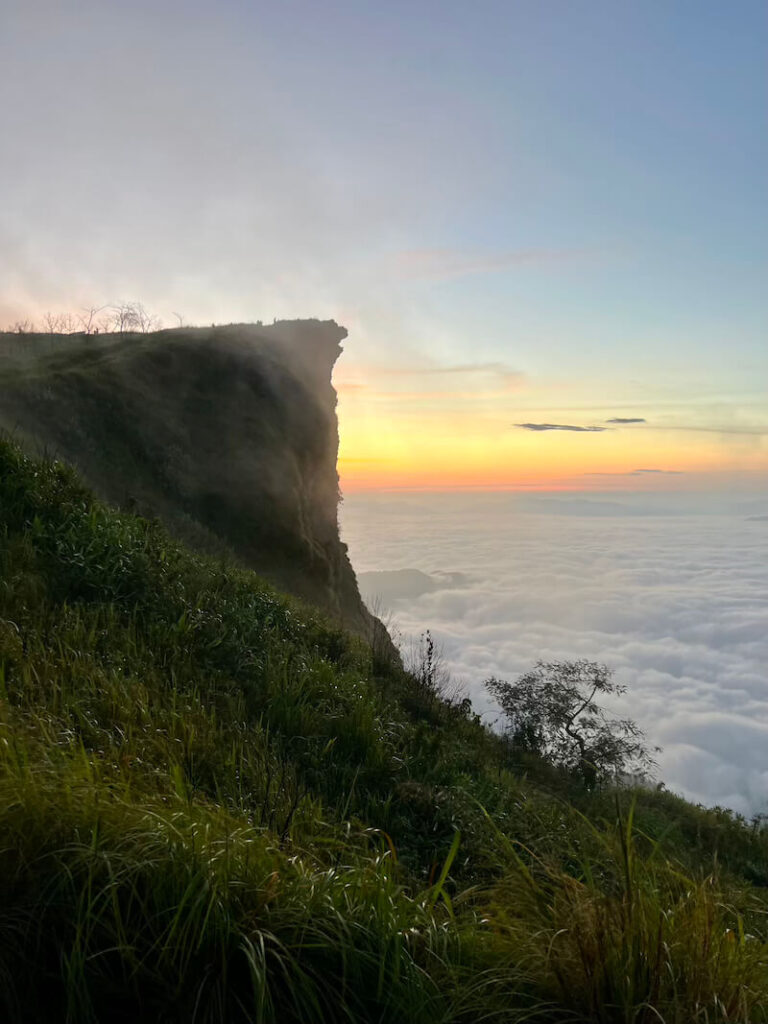
But first we must climb it. Phu Chi Fa means “the mountain pointing to the sky,” and so it does. As the sky lightens, we begin to catch glimpses of the peak through tall stands of broom and tiger grass rustling in the morning breeze. On the Thai side, the slope rises gradually to its summit, but on the Laos side, a steep cliff plummets to depths obscured by banks of clouds.

The trail is not at all difficult, though the mists condensing on the red clay soil hint of slips to come. We walk the roughly one-kilometer path in less than 30 minutes and our not-yet-four-year-old Harry handles it without trouble. To the south, the cloud sea washes against the forested peaks of Phi Pan Nam Range.
From the summit, we cannot see anything of Laos below us. The sky brightens and reddens and then the sharp point of the sun emerges from the clouds and bathes our peak in light. The clouds take on more distinct shapes, drawing more clearly into ranks of waves. It is among the most magical sights in Thailand.
What Climbs up Must Slide Down
As the sun climbed higher and the mists began to clear, we started our walk back down. By this time, the mists had condensed into a soaking dew. The silver beads of water ornamented the tufted tiger grass, but turned the trail into a slimy, slippery mess. Within ten minutes, Isobel and Henry were giggling as they added fresh streaks of red clay to their jackets, squealing with every slippery slide.

The owner of Ukrist Farm, who had driven us to the trailhead and climbed the peak with us, now took an even more active role. Defying his apparent age, he scooped Henry up—over everyone’s objections but Harry’s—and carried him down the mountain. Harry wouldn’t fall again, but I felt very sheepish as the rest of my mud-slimed family crawled back into his truck.
After a quick breakfast and a long clean-up, we piled back into Sumo’s van, said goodbye to Ukrist Farm, and began the drive back to Chiang Rai. Without any further scenic stops, I wondered whether anyone would notice how much shorter the drive was this time.
Continue the journey as we linger at Chiang Rai’s temples, rest by the river, explore Ban Daam, and eat our way through the Saturday night market. Read about it here: After the Day Trippers Leave: Taking Time in Chiang Rai.
Plan Your Trip to Phu Chi Fa
Some links below are affiliate links. At no extra cost to you, we earn a small commission if you make a booking, which helps us keep our family on the road. Thank you for your support!
Getting There
The destination is the Phu Chi Fa Summit in the Phi Pan Nam Range, roughly 100 km northeast of Chiang Rai City.
From Chiang Rai: The drive is approximately two hours to the nearest accommodations near the peak. The roads are well-paved, but winding mountain roads (self-drive is fine, or hire a driver, like Sumo).
From Chiang Mai: The drive is considerably longer, taking approximately 5–6 hours. It is better done as a separate trip or a leg of a multi-day Northern Thailand road trip.
Local Transport: Once you arrive at the accommodation area, you will need a 4WD vehicle or hire a local truck/minivan to take you the final distance to the trailhead in the early morning darkness. Your homestay or guesthouse will usually arrange this.
Where to Stay
There are quite a few guesthouses perched up on the hills around Phu Chi Fa, but they cater heavily to Thai tourists. Many are not easily bookable through the usual sites.
Ukrist Farm Stay This is a very convenient and comfortable spot not too far from the trailhead. Individual A-frame cabins offer great views over the valleys below. They will happily handle all transportation to and from Phu Chi Fa (and even walked up with us). Location is perfect for the early morning departure.
When to Go
The best time to visit is during the cool season from November to February. This offers the best chance of seeing the spectacular “sea of clouds” (the fog bank below the cliff).
Be prepared for the cold! The high elevation (1,200 to 1,600 meters), temperatures can drop to 10°C (50°F) or lower in the mornings. Bring layers, jackets, and possibly hats/gloves. This is especially true if you’ve grown weak from long years in the tropics like we have.
While still beautiful, the June-October rainy season sees fewer cloud seas and more frequent mists/rain, making the trail a bit more slippy.
Booking/Tours
Phu Chi Fa Sunrise Hike You won’t really need to book a “tour” for this. Arranging transportation through your accommodation should be plenty. Start driving around 5:00 a.m. to ensure you reach the summit by sunrise (approx. 6:30–7:00 a.m.). The one-kilometer trail takes no more than 20–30 minutes to climb.
On the drive from Chiang Rai, you can take a 45-minute detour to Phu Sang National Park. It’s a charming waterfall fed by a spring, a perfect spot for the kids to paddle in the mineral-rich, knee-deep water.