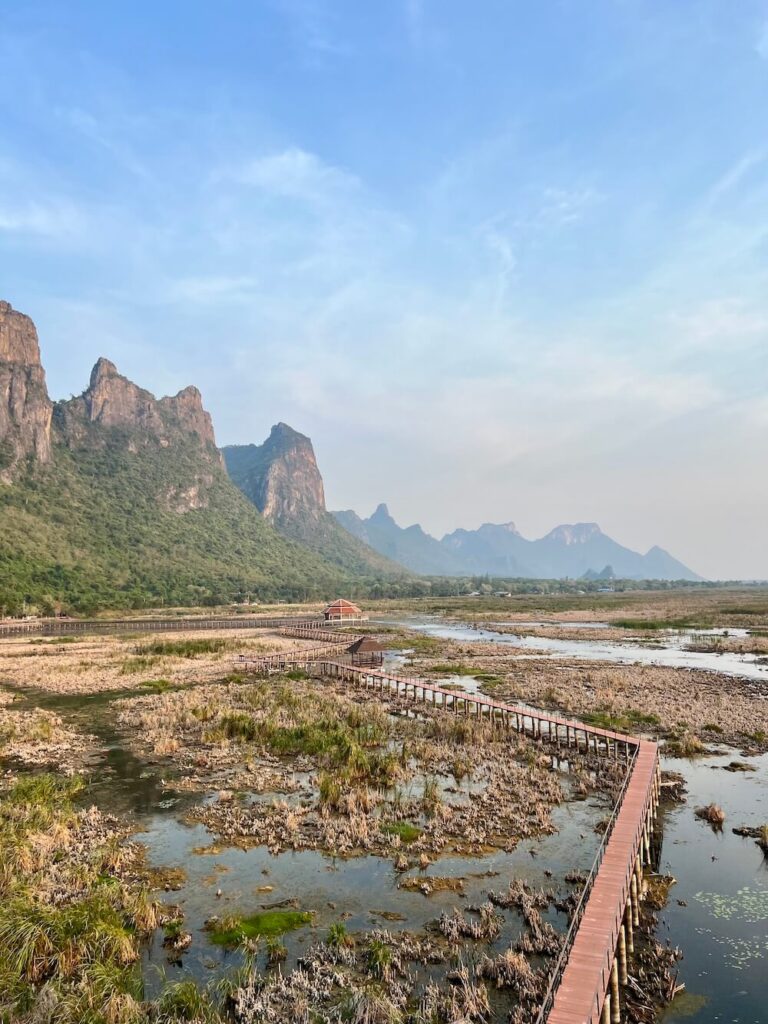
With striking shapes and colors perfect for filmmakers and Instagram feeds, the mangrove estuaries and limestone karst islands of Phang Nga Bay have become an essential stop on almost every Southern Thailand itinerary. With that popularity comes crowds, however, so while you’ll likely be sharing the experience with a lot of other people, it’s still an experience worth having.
Sunrise from Samet Nangshe
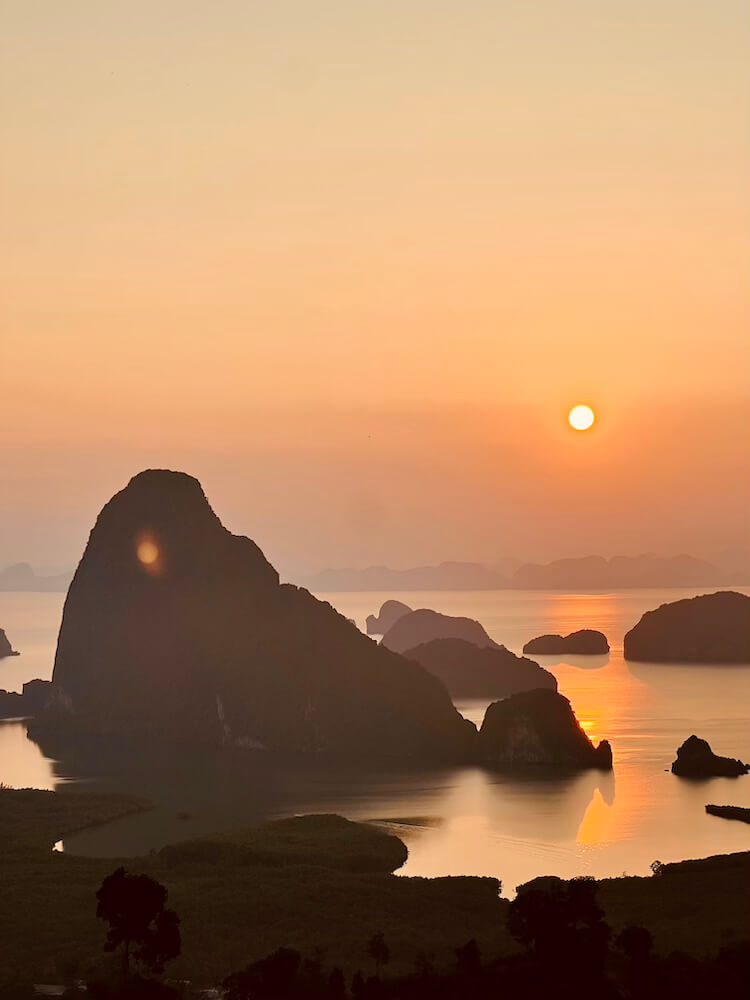
Watching the rising sun paint the morning sky over Phang Nga Bay in continuously changing shades of red and gold is a magical experience. Despite our early departure, we had a few missteps and very nearly missed it altogether.
Because we were staying up in the hills north of Phang Nga Town, a 45-minute drive from the viewpoint at Samet Nangshe, we needed to be on the road by 4:45 a.m. – a feat I’m proud to say we can now regularly pull off.
We have discovered that flexibility, not always routine, is the key to making this life work. Lunch is two hours later than usual? We can handle it.
So we were feeling good as we drove through the empty roads of Phang Nga on our way to the viewpoint, high up the hillside on the western end of the bay. This is an area that has seen enormous levels of development over the last five years, and the maps have not kept up with reality.
Losing Our Way to the Viewpoint
The road our GPS directed us down was barricaded, the old route in the process of being transformed into a construction site. Signage led us further down the road, and we pulled into a large parking lot where buses were unloading tour groups to catch shuttles up the hill.
This was our first mistake. All this was for the “Beyond Skywalk Nangshi,” a 180-meter glass-bottom walkway suspended above the bay. By the time we’d figured this out (and run away from this monstrosity as fast as we could), the sky had already lightened significantly. I was terrified we had woken up three hours early to watch the sunrise from a parking lot filled with package tourists.
A local security guard gave us better directions than Google Maps: the old road up Samet Nangshe is actually a couple of hundred meters south of the glass walkway. A dirt road climbed and wound its way up the hill, leading to a mostly empty parking lot. From here, a few dozen Baht gets you a ride in the back of a songthaew up a very steep series of switchbacks (a mode of transportation we’re getting very used to).
The Magical Sunrise at Samet Nangshe
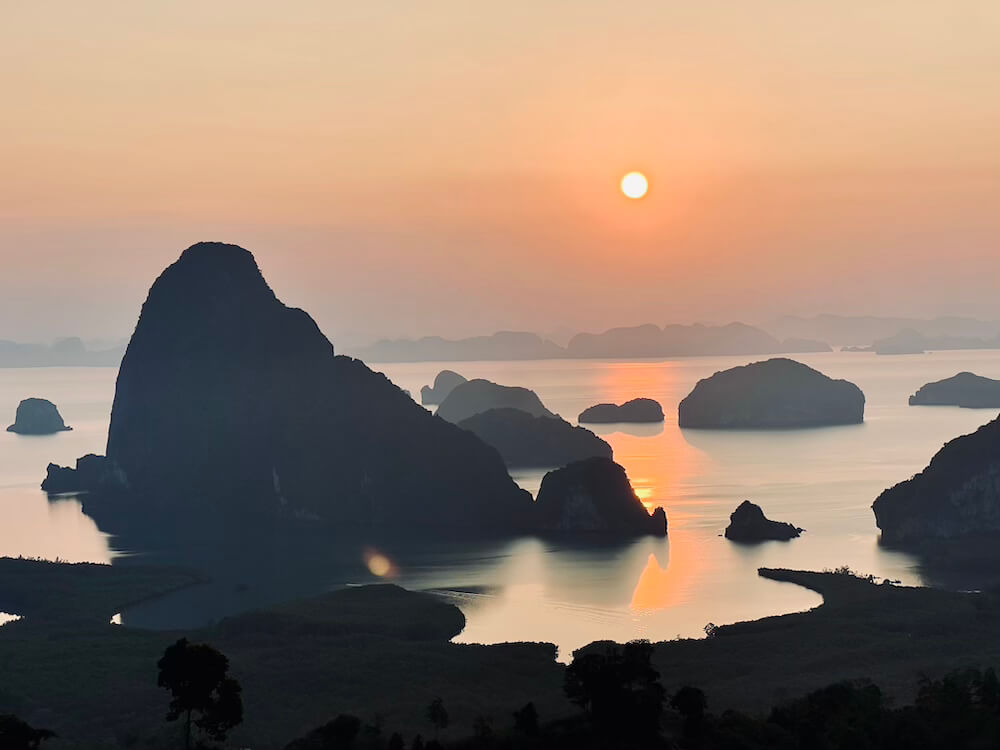
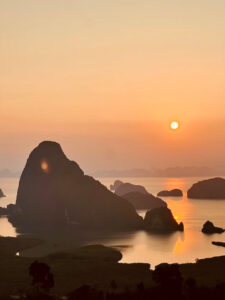
We climbed off the truck and I was even more worried that we’d missed the best part of the sunrise. The red sun sat low on the horizon, everything bathed in a dull, grey light. But with each passing minute, the grey light sharpened to silver and then soon caught fire. Bright golden light shone across the bay, casting dozens of islands into sharp relief. Every five minutes, the scene transformed into something new.
We hadn’t missed a thing; it was spectacular.
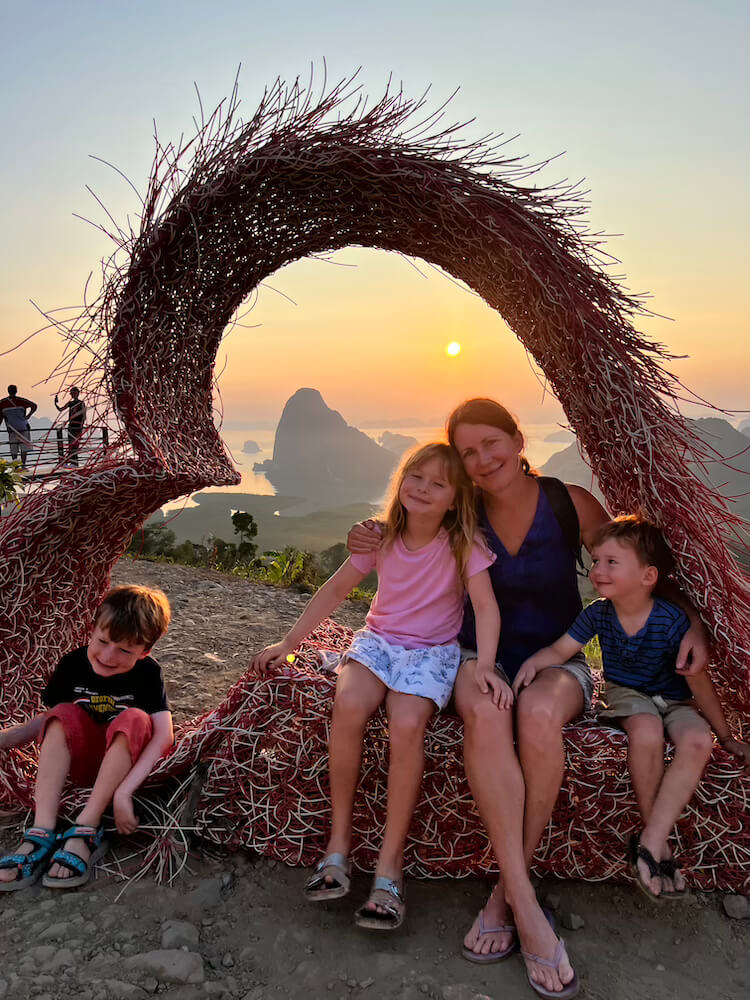
A five meter boardwalk extended over the side of the hill, and visitors took turns posing at the end of it against the backdrop of the Samet Nangshe sunrise. It reminded me of our travels through parts of China—everyone with their backs turned to the thing they’ve come to see and almost no one just looking at it.
At least for now, just looking remains an option. There are clear signs of construction across the entire hillside, and I would be surprised if, in a few years, it’s still possible to just drive up the hill for the view. Expect more glass catwalks, concrete hotels, or, if you can afford them, private cliff-side bungalows.
Until then, though, this is a view absolutely worth chasing.
Private Tour of Phang Nga Bay
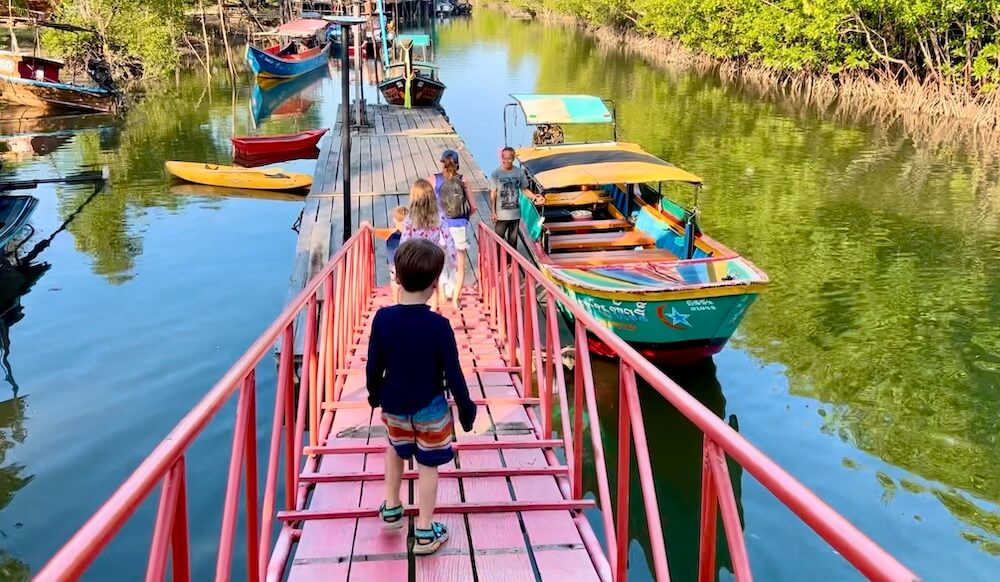
As dawn transformed into early morning, we rode the songthaew back down the mountain and made the short drive to Koh Khlang Pier. We’d arranged a bay tour directly with a nearby tour operator, since we wanted to get on the water while the golden hour light remained.
There are plenty of operators to choose from. In my mind, this was a mangrove tour which, as much as our family enjoys them, doesn’t usually attract huge numbers of casual tourists. Perhaps because Phang Nga is so close to major hubs like Phuket and Krabi, it draws in large numbers of day-trippers looking to add something to the resort routine.
Each estuary seems to have its own village, which has its own pier, which supports half-a-dozen tour companies. See the Plan Your Trip section below for more details on who we went with, but I don’t think you can easily go wrong. Ultimately, with so many boats on the water, finding a ride is rarely an issue.
Is James Bond Island (Koh Tapu) Worth Visiting
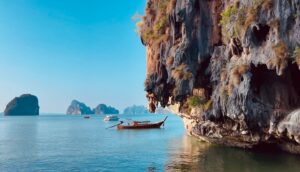
With the sun still low in the sky, we left the brightly painted Koh Khlang Pier in the nearly equally colorful longtail that would see us through the day. She seemed to be older than some of the other boats, with more angular and less graceful lines. But when our captain fired up the diesel engine, she was certainly up to the task of a day of island hopping.
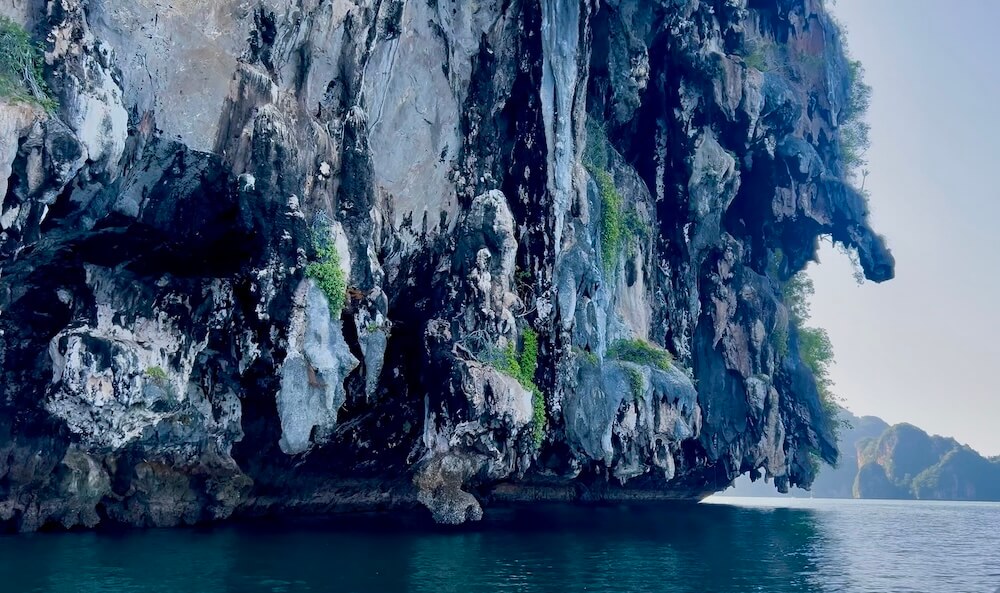
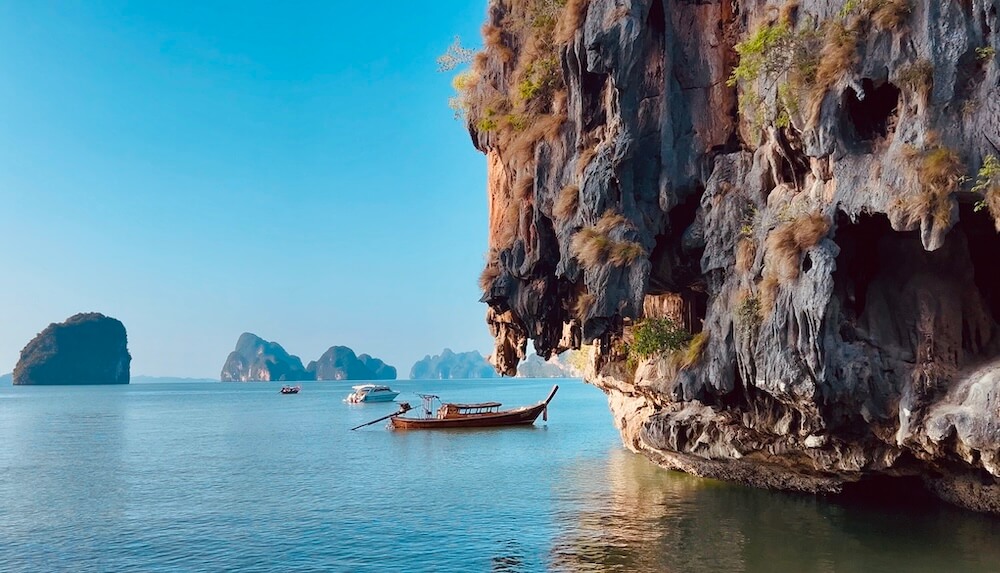
After ten minutes of motoring through ever-widening estuary channels, we emerged onto the open sea. The islands we had seen silhouetted against the rising sun now revealed their details—jungle-covered peaks and sheer karst cliffs. Wave action had deeply eroded them at the waterline; from the lips of these undercuts hung impossibly twisted stalactites.
Our early start allowed us to be among the first boats to pull up on the sand of Khao Phing Kan. A concrete staircase led away from the beach and over a rocky ridge covered in jungle scrub. Around the headland, we caught sight of the feature that has made this part of Phang Nga so famous: the iconic “James Bond Island.”
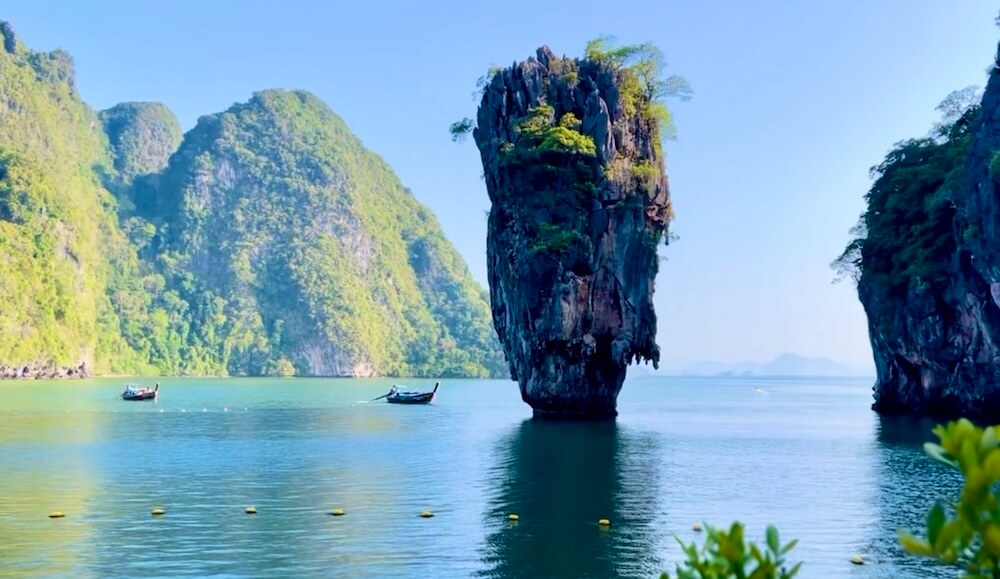
It was here that Francisco Scaramanga, played by Christopher Lee, held his final duel with James Bond in The Man with the Golden Gun. I’m not an enormous fan of Roger Moore’s portrayal of Bond, but there’s no denying that the island, with its caves and secret passages, makes a perfect lair for the villain. Top billing goes to the needle-shaped rock of Koh Tapu, however. Following the movie’s massive success, the island became a major tourist icon, forever cementing the nickname “James Bond Island.”
The tourists continue to come, just as they have since shortly after the film’s 1974 opening. Capitalizing on the connection, the island’s main bay is backed by densely packed souvenir stalls hawking anything even vaguely spy-themed.
So early in the morning, though, these had yet to open. The few boatloads of passengers who had already landed almost had the run of the place. This was convenient, as the caves and ledges that run along the inner bay don’t really allow for two-way traffic.
The pinkish glow of morning light on the cliffs gave the bay an almost Amalfi Coast kind of feeling, at least until the roar of the diesel engines from a wave of incoming longtails brought us firmly back to Thailand.
In a strike against another kind of unpleasant noise, a sign informed visitors that drones were strictly forbidden. You might dare risk it, though. A misspelling on the sign promised that “violators will be fine.”
Exploring one of the Ice Cream Caves (Probably)
There appear to be several caves in Phang Nga Bay called the “Ice Cream Cave,” and none of them seem to be the one we visited. Ours was only a short trip away from Khao Phing Kan, lying in the shade of a massive cliff. A gap opened near the base of the sheer face and, from the water, we could see an expanse of blackness behind it.
The landing was tricky: a narrow rocky shore via a questionable pier that was really no more than a wooden ladder laid against the wet stone. The ledge was narrow, but wide enough, at least, for a couple of large hardwoods to have anchored themselves into the limestone, giving us something sturdy to help us climb up.
Our guide passed us headlamps and sent us into the first, surprisingly expansive cavern. Thailand must have tens of thousands of caves, and we’ve visited a fair few of them ourselves. This one would not crack the top twenty, but we still enjoyed its columns and stalactites, formed from glittering, crystalline dripstone.
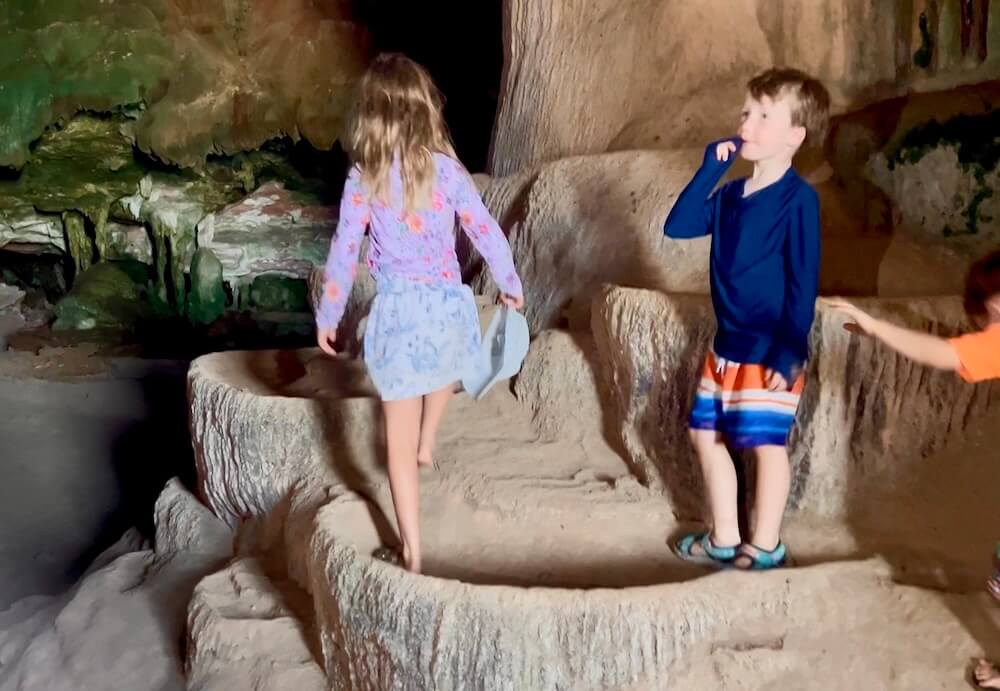
Despite openings higher in the cave that admitted light and fresh air, it trapped the humidity of the sea leaving the air damp and stagnant. The sharp smell of ammonia told us that bats lived here. As we moved farther from the noise of the open water, we could hear them too—far more than we could see, their calls echoing from corners of the cave inaccessible to us.
Isobel suggested the name came from the rimstone pools, which descended in terraces down the largest of the cave’s columns. These, she said, looked like ice cream bowls. I’d guess it’s more to do with the flowstone, which looks like melting vanilla ice cream dripping down the walls. We climbed around the cave for ten minutes or so, unclear how deep we could (or should) go, before climbing back down into the light and boarding the boat.
Kayaking the Hongs and Caves of Panak Island
Most itineraries in Phang Nga Bay will offer the chance to kayak through some of the interior bays of the larger islands, called hongs. These are rarely included in the price of your tour, so expect to pay around THB 500 for up to three people to be ferried around in inflatable kayaks. Compared to the mangrove tours operated by groups like the Ban Din Daeng Community in Khao Lak, this is a bit more like a theme park ride.
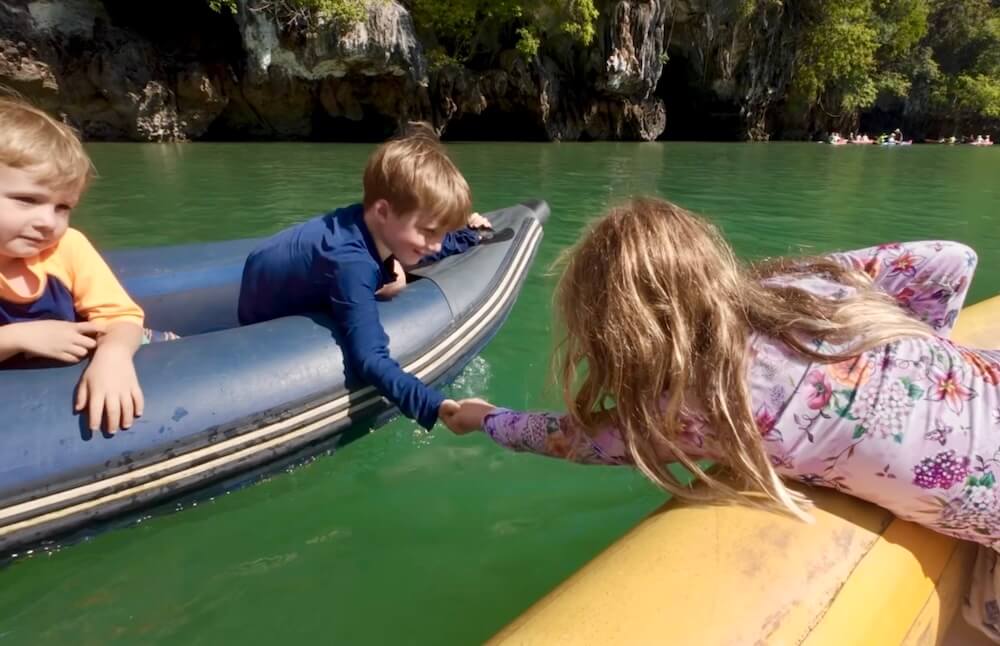
When we arrived at the staging area, I had my doubts. Dozens of longtails were moored to ropes outside the entrance to Panak Island, their passengers transferring by twos and threes into the smaller kayaks. Just as we tied off, a luxury multi-deck speedboat arrived. Two dozen kayaks immediately descended on it. It looked like something out of the eighteenth century: Captain Cook and the Endeavour arriving at Pacific island to be met by a fleet of outriggers hoping to trade.
The kids had been looking forward to this part of the trip, though, so we couldn’t back out. We boarded our inflatable kayaks and queued with the other tourists as we completed the circuit through the bay. The guides, cigarettes hanging from their lips, pointed out any rock formation bearing the vaguest resemblance to an animal, cracking jokes from the same script they’d probably use twenty times that day.
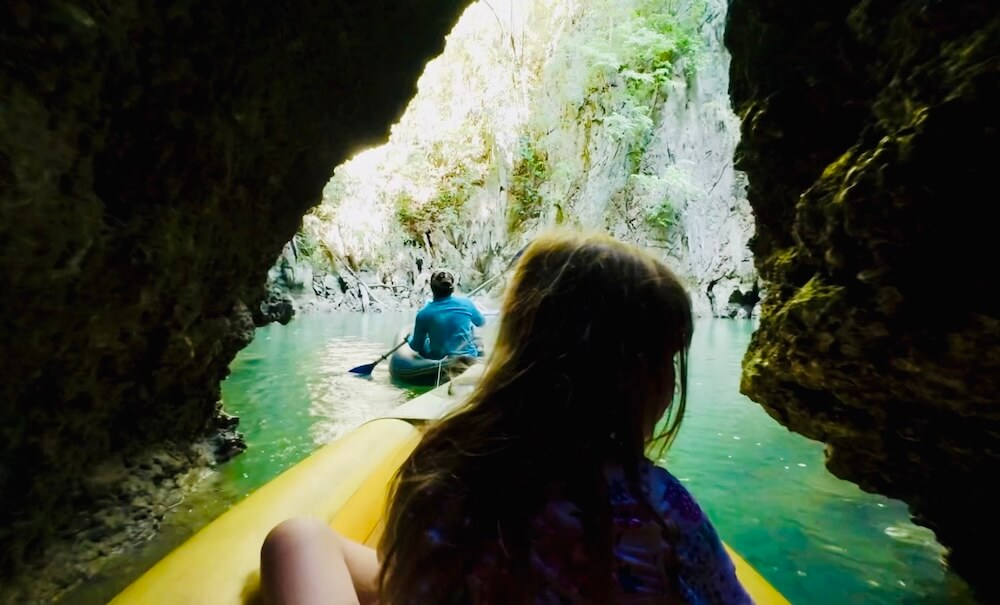
But you know what? I found myself enjoying it despite myself. Some of this was vicarious: it’s always a pleasure to see the kids smiling, but moving through these caves and lagoons is genuinely just a lot of fun. Is the idea of a “honeymoon cave,” so-called because of its heart-shaped opening, a little bit cheesy? Oh, it definitely is, but a roof that has collapsed into the shape of a heart is, actually, quite cool.
The entire excursion lasted no more than a half-hour, during which we were introduced to stone elephants and camels. There was even a spire of rock the guides had dubiously named “Little James Bond Island,” or “006” for short.
It’s silly fun, but it’s fun all the same.
From the charming chaos of kayaking around Panak Island, we motored another ten minutes to another world: an island with not another boat in sight. We drew the boat onto a yellow-sand beach between two cliffs and walked across the hard-packed sand to a ladder that led up to another cave.
Our guide didn’t share the name of the cave, and my research hasn’t uncovered it either, so it shall have to remain nameless.
Unlike the cavernous Ice Cream Cave, formed by water erosion from the top down, this one is long and narrow, the product of a persistent flow. It’s also much darker. I still get a small thrill from flicking off all the lights in the middle of a passage and experiencing what true darkness feels like.
The dark doesn’t extend the full length of the cave, however. After passing through delicate columns of lace crystals, light began to show from the far end of the cave. At what should be its terminal end, deep inside the cliffs, a series of small windows appeared in the cave wall.
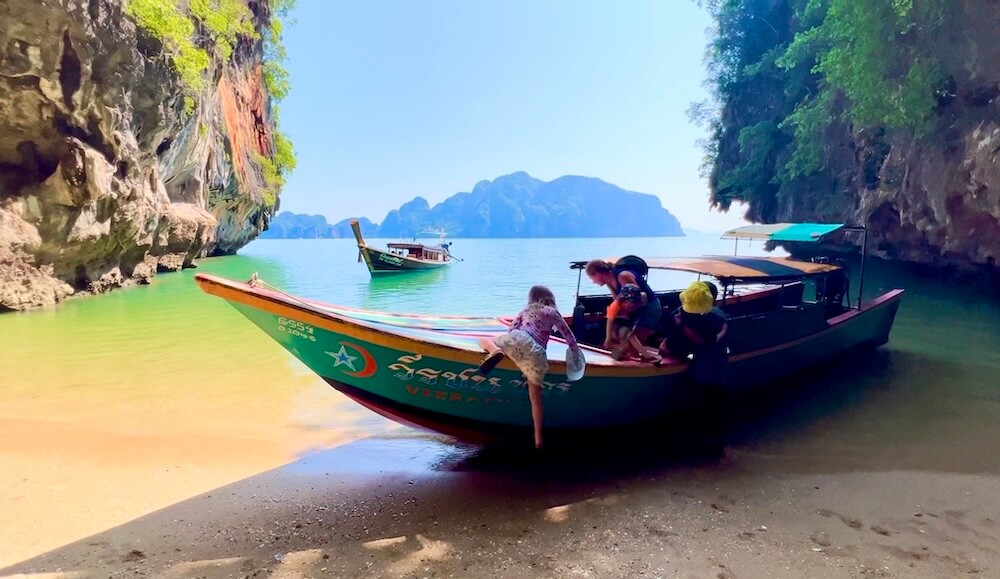
Once our eyes had adjusted to the blaze of light, we could see through the windows a hidden lagoon, filled with jade-colored water, completely inaccessible from outside the island. This mysterious doline, a tiny Eden of rainwater and palm trees, hinted at all the other undiscovered places Thailand must still hide beyond the reach of even the most determined tourists.
We made our way back through the cave and when we emerged into the light, the colors had assumed new levels of vibrancy. The jungle leaves were a near-fluorescent green, while the still water between them was a deeper, darker shade of jade than the hidden lagoon. Set between them, our joyously colored boat suddenly seemed the least colorful thing in the scene. The colors that I had thought were almost garishly loud I now saw as perfectly suiting the environment.
The sun had risen much higher now and it was beginning to grow quite warm. Fortunately, our final stop was the empty beach of one of the islands we had seen from the top of Samet Nangshe. We pulled the boat onto the broken-shell beach and climbed into the sea.
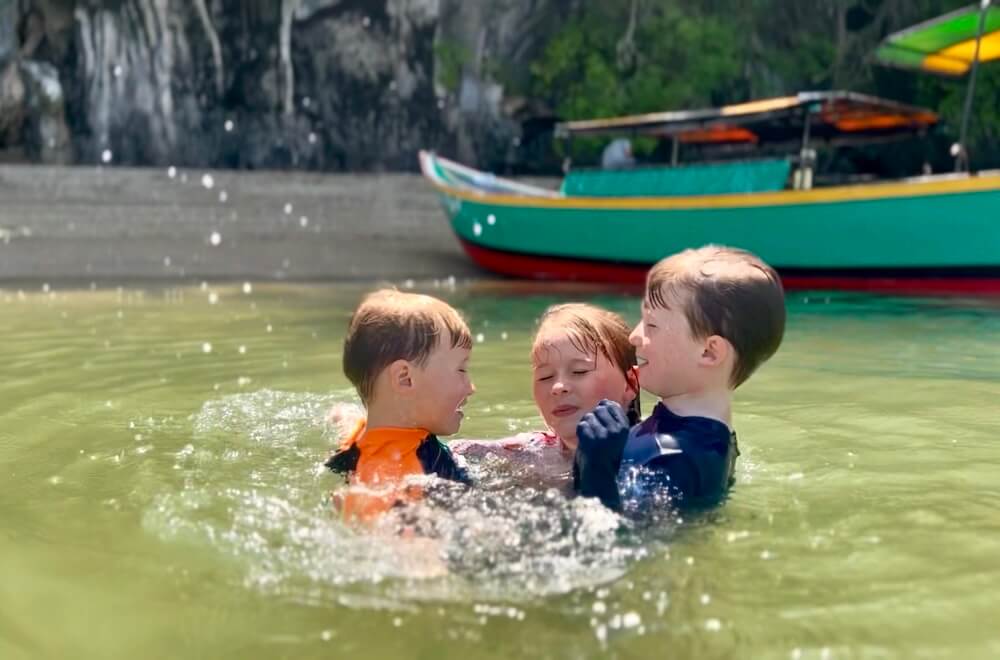
The warm, shallow water of the bay wasn’t cool enough to be completely refreshing, and the sediment laden water wasn’t nearly as clear as the white sand and turquoise waters we had left behind in the Andaman Sea, but a swim is almost never bad. With some luck, splashing around in the sea would invigorate the kids enough to take them through lunch. It wasn’t yet noon, but we had already enjoyed a very full day.
Plan Your Trip to Samet Nangshe and Phang Nga Bay
Some links below are affiliate links. At no extra cost to you, we earn a small commission if you make a booking, which helps us keep our family on the road. Thank you for your support!
Getting There
Phang Nga Bay sits roughly midway between Phuket and Krabi, making it highly accessible but prone to heavy day-tripper traffic from both hubs.
To Samet Nangshe Viewpoint: Located about a 45-minute drive south of Phang Nga Town, or roughly 1 hour and 15 minutes north of Phuket International Airport. Avoid the GPS route to “Beyond Skywalk Nangshi” unless you want a massive glass walkway and tour crowds; the original local road up Samet Nangshe is located a few hundred meters further south.
The Hill Shuttle: You cannot drive your own vehicle up the steep switchbacks to the viewpoint. Park in the dirt lot at the bottom and pay THB 30–50 per person for a round-trip ride in the back of a local songthaew truck.
To the Bay Tour Pier: We used Koh Khlang Pier, situated just a short drive from the base of Samet Nangshe. This gives you immediate access to the mangrove channels and gets you onto the open water ahead of the Phuket speedboats.
For Thailand, and indeed, much of East Asia, 12go.asia is by far your best resource for booking transportation.
Where to Stay
To catch the spectacular sunrise at Samet Nangshe without waking up at 3:00 a.m. in Phuket, staying locally in Phang Nga province is essential.
Hom I Din Farm and Homestay is a peaceful organic farm in the hills north of Phang Nga Town featuring forest views, farm-to-table dining, and a pool with waterslides. It’s a quiet countryside escape roughly 45 minutes from the bay piers and viewpoint.
Samet Nangshe Boutique is located directly at the viewpoint area. If your budget allows for their private cliff-side bungalows or tents (and well done you if so), you can watch the sunrise over the karst islands right from your balcony without the early morning drive
When to Go
Dry Season (November – April): The gold standard for calm waters, clear skies, and spectacular sunrises. February and March offer excellent weather but see the highest peak-season crowds at James Bond Island.
Shoulder Season (May & October): Fewer boats on the water, but afternoon downpours are common and the morning sky can be hit-or-miss for the sunrise.
The Golden Rule for Itineraries: Start Early. Be on the road by 4:45 a.m. to catch the sunrise at Samet Nangshe by 5:45 a.m. Head straight to the pier afterward to reach James Bond Island before 8:30 a.m. By 10:00 a.m., massive waves of package tourists arrive, completely transforming the vibe of the bays.
What It Costs
DIY Pier Booking: Drive directly to Koh Khlang Pier (or nearby Samet Nangshe piers) right after sunrise. You can negotiate a private longtail boat directly with the local community operators. Expect to pay between 1,500 to 2,500 THB for a private half-day charter for your family, depending on the exact loop and islands you want to see.
We used The Bay Tour, which operates out of Koh Khlang. We appreciated their flexibility both in terms of timing and itinerary.
National Park Fees: Keep cash on hand. James Bond Island is part of the Ao Phang Nga National Park, and entry requires a separate fee (typically THB 300 for foreign adults / THB 150 for children) paid at the island’s ranger station.
Sea Kayaking at Panak Island: Hire an inflatable kayak at the island staging area (approx. THB 500 for up to three people). A local guide will paddle you through the hongs (interior lagoons) and low-ceilinged tunnels like the “Honeymoon Cave.”
Booking/Tours
While we recommend booking directly with a local operator, sometimes, the door-to-door operators just make the most sense. This is the operator we would have chosen:
Seven Wonders of Phang Nga Bay and Six Islands Tour
- Duration: 8 hours.
- Includes: Light breakfast, lunch and snacks. National Park fees included.
- Vibe: Group tour.
- Flexibility: Reserve now, pay later. Free cancellation up to 24 hours before the trip starts.
- Cost: From THB 2,250 per person.
Another tour that we thought looked quite cool was this one, but we haven’t yet tried it:
Phang Nga Bay Bioluminescent Plankton and Sea Canoes
- Duration: 8 hours.
- Includes: Pick-up and drop-off from Phuket hotel, dinner at a local restaurant, and all national park fees included.
- Vibe: Small group tour.
- Flexibility: Reserve now, pay later. Free cancellation up to 24 hours before the trip starts.
- Cost: From THB 2,950 per person.