This is the sixth in a series of posts that tracks our 10-Day Journey across Northern Thailand from Laos to Myanmar. Read our last entry from Chiang Dao, or start from the very beginning at Pu Chi Fa.
The drive to Pai is more famous than fearsome. Over 135 winding kilometers, drivers navigate Highway 1095’s well-known 762 curves over and through the Thanon Thong Chai Range. In the unlikely event this is the first time you’ve heard the “762” number, don’t worry. You’ll hear it many, many more times before your trip is over.
Yes, the road bends a bit, but even with children in the car, it is entirely manageable.
My kids, however, are notorious for keeping their nausea to themselves before sharing it in the most public way possible. Prevention is better than a cure, so it’s a good idea to preemptively break up the drive with a stop or two.
Swimming with Kids at Mok Fa Waterfall
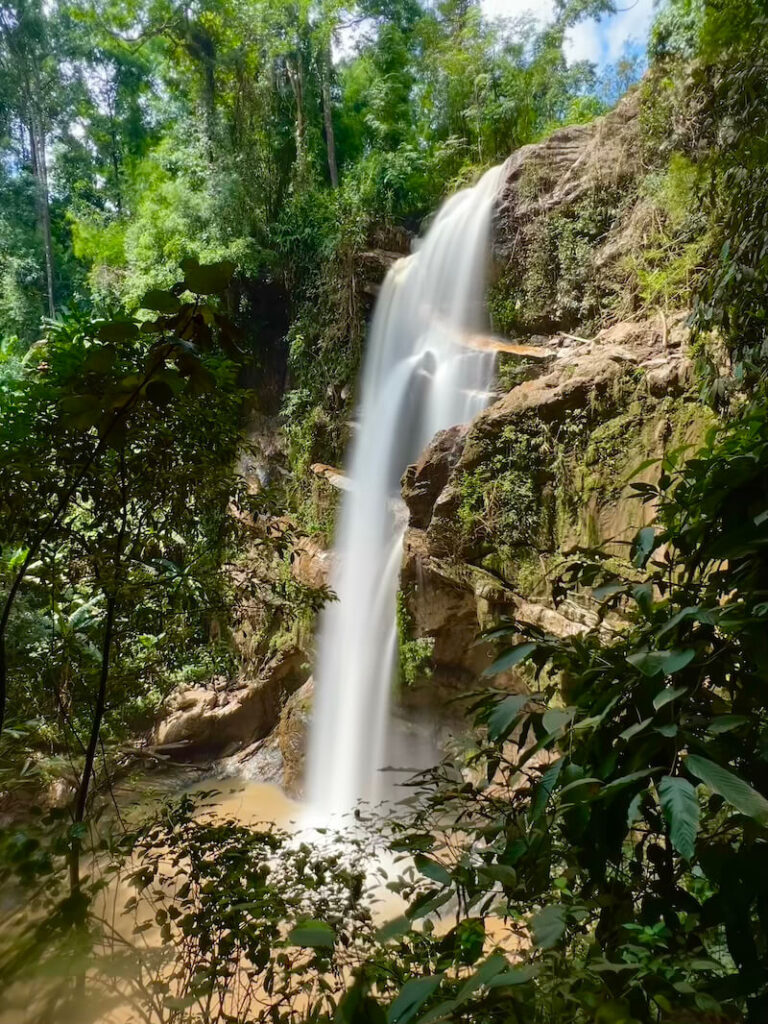
We made our first stop at Mok Fa, a waterfall located about 50 kilometers north of Chiang Mai, just before the road begins its serious climb into the mountains. Unlike the region’s more typical limestone terraces, which spread water evenly across a wide face, Mok Fa erupts from the top of a 60-meter cliff, plunging straight down into a sand-ringed pool.
Still swollen from mid-October’s late-monsoon rains, this was a powerful waterfall. Isobel, my bravest swimmer, fought through explosive spray as she edged toward the column of falling water. Her reward? She slipped into the depression carved out of the loose gravel beneath the falls. My poor girl was too shocked to stand back up, and I had to haul her out of the churning froth.
She was never in any real danger, but Isobel still refers to it as the time she nearly drowned.
If you have time, and post-trauma recovery allows it, a short trail above the falls leads through the jungle to the Tham Mok Fa bat cave. You’ll smell more bats than you see, but the walk includes a river crossing over a rickety bamboo bridge and a bird (or bat’s) eye view of the main falls. It’s the perfect detour to let everyone drip dry before climbing back into the car.
Arriving in Pai to Find It All Grown Up
There are further stops to break up the 78 kilometers left before arriving in Pai. From the road, The Witches Coffee Shop and 32 Coffee both looked like good options. There are also plenty of pull-outs should mild nausea become something more. That’s more than I can say for some of Thailand’s other notoriously tortuous drives.
Except for once, when our driver pulled over and inexplicably disappeared for five minutes (he was buying melons for his wife from a roadside stand), we did not stop and nobody got sick. It’s not quite a two-hour drive, and other than the occasional pause to appreciate the view, I recommend rolling down the windows and getting on with it.
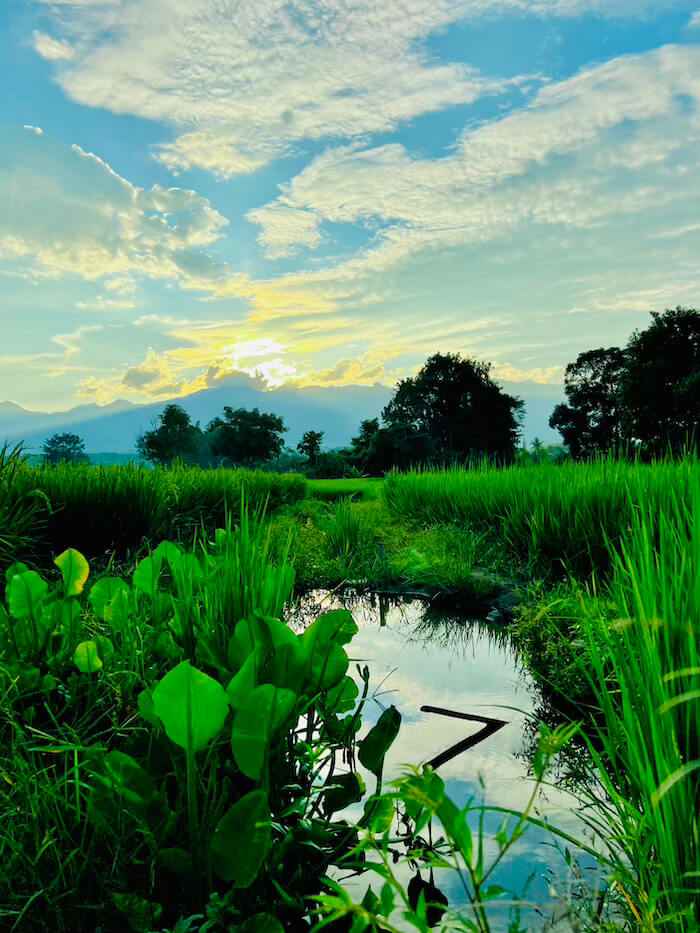
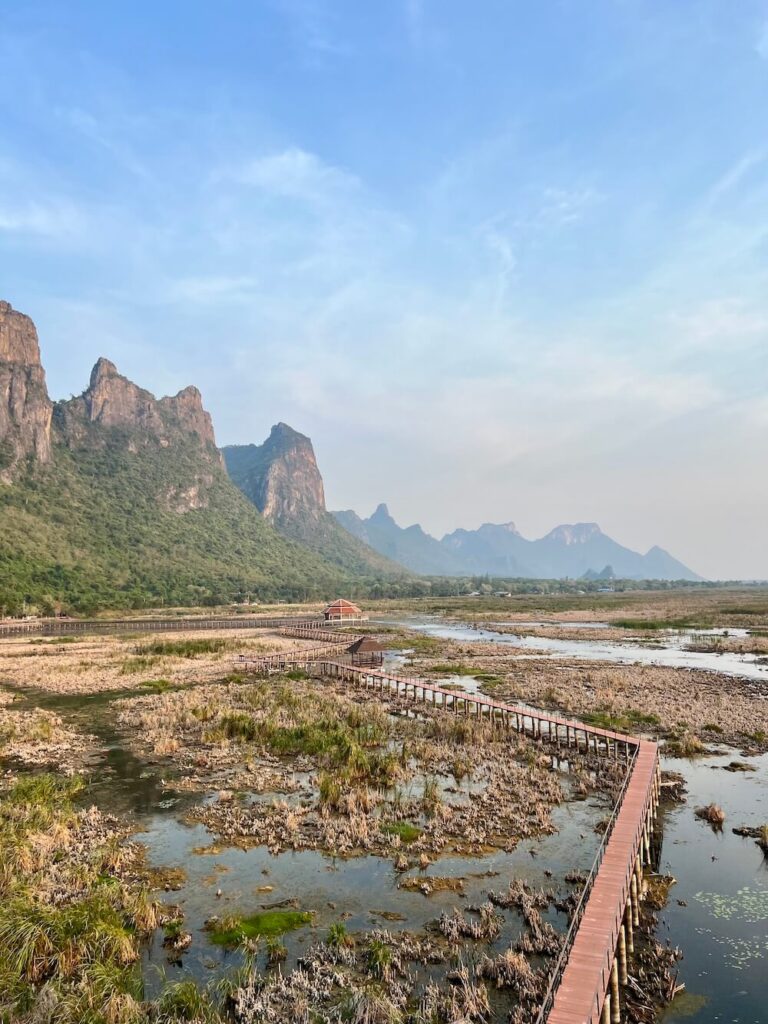
The Pai valley is beautiful, and its ordered rice terraces, framed by wild mountains and jungle, make it clear why it became a stop on the original Banana Pancake Trail. Pai may have lost its reputation as a bohemian hideaway to frontier towns like Mae Sot, but there still exists a relaxed hippie vibe that fits well with the local culture.
We stayed for two nights among those rice fields at the charming Pura Vida Pai Resort, just north of town. While we waited for a taxi into town, water buffalo in the field across the road wallowed in neck-deep mud.
The Clear and Quiet Sai Ngam Hot Springs
Our plans to spend the day traveling deeper into Mae Hong Son province had us finishing breakfast not long after sunrise. Our first stop was Sai Ngam Hot Springs. I had seen from photos that this can turn into a bit of a scene, and I wanted to be sure to beat the crowds.
If there’s one thing about backpackers on which you can rely, it’s that they will sleep in. We arrived at the spring just after 8:00 in the morning, and there was not another soul in sight. With nothing to disturb it, the water was as clear as filtered spirits. Looking down at the colored stones beneath your feet, the water is invisible.
Sai Ngam is a hot water spring, but at this elevation and so early in the morning, it is only pleasantly warm rather than hot. We had nearly a half hour of paddling around before the first ones and twos began arriving from Pai by scooter. By the time the first minibus pulled up, we were happily leaving for our next stop.
The Water Caves of Nam Lod
A twisting hour’s drive away lies Tham Nam Lod, a cave that gives birth to the Nam Lang River. As we walked the path toward the cave, the scale of this geological oddity became increasingly clear.
The limestone mountain is rent by a wide, low cave, out of which flows a swift-moving river roughly 15 meters wide. Where on, or in, earth does it come from? Like the waterfall at Thi Lor Su, it was a scene my parents would have described as fantastical had I drawn it as a child, but here we were.
The path hugs the side of a karst wall before climbing the last steps from the river bottom up to the mouth of the cave. There, overlooking the river, a small lake extends deep into the darkness.
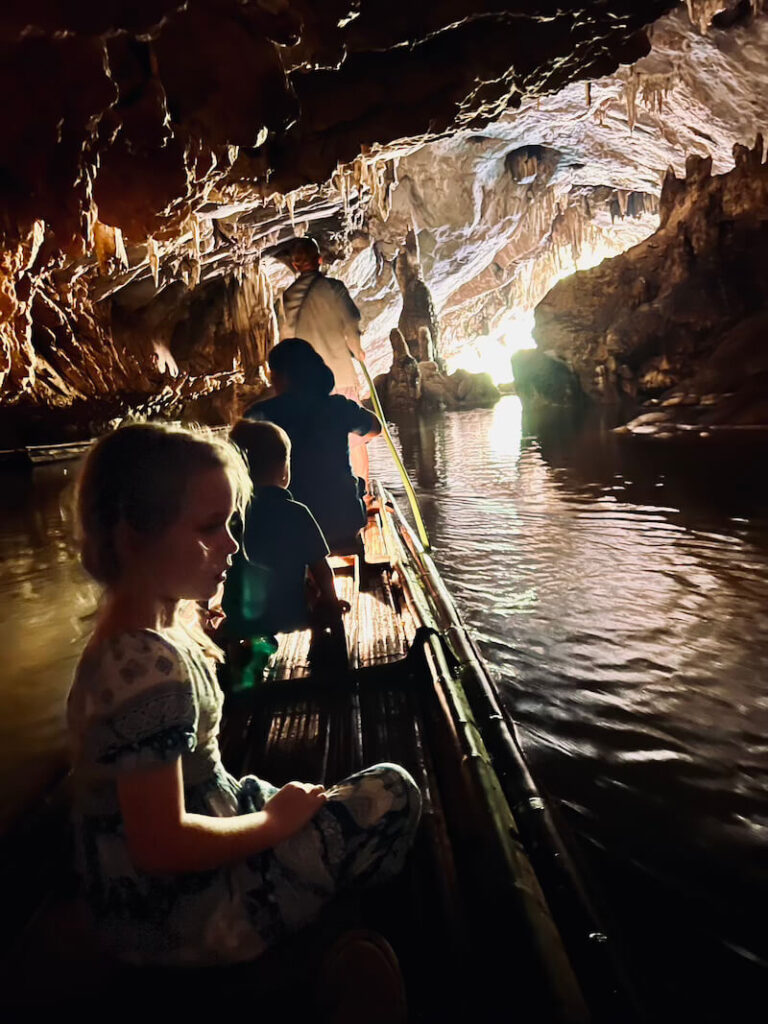
For THB 400, we hired a boat to take us deeper into the chamber. I say boat: these are just long stalks of bamboo lashed together, and a few small benches set on top. The simplicity is half the fun.
Punting across a still lake through a black cave, the only light coming from kerosene lanterns feels very Stygian. For the kids, who already enjoy caves, boats, and the dark, this is perfect.
Our guides floated us past sparkling stalactites, stalagmites, and columns, their mirrored reflections doubling their height. The highlight is a 20-meter flowstone column that reaches from floor to ceiling. Elsewhere, stalagmites pushing up through the inky water seemed to float in the blackness. The dim light of the kerosene lanterns failed to even reach the ceiling of the chamber.
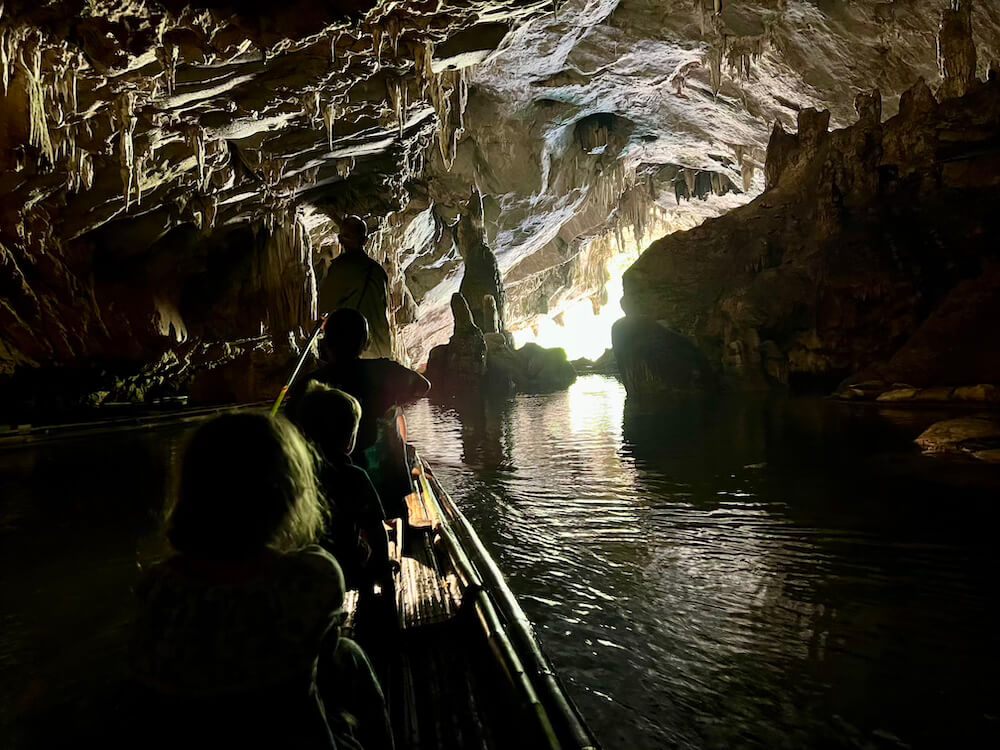
Unfortunately, there is a price to be paid for seeing Pai’s rice fields at their most vibrant green, or meeting Mok Fa at the height of its power. The Nam Lang River was running full and much of the cave would not be accessible for another six weeks at least.
Out of reach were the Doll Cave, so named for the goblinesque grotesques that line the chamber. So too, the Coffin Cave, which holds the timbers of the hanging coffins of the Lawa people who lived in the area more than 1,400 years ago.
With no idea of what else the floodwaters had prevented them from seeing, the kids left satisfied, but I would very much like to return in the dry season.
Lunch at the Noodle Soup House in Ban Cha Bo Village
From the caves, we continued north on the gorgeously scenic Highway 1095, arriving after 30 minutes at Ban Cha Bo, a village home to the Black Lahu hill tribe. This ridgetop village is famous for its stilt-legged restaurants and coffee houses, which offer excellent mountain views.
The most famous of these, Noodle Soup House, serves up pork noodle soup while you sit with your legs dangling over the void and admire the view. All this for less than two dollars, it feels almost like theft.
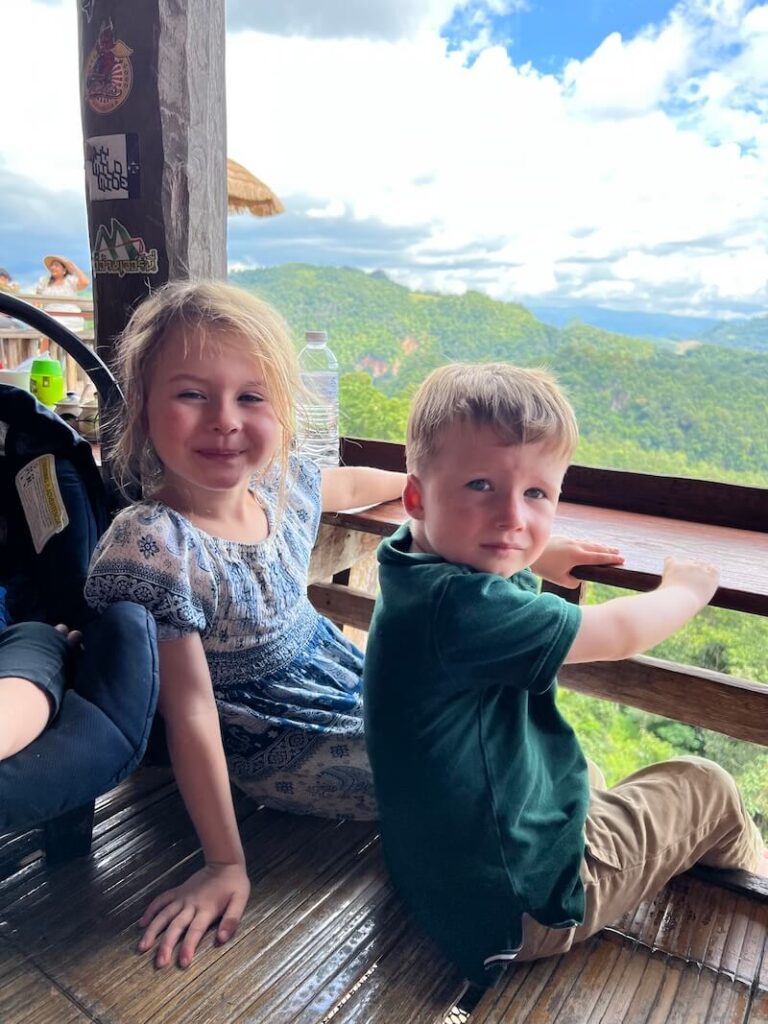
I have no doubt that for most guests, this was the most relaxing part of the day. With as many tiny kids as we have, however, total relaxation was not possible.
I have seen my children tumble out of more chairs than I can count. I have seen them violently fall off a bed on which they had been lying still. Flat, featureless sidewalks are no protection against total collapse. Their clumsiness knows no bounds, which is fine, but an accident here would have consequences, so we upped our vigilance accordingly.
With one hand on the chopsticks and another on a kid’s knee, we watched the clouds slowly roll over the mountains of Mae Hong Son. The ridges in the farther distance would almost certainly have been in Myanmar’s Shan State. Only a week before, we had gazed across another of Thailand’s borders into Laos.
Sunrise Private Tour Jabo Viewpoint & Nam Lod Cave
- Duration: 6 Hours.
- Includes: Round-trip transportation from Pai; food and drink excluded.
- Vibe: Private tour. This is very hands off – essentially a driver to get you there and back. Which given the nature of the stops is all you need.
- Flexibility: Reserve now, pay later. Free cancellation up to 24 hours before the trip starts.
- Cost: From THB 3,866 per group (of two).
Peacocking at Mo Paeng Waterfall
As full as the day had been, and though we were already late in the afternoon, no one was ready to go home. Waterfalls rarely draw objections, so on we went.
The Mo Paeng Waterfall is quite a lot of fun. The monsoon-powered stream emerges from a jungle hillside before splitting into braided channels that cascade over a large granite outcrop. The falls end in a deep, swimmable pool.
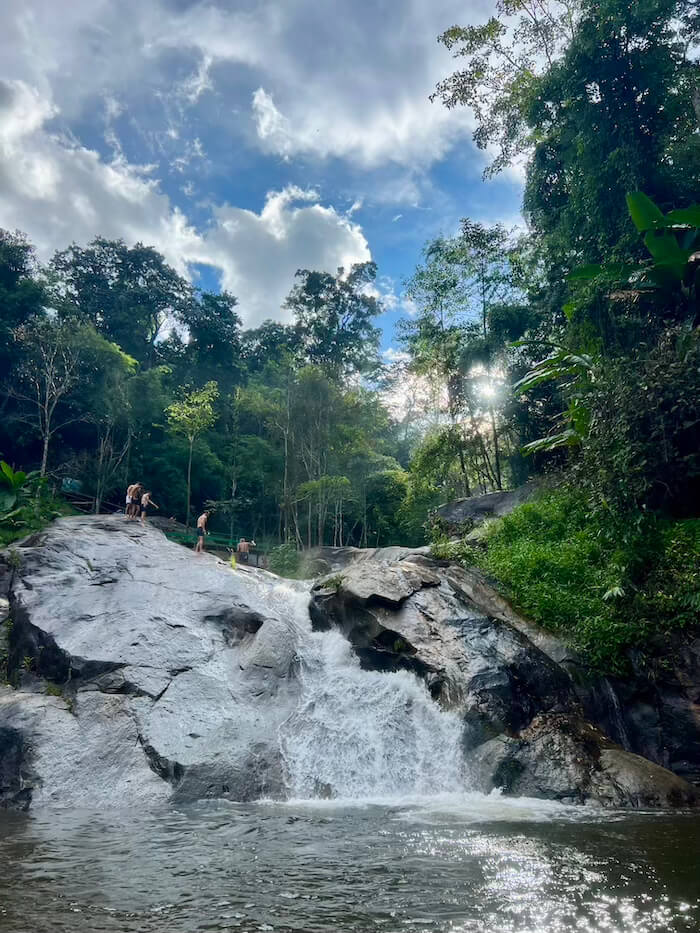
It’s lovely to look at, but Mo Paeng is, at heart, a venue for peacocking backpackers to find mates.
Unlike the sticky waterfalls of Sri Sawang or Bua Tong, these channels are slick enough with moss and algae to form slides. The waterpark-like features draw waterpark-like crowds, and here they were. In our ten-day journey across Northern Thailand, this was the youngest crowd we’d seen yet. Exactly as I would have done twenty years earlier, they spent most of their time daring each other to slide down the chutes in increasingly exotic ways.
Caught up in the spirit, Isobel decided she too would slide down the rock. We found a short and not-too-steep channel, and she readied herself for the drop. Just as she started to slide, she panicked and awkwardly tried to climb out of the channel.
Without a protective layer of growth, the granite here was sharp and jagged. A minor cut on her foot led to a few tears, but whether from embarrassment or pain, it wasn’t clear. I suspect the former, because once patched up, she was swimming in the pool at the bottom of the falls with her brother.
Na’s Kitchen and the Pai Night Markets
After the falls, exhaustion was creeping closer but still hadn’t completely overtaken us. We capped off a very full day, which could very easily have been split into two, with a wander of Pai. The town’s reliable tourist numbers may not guarantee better food, but there’s certainly more variety than most Thai cities this size.
Na’s Kitchen is a heavy favorite, and we liked the Thai basics very much. If you can’t decide on a single place, a stroll along the walking streets centered at the junction of Chaisongkran and Raddamrong roads is a great choice too.
Finally exhausted, we retired to Pura Vida in advance of tomorrow’s return drive to Chiang Mai. I had complete confidence we would conquer the curves. We had better. Charlie was already wearing the t-shirt we’d bought at the night market telling the world he’d triumphed over every one of the 762 turns.
Up next: We return to Chiang Mai and take a day to Doi Inthanon, the “Roof of Thailand.” We hike the Pha Dok Siew Nature Trail to Ban Mae Klang Village for some local coffee. Read about our Doi Inthanon Day Trip: Cloud Forests, Waterfalls, and the Walk to Ban Mae Klang Luang.
Plan Your Trip to Pai
Some links below are affiliate links. At no extra cost to you, we earn a small commission if you make a booking, which helps us keep our family on the road. Thank you for your support!
Getting There
Most visitors reach Pai via the famously winding Highway 1095 from Chiang Mai. The drive is about 3 hours without stops, but you’d be missing the point if you rushed it. With waterfalls, caves, hot springs, and villages strung along the route, this is a road best enjoyed slowly.
If you’d rather not drive, minibuses run frequently from Chiang Mai’s Arcade Bus Station. They’re cheap and efficient, but tight curves and enthusiastic driving make them less ideal with young kids or sensitive stomachs.
Once in Pai, having your own vehicle makes a huge difference. Many of the highlights in this post — Sai Ngam Hot Springs, Mo Paeng Waterfall, and Tham Nam Lod — lie well outside town. Scooters are popular, but with children we strongly preferred a car for comfort, flexibility, and safety.
Where to Stay
Pai offers everything from backpacker hostels to quiet countryside resorts. We stayed just outside town at Pura Vida Pai Resort, surrounded by rice fields and water buffalo, and found it a perfect base: peaceful at night, but only a short ride from Pai’s restaurants and night markets.
Pura Vida Resort These standalone bungalows are tucked into the rice fields north of town, trading bohemian chaos for bucolic charm. The garden villas have plenty of room for a family—and the charm of watching the valley turn that vibrant, monsoon green from our doorstep.. Your hosts will happily arrange transport in and out of town.
Further afield from Pai. Tham Lod Cave area.
Jungle Guest House A bit of an institution. Staying at Jungle guest house near Tham Nam Lod lets you beat the morning minibus crowds from Pai. You’ll wake up to limestone views and the river’s rush, ensuring you’re first in line for a bamboo raft.
When to Go
The best time to visit Pai is during the cool, dry season from November to February, when days are mild and nights can be surprisingly crisp.
That said, we visited in late October, and the lush green rice fields and powerful waterfalls were spectacular. The tradeoff is higher water levels: during or just after the monsoon, parts of Tham Nam Lod Cave may be inaccessible. If seeing the Coffin Cave is a priority, aim for the heart of the dry season.
Booking/Tours
We hired a driver in Pai and more or less ran our own tour ad hoc. That’s very doable, but if you (very understandably) want to cut out the hassle, the following tour is the closest to what we did.
It’s a private tour, and I suspect some of the stops are negotiable if you want to adjust the itinerary to better suit your interests.

Two-Day, One-Night: Pai and Lod Cave Adventure
- Duration: 2 Days.
- Includes: Round-trip Chiang Mai transfers; two lunches, one-night accommodation in Pai.
- Vibe: Private tour. Kids welcome, but ages six and above preferred. Contact operator directly for any exceptions.
- Flexibility: Free cancellation up to 24 hours before the trip starts.
- Cost: From THB 7,900 per person.