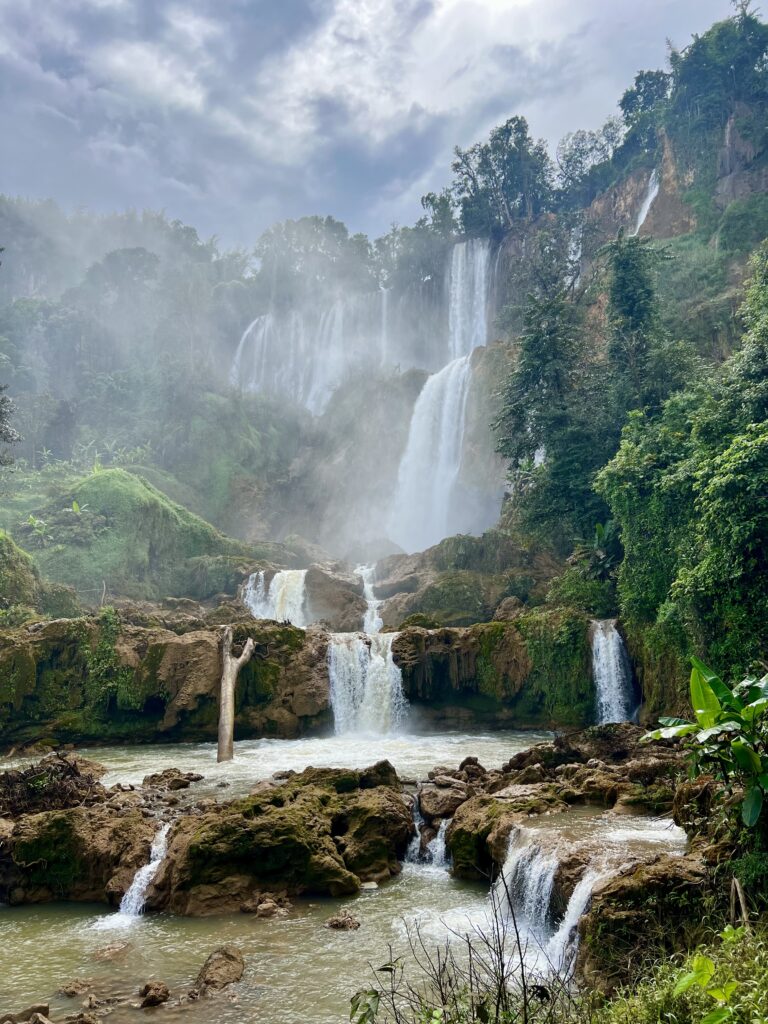
We’ve visited dozens of waterfalls across Thailand over the years, but none are as dramatic or spectacular as Thi Lor Su. The Klotho Creek spills over a ridge extending 400 meters, with dozens of individual falls forming a curtain of braided cascades. When we visited at the end of the rainy season, the falls shrouded themselves in mist as they plummeted more than 250 meters down the limestone cliffs.
The Mae Klong River too is pure magic. Smaller streams and rivulets shower and spray off jungle cliffs on both sides of the river. The most famous of these, Thi Lor Cho, refracts a permanent rainbow if you ensure you drift past at the right time of day (usually between 9:00-10:00 AM). Umphang is magical and entirely worth braving the Death Highway.
We built the entire journey around this incredible natural wonder. To understand the full context of the ride and the rest of the stops, explore our complete 9-Day Northern Thailand Itinerary.
Note: You’ll see the name written as “Thi Lo Su,” “Thi Lor Su,” or even “Namtok Thee Lor Sue”—they all refer to the same waterfall.
- First Evening in Umphang Town
- Rafting Down the Mae Klong River: The Journey to Thi Lor Su
- Behold Thi Lor Su: Thailand’s Largest Waterfall
- Overnight: Camping at the Thi Lo Su Campground
- Trekking to the Kota Karen Village
- Giant Centipede Attacks
- The Surprise Splendor of Kota Waterfall (Namtok Ko Tha)
- Evening in the Kota Village Schoolhouse Community
- The Long Way Home: Return Trek via the Mae La Moong River
First Evening in Umphang Town
Umphang is the base for a variety of adventures beyond Thi Lo Su, and I can see it becoming more of a destination over the next few years. The town has a sleepy frontier vibe, with a growing guesthouse, restaurant, and café scene; all set in the lovely Mae Klong River valley. It’s perfectly possible (and likely cheaper) to arrange activities upon arrival in town. Given that we were coming at the end of the rainy season, we didn’t want to risk it and organized a four-day tour prior to our arrival.
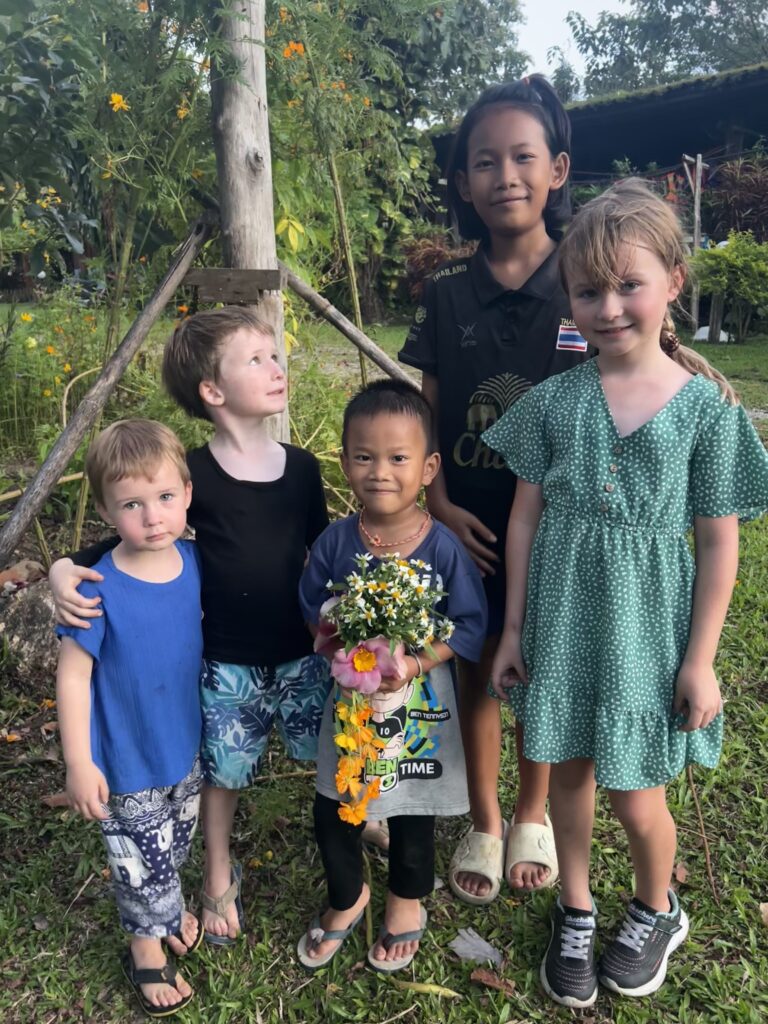
We arrived at our overnight lodgings by mid-afternoon, with plenty of time to decompress (and air the car out) after the harrowing 1,219 curves. For dinner, you won’t beat the view from The La Land, a coffee shop and restaurant set on a hill just south of town. We also took advantage of one of the many convenience stores in town to stock up on snacks (bribes) for the coming trek.
We sipped a couple of Chang beers on the veranda while the kids played tag with new friends. By the time the sun had slipped behind the hills and the frogs had begun to sing from the verges of the Umphang River, I had forgotten the drive altogether.
Rafting Down the Mae Klong River: The Journey to Thi Lor Su
The Permanent Rainbow of the Thi Lor Cho Rain Waterfall
The next morning, we climbed aboard our inflatable dinghy and pushed off into a strong but manageable current. Even during the rainy season when the flow is strongest, this stretch of the Mae Klong is tame enough for small kids. Operators can accommodate even very small children (Charlie is an undersized three-year-old) and will be able to provide appropriate life jackets.
As we drifted further from town, the cliffs grew taller and the jungle denser. Dozens of waterfalls, from trickling streams to more substantial cascades, tumbled down verdant moss-covered walls on either side of around us.
The river has cut deeply into the limestone karst along much of its length, creating impressive overhangs. The thick forest spills over the banks, and roots and vines stretch into the water. Our guides first tried to avoid piloting us through the falling water and, when they see how much the kids like it, steered us straight into every cascade.
The reason for leaving at so precise a time became clear as we rounded a bend and saw a long stretch of falls cascading into the main river. The largest of these is Thi Lor Cho, which builds a wall of mist around itself as it ricochets down the canyon wall. As the light from the low morning sun passes through this cloud, it refracts a delightful rainbow that dances across the mist. It is a perfect, colorful appetizer in advance of the main course.
Mae Klong Hot Springs
I’ll confess to having mixed feelings about the Mae Klong Hot Springs. The rafts, which the guides had ensured were well spaced along the river all morning, now jostle for space on the stretch of riverbank near where two small springs bubble out sulfuric streams of hot mineral water.
The gathering can spoil the sense of solitude somewhat, and the crowds trample the ground around the springs into a sodden mess. There are, however, coffee, tea, snacks, and toilet facilities nearby. If you have a river-waterlogged diaper to dispose of, you might be more likely to excuse the eyesore.
After perhaps three or four hours on the water, the journey ends at a sand bank by the side of a small park. After deflating and packing the rafts, we transferred our packs to a waiting 4WD truck. The journey to the Umphang Wildlife Sanctuary continues overland.
In the rainy season (when the road is closed for recovery), your guide will lead you on a challenging 10-12 km trek over 3-4 hours. When the roads are dry, a short but bumpy trip in a 4WD truck. In the buffer season, it’s a truck driven through what surely must be the deepest mud a vehicle can pass. As I listened to the gear box scream a metal-on-metal song, I was glad my Kia was sitting this one out.
Behold Thi Lor Su: Thailand’s Largest Waterfall
Almost immediately as soon as our mud-caked truck limped into Umphang Wildlife Sanctuary, we set off on the two kilometer walk to the waterfall. Even in wet conditions, the concrete path is easy walking and shouldn’t take more than 30 minutes. We heard the falls long before we saw them and when I did get my first glimpse, they took my breath away.
When I drew my first landscapes as a small child, I scribbled mountain ranges and waterfalls and forests. I wanted dramatic scenes and would sometime cause my waterfalls to tumble off the very summits of my mountains. When it was explained to me that the physics didn’t really pan out, I couldn’t accept it. “What,” I reasoned, “is a waterfall for except to fall from the highest place it can?” Forty years later, little Mike was finally vindicated.
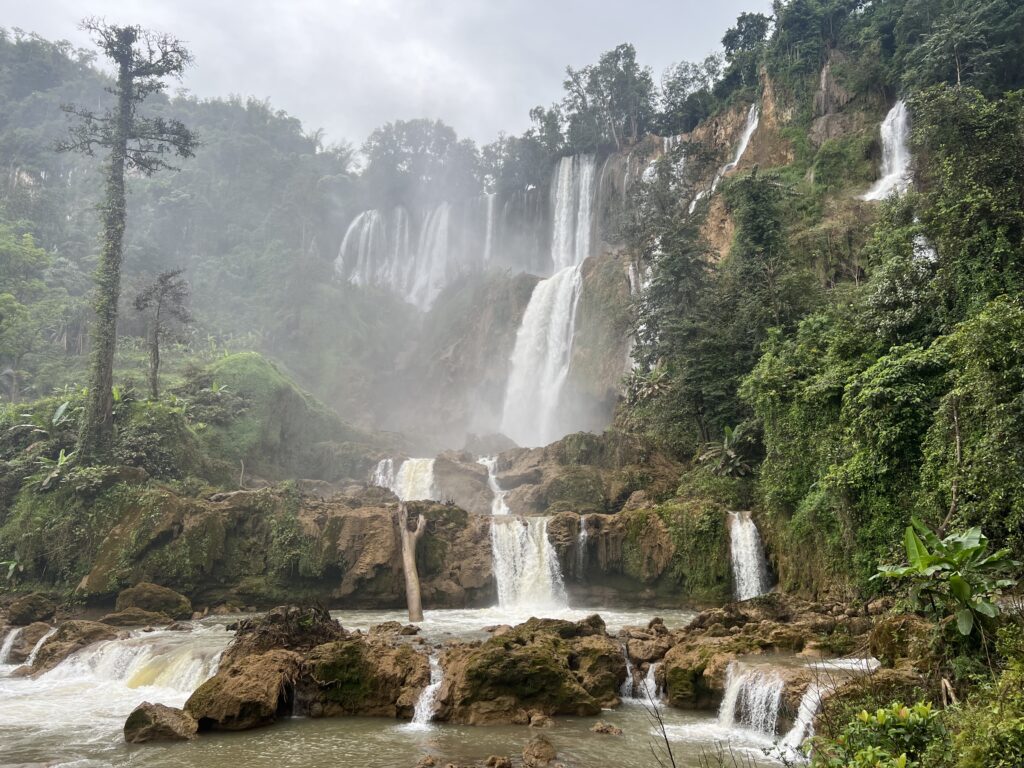
There is an optical illusion at play at Thi Lor Su that makes it look as though the water pours over the mountain’s highest point. This is because the immense, semi-circular limestone cliff face bows out towards the viewer. Klotho Creek is not Thailand’s biggest river by any stretch, but when it spills over the rim, it transforms into a shimmering liquid curtain spanning more than 400 meters. The creek splits into dozens of separate streams that join and break again as they crash to the valley below. The whole mountainside is alive with running water.
From the well-fenced viewing platform, the kids took in the sight and sound of Thailand’s largest waterfall. I know it’s hard for them to disassociate any waterfall from the hike that must necessarily precede it. But then, Isobel picked her way across mist-slick flagstones, stood next to me, and said quietly “dad, that’s… really cool.”
Overnight: Camping at the Thi Lo Su Campground
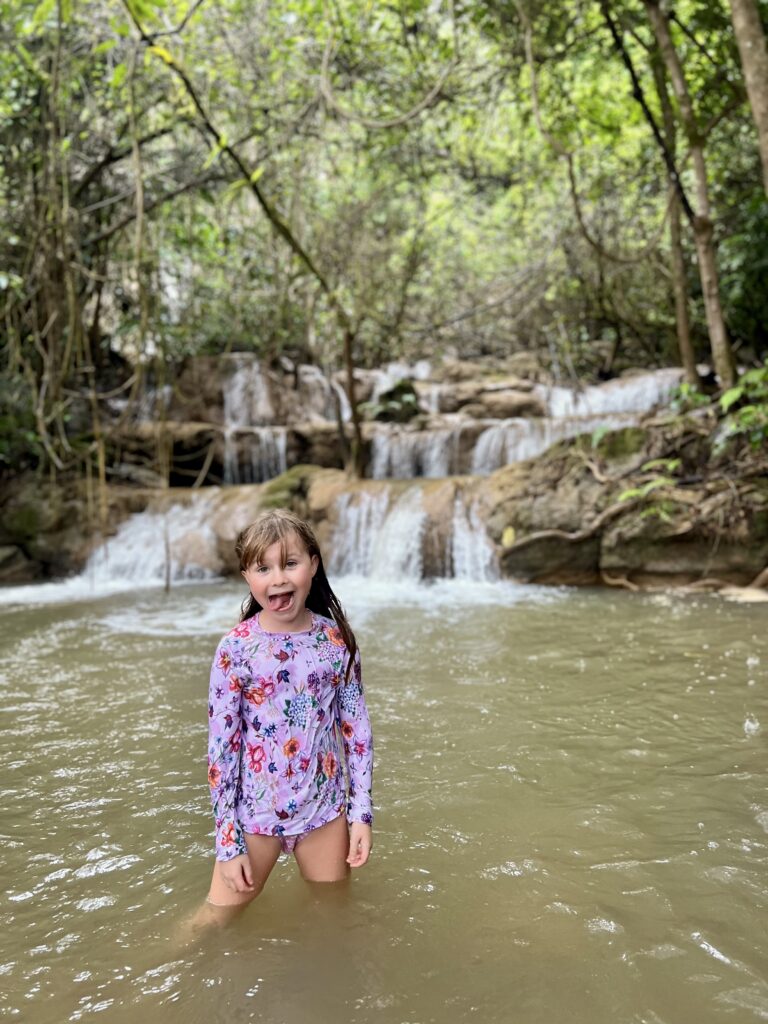
While Thi Lor Su is far too wild to allow swimming, some of the subsidiary falls support a quick dip. The water is murkier during the rainy season, and more likely to be filled with debris washed along from larger storms. Isobel risked a swim the cold, terraced pools above the viewing platform and had no complaints.
As we walked back to the campground post swim, we tried to spot wildlife in the surrounding forest. Kat tried to hide her disappointment when our guide said there were no hornbills in Umphang. “But we have many ‘Racket-tailed Drongos,’ he quickly offered by way of apology.
These birds have two exceptionally long tail feathers ending in distinctive paddle-shaped plumes. They are perfect for spotting with the kids, because the flock seems to fly single-file in two-second intervals. I spot the first one and shout “look!” right as it disappears. If I’m persistent and Charlie is willing, we might all catch the sixth and final bird just before it too vanishes.
One advantage of camping at Thi Lo Su during the rainy season is that no one in their right mind will join you. From late afternoon on, these magnificent falls are all yours. The downside is that frequent showers mean it will be far too wet to sleep in the open. Forget sleeping under the stars; anticipating overnight rain, our guides instead pitched our tents directly onto the cold, hard concrete floor of a picnic pavilion.
Honestly, I probably would have risked a night under the stars but was glad I wasn’t calling the shots when a the skies opened up just after midnight and didn’t stop until dawn. My joints took a beating from the hard floor, but the sound of the rain pounding on the pavilion roof made me grateful that we were at least dry.
Pro Tip
“Can” Doesn’t Mean Comfort: Just because a tour operator says a trip runs during the rainy season doesn’t mean you should book it without knowing what you’re getting into. We’ve known for 2,200 years that you can take elephants across the alps in winter – but that doesn’t make it a pleasant way to spend the holidays. Shoulder season in Thailand means you might get a lot of rain.
Trekking to the Kota Karen Village
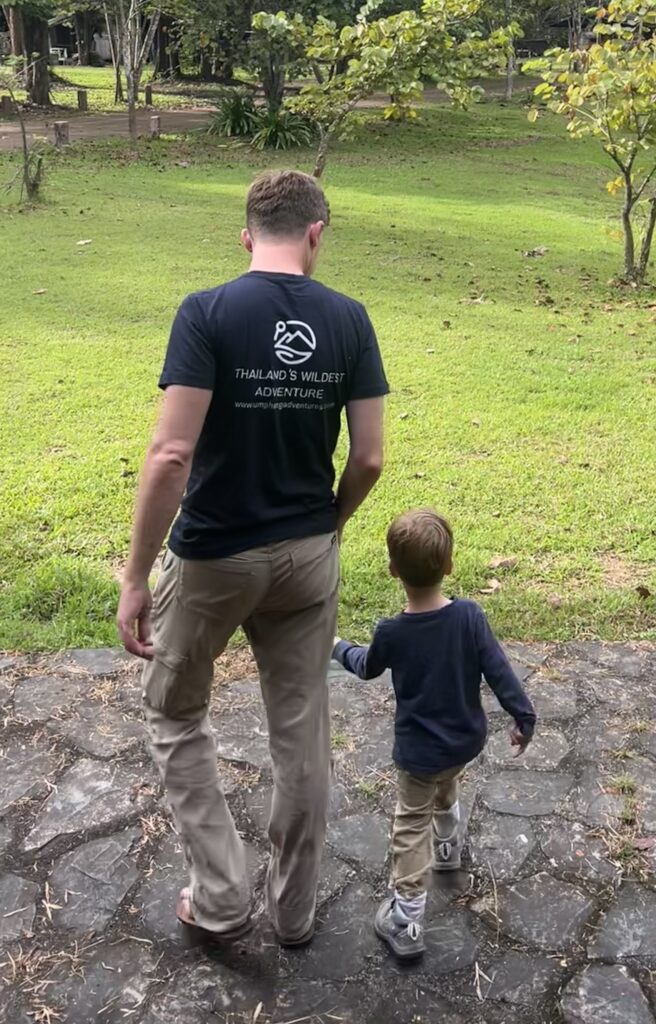
After the storm, we knew we faced some wet walking. Only when the sun drove away the morning mist did we realize just how much mud we’d be wading through. Clumping through the forest was out of the question, so we were grateful for our choice of the wider logging track over the more scenic jungle trail. Though still slippery, it at least offered us rough footing. October hikes in Thailand’s more remote corners can be challenging: the monsoon leaves the forest to reclaim many paths, and the first unfortunate trekkers must cut their way anew.
Thailand’s red clay laterite soil holds water like a concrete swimming pool and, at some points, we had no choice but to walk through it. The sucking mud claimed a few shoes, especially from Henry, but we managed to fish them out. Progress was slow and the kids were managing but not enjoying themselves.
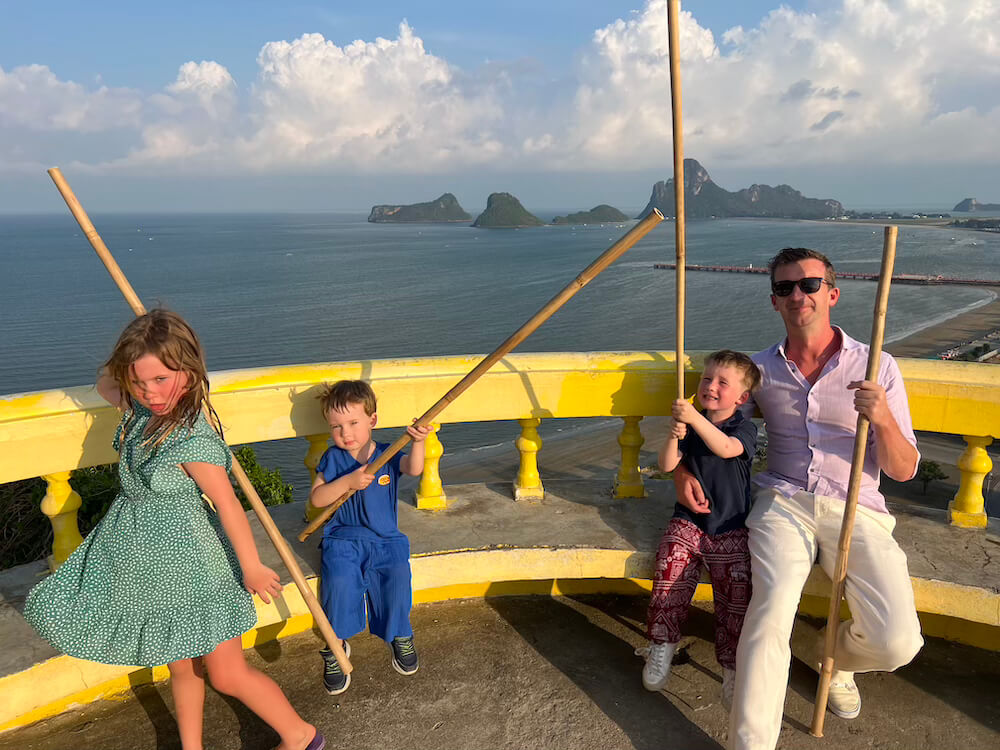
Our guide had seen this all before. He cut a long bamboo stalk a bit thicker than his thumb and worked it with his knife as we walked. He had soon fashioned it into a sort of pump-action tissue-paper-wad air gun. Simply load a wet wad of tissue into the barrel, tamp it down with the ramrod. One sharp push and the tissue explodes out the front with a bang. The kids were enjoying themselves again.
Giant Centipede Attacks
Even the novelty of weaponized toilet paper had worn off by the time we straggled into Kota village after five hard hours of trekking. We must have made good time because we were a bit early. Our accommodations (the village school) weren’t available yet because the previous guests (the students) were still using them for their intended purpose (learning).
As the kids shyly resisted the urge to join in the playground activities, we heard a commotion among the students on the grass pitch. A small girl darted past us into the cooking area, then ran back out wielding a chef’s knife as long as her arm. We still had no idea what was happening, but in New York, the introduction of a large blade was the kind of escalation that called for adult intervention.
I arrived to find a circle group of small children beating to death a 25-centimeter giant centipede that had just bitten a little girl. These stings are famously painful; you can easily find videos of lunatics instigating bites for clicks. This child was making far less fuss than any of those men, but you could tell she was in serious pain. We gave her a cheer as she climbed onto a moto with her teacher and drove off to the village clinic.
The Surprise Splendor of Kota Waterfall (Namtok Ko Tha)
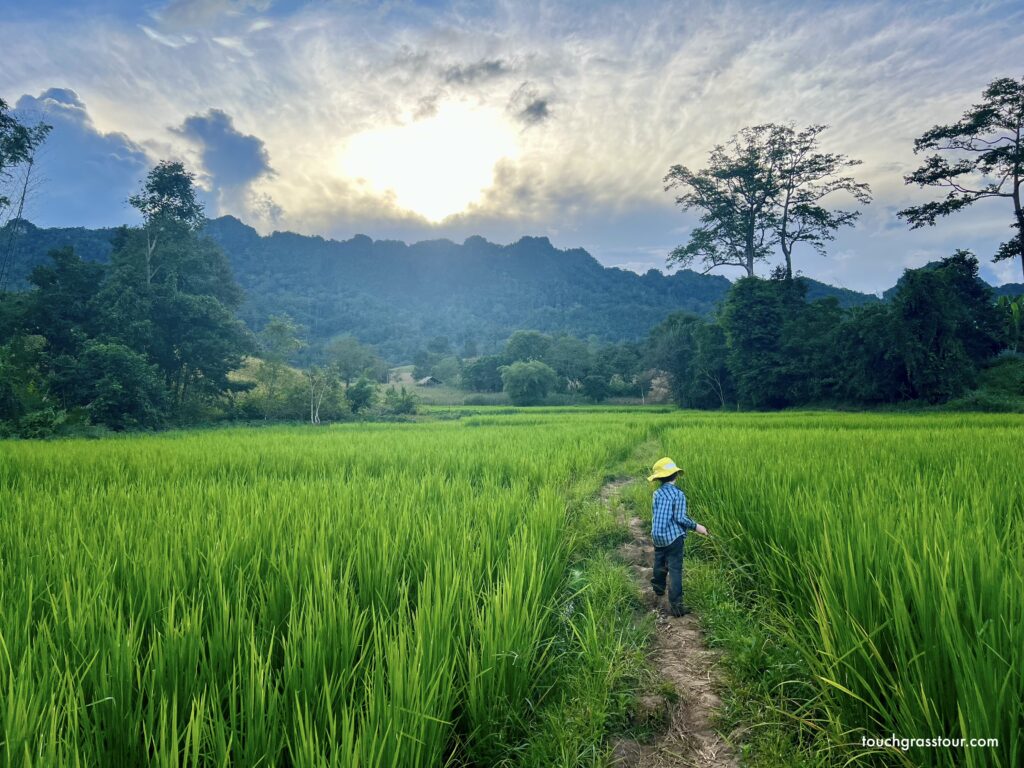
Reenergized as kids sometimes are by the trauma of their peers, the kids agreed to walk the two kilometers down to Kota Waterfall (also rendered as Namtok Ko Tha) after lunch. After the morning slog over a mud-soaked logging road, this was truly a splendid stroll through rice and corn fields and along gurgling streams which kept to their paths instead of ours.
There is no color more beautiful than new rice, which almost fluoresces in late afternoon light. The earlier rain had given way to an electric blue sky, even more vivid against the lushness of the post-monsoon valley and the new thunderheads forming on the horizon.
Nothing in this bucolic setting prepared us for anything as dramatic as Kota. If Thi Lor Su wows with its sheer vertical drop, Kota’s drama is in the way its 50-meter-wide curtain of water occupies the full width of the river basin. The falls’ roar reverberates through stands of trees clinging to the riverbank. The gnarled roots cause us many stumbles but are clearly necessary to survive the periodic floods which must tear through the valley.
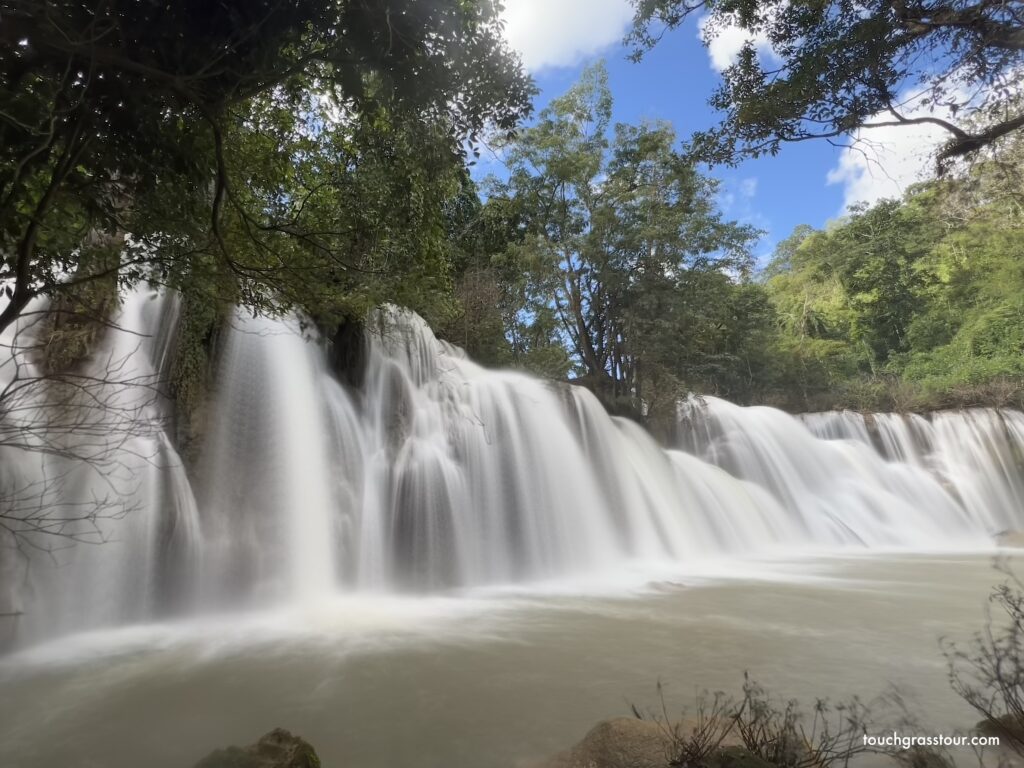
We came prepared to swim, but with the murky water and the swift current, didn’t venture beyond some of the more protected shallows near the riverbank.
Evening in the Kota Village Schoolhouse Community
The night before we returned to Umphang, we sat outside the classroom where we would spend the night and watched every child from 2 to 20 gather inside the school’s central yard. We saw soccer, volleyball, and the highly athletic game of Sepak Takraw, where players perform flips and bicycle kicks to smash the ball over over the net. At least seventy kids, a dozen activities, not a single phone, no crying.
I rebel against pat conclusions like “oooh, with their simple life, these villagers have really held on to some deeper meaning that we’ve all lost.” It’s reductive, based on very little real information, and reflects more about the observer than the observed. Sometimes, though, you just need to believe your eyes. These guys look happy. This feels good.
The Long Way Home: Return Trek via the Mae La Moong River
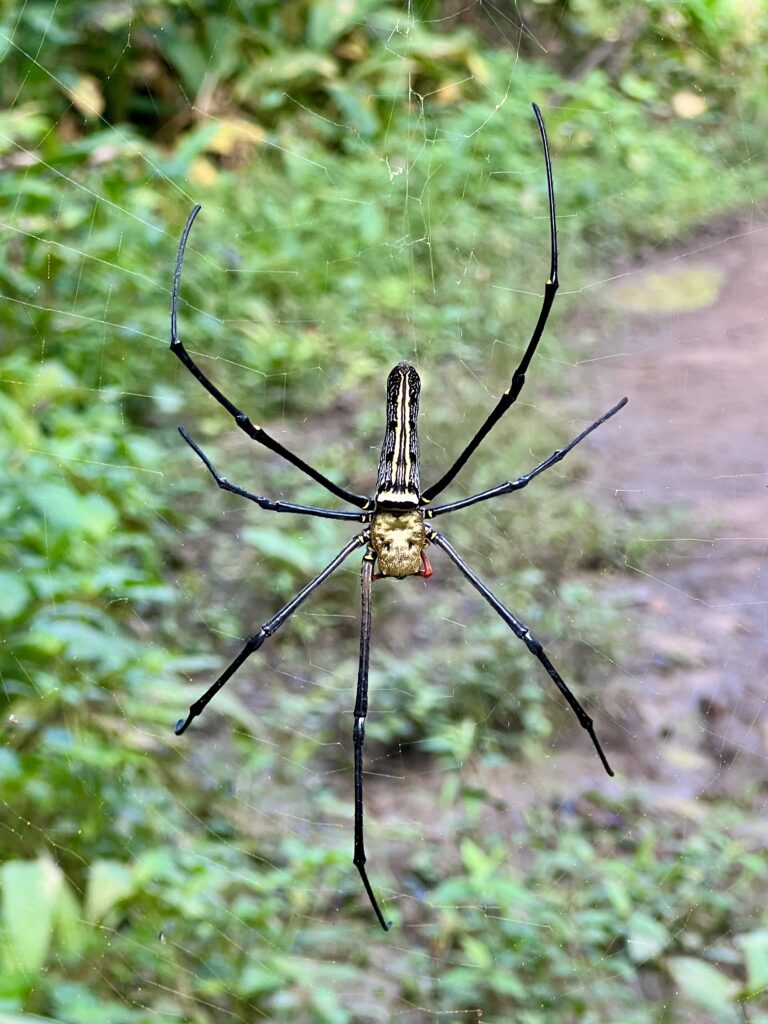
We left early the next morning before the mists had cleared, walking the same route towards Kota Falls. Thousands of individual spider webs that were invisible in the bright sun now held the dew and looked like sheets of tissue draped across whole fields.
Charlie had clearly decided he was done walking and within a kilometer was riding on my shoulders. He wouldn’t come down for the next four hours, except where the bush was so dense he had no choice. We walked perhaps a dozen kilometers, mostly along the Mae La Moong River, before crossing a suspension bridge over the Mae Klong to find our 4WD waiting for us, still running despite everything.
Over four days we had rafted, swam, hiked, and climbed our way through some of Thailand’s most remote terrain to see some of its most stunning sites. The family was exhausted, which promised a quiet drive back to Mae Sot. Just an easy 1,291 curves to go before a shower and a soft bed.
Plan Your Trip to Umphang
Some links below are affiliate links. At no extra cost to you, we earn a small commission if you make a booking, which helps us keep our family on the road. Thank you for your support!
Getting There
Umphang is remote. The drive from Mae Sot is notoriously difficult, enough so that it merited its own post. Drive only if you are confident with mountain roads.
Public minibuses and songthaew run from Mae Sot, but pre-arranging a dedicated driver or minivan is safer and more comfortable, especially with children.
If you’re not driving, consider booking a transfer service in advance to be sure you can make the trip.
Where to Stay
Umphang town is the base for all activities. It has a sleepy, frontier vibe with growing guesthouse and cafe scene. It’s best for pre- and post-adventure nights.
When to Go
The Cool Season (November – February) is ideal for dry roads and clear views. The Rainy Season (June – October)offers the most dramatic waterfalls, but expect mud, challenging trekking, and possible road closures.
Rafting is done in the morning (start by 8:00 AM) to ensure you pass Thi Lor Cho between 9:00 AM – 10:00 AM to guarantee the refracted rainbow effect.
Pro Tip “Can” Doesn’t Mean Comfort: Rainy season trips are possible but involve significant mud and wet camping. Prepare accordingly!
Booking/Tours
Due to the remote location and the need for 4WD transport/river rafts, booking a package is not only highly recommended, it is for all practical purposes mandatory. Packages cover rafting, trekking, park fees, and camping gear.
Tours can be booked upon arrival in town or, to ensure availability you can start here.