They could smell blood before Kat had even taken her seat at the collapsible card table. The women gathered around, producing tiny plastic bags filled with glinting rubies, spinels, emeralds, and sapphires, sliding a few choice stones across the table for Kat to inspect. They waited for her to name a price.
For dealers at Chanthaburi’s International Gem Market who trade in precious stones by the pound, a few extra hundred baht from a poor, misguided tourist doesn’t matter much. But it does make for a little sport. And even knowing we would almost certainly lose those few hundred baht, it was a game we were happy to play.
Scenes just like this have been playing out in Chanthaburi for hundreds of years. Nestled along the coast between Central Thailand and Cambodia, the provinces of Chanthaburi and Trat sit at a crossroads of ethnic, cultural, and geographical currents that make this one of the most interesting parts of the country.
It’s not on the usual tourist circuit by any means, but whether as a long weekend from Bangkok or a stop en route to the Koh Chang archipelago, it’s rich in experience, even if some of those experiences (like haggling for gems), leave you less rich in financial terms.
Chasing Treasure in Chanthaburi Town
Chanthaburi’s Gem Markets and Si Chan Road
We arrived in Chanthaburi late Sunday afternoon. As soon as we could find a place to park in the narrow streets around Chernchan Hostel, we dashed off to the Gem Market on Si Chan Road.
The market is technically open all weekend, but is most active on Saturdays. Dealers come in from Bangkok, conduct their business, and have mostly left by Sunday. There are usually at least a few traders still active even after Sunday lunch, and it was to them we went.
How does an amateur even begin to guess the value of a raw gem? You simply can’t, and you probably shouldn’t try. We had in mind a very specific stone to replace one that had fallen out of a locket. It was a tiny stone, but the initial prices the dealers showed us on their calculators were anything but. We were beyond help now.
Foreigners are hardly rare at the gem markets, indeed, buyers and sellers from around the world descend on the market every weekend to transact in commercial quantities of stones. I realized just how little we mattered when, as the bargaining continued, I saw at the table nearby an open duffel bag filled with red bricks of 100 RMB notes.
If you’re wise enough to be scared off buying raw stones, but still foolish enough to want jewelry, Si Chan Road is studded with shops of every description. These too begin to close early on a Sunday evening, but even on a quiet afternoon, we found more than we could visit.
In the end, we got our stone (and a few others besides), and if we were taken for a ride, it was at least a scenic one.
The Chanthaboon Waterfront Community
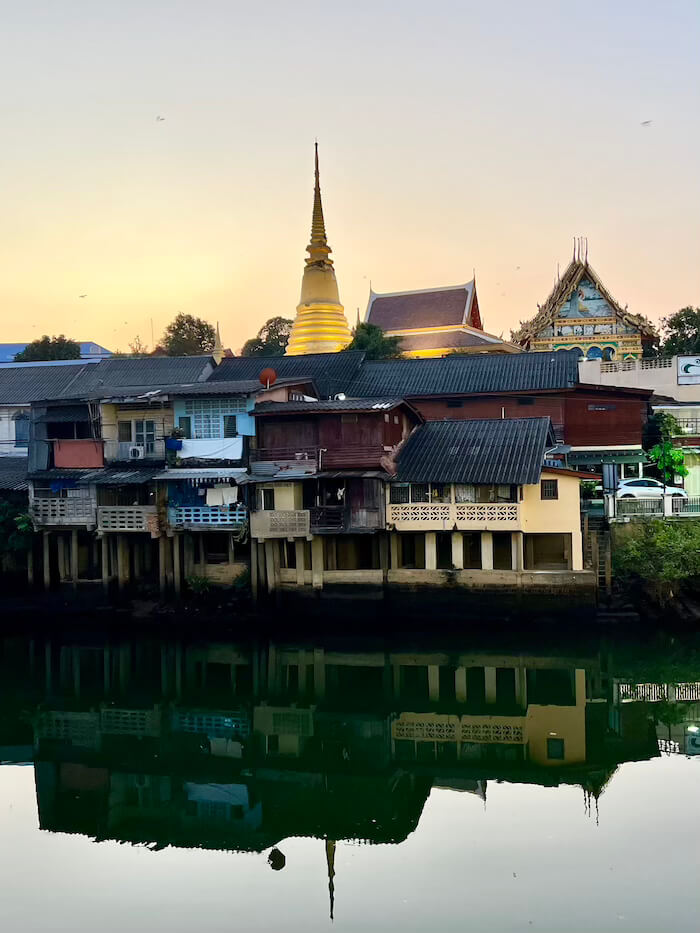
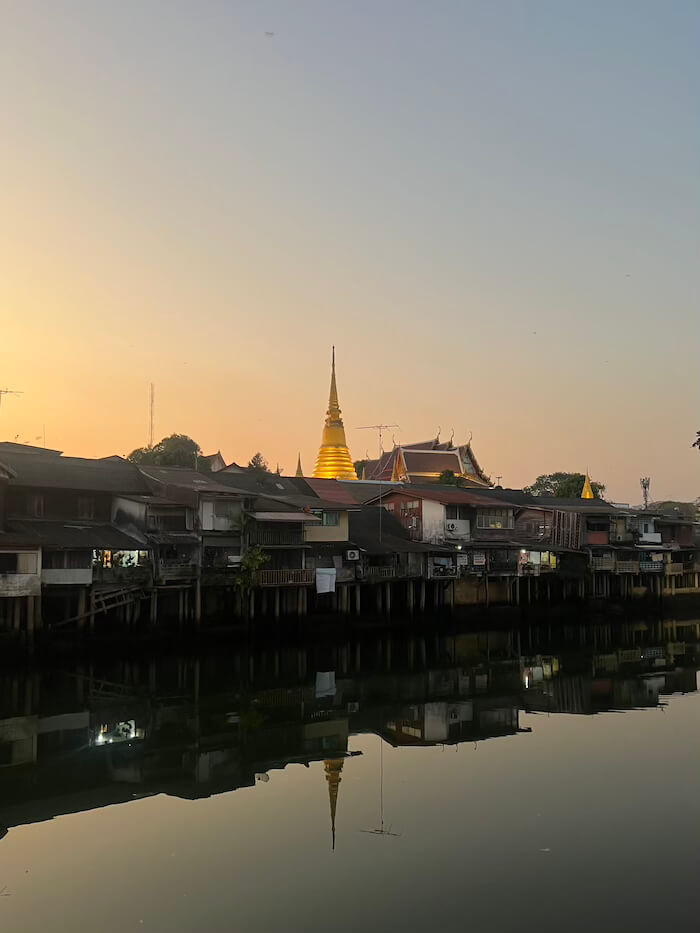
Once finished shopping for gems, a more relaxed stroll along Sukhaphiban Road, which backs the Chanthaboon Waterfront Community, felt well earned. The side of the street closest to the river is lined with the wooden storefronts of a merchant community that has thrived here for 300 years.
Like Lampang, this riverside neighborhood is developing a new identity as a destination for travelers in the know. Two riverside mansions have been converted into boutique hotels which, unfortunately for us, don’t accept children.
Banning young children from spending the night in buildings made of creaking wood that amplifies every footstep is understandable. Fortunately, there were other attractions in the area, like dessert from Chanthaboon Rimnam Madeleines.
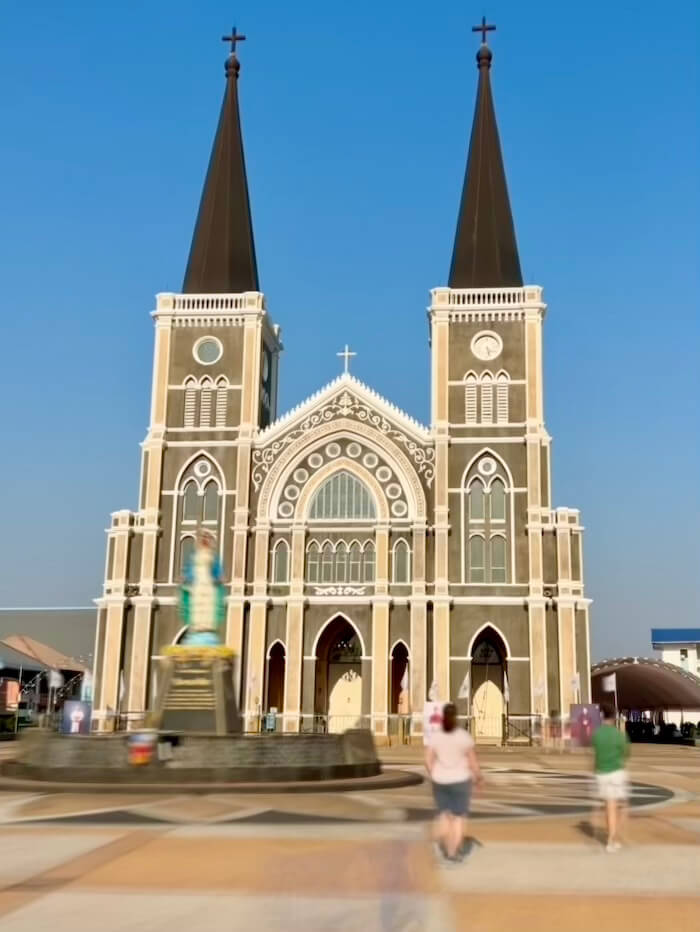
We ate these as we crossed the bridge to the Immaculate Conception Cathedral: Thailand’s largest Catholic church. The Gothic Revival church houses the Diocese of Chanthaburi and is evidence of century-old Franco-Vietnamese influence. A special treat is the blue sapphire-studded sculpture of Mary, though an ongoing mass prevented a proper visit.
We instead finished the walk at the Amulet Market on Pracha Niyom Road. Again, it was quiet on a late Sunday afternoon. We walked through passages of glass-fronted wooden cases filled with every conceivable style of Buddhist talisman. As with the jewels, I could appreciate the beauty, but had no real sense of what I was looking at.
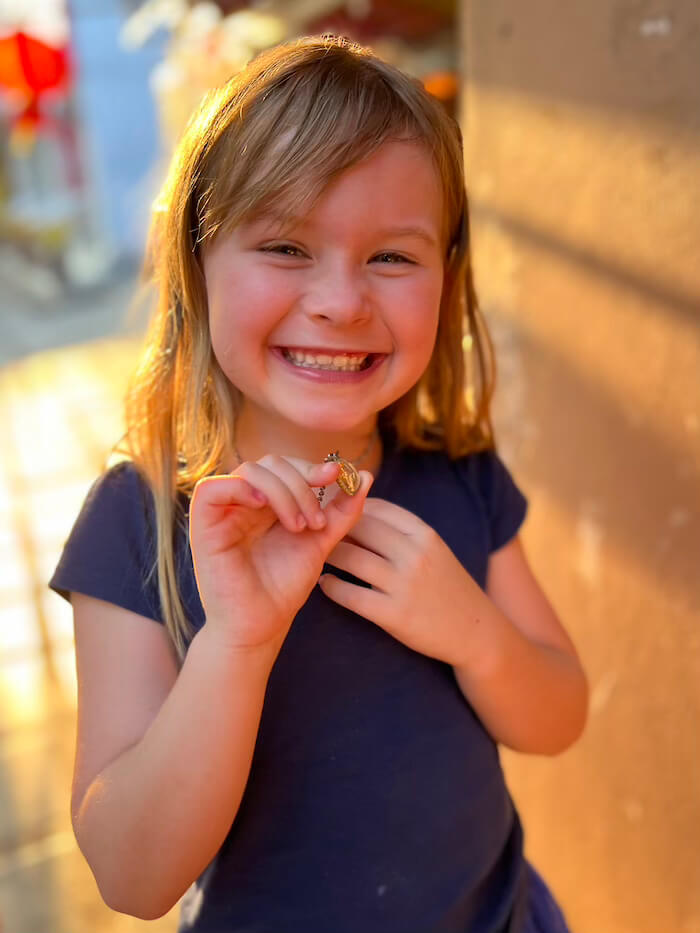
A kind shopkeeper gifted an amber-colored amulet with a depiction of the Buddha to Isobel. I think she enjoyed receiving it more than we did any of our rubies or emeralds. It was also an apt prelude to the following day’s activities, when we would begin to explore beyond Chanthaburi Town in search of a footprint of the Buddha.
Wat Khao Khitchakut and the Buddha’s Footprint
Our adventures outside the city began with a 45-minute drive to Wat Phluang. During the peak months of February and March, tens of thousands of visitors ascend Khao Phra Bat daily to visit the Buddha’s footprint, and a highly organized system has developed to move the masses up the mountain.
Songthaew Transfer from Wat Phluang to Khao Phra Bat Trailhead
Upon arrival, we transferred into a songthaew for the drive up the steep, winding dirt road. “Steep” is the operative word here – it’s an eight-kilometer trip straight up the mountain. Find a good handhold—otherwise, you and your fellow passengers will end up in a heap at the back of the truck.
It’s an adventurous ride, even more so than the trip up Wat Chaloem Phra Kiat, and there have been a few tragic incidents over the years. Hundreds of thousands of people make the journey annually, however, and we put our faith in the odds. It was a wild ride, but still within our margin of comfort.
The Walk to Khao Phra Bat
The “trailhead” begins directly from the songthaew drop-off point, though calling it a trail is a bit misleading. The path is largely paved, with broad staircases covering some of the steeper sections.
It has to be. Climbing the mountain during the two months around the Buddhist holiday of Magha Puja is believed to bring great merit, and making the ascent multiple years in a row is said to strengthen one’s karma. This promise draws tens of thousands of pilgrims, and the mountain remains open all night to accommodate them.
Families often make the journey together. Grandparents help their grandchildren—or just as often, grandchildren help their grandparents—as they climb the stone steps up the mountain.
The importance of the pilgrimage is underscored by the occasional sight of those unable to walk being carried in palanquins: simple chairs suspended from long bamboo poles and carried by a team of four sweating men who, I hope, are earning enormous amounts of merit.
To serve the constant flow of visitors, a micro-economy has sprung up along the route. The path is lined with stalls selling coffee, tea, and snacks. It is an incredibly lively scene, and a constant reminder that this is very much an active place of devotion, not merely a tourist attraction.
It’s an easy and pleasant walk, and in less than thirty minutes, the massive granite boulder sheltering the Buddha’s footprint comes into view.
Khao Phra Bat: The Buddha’s Footprint
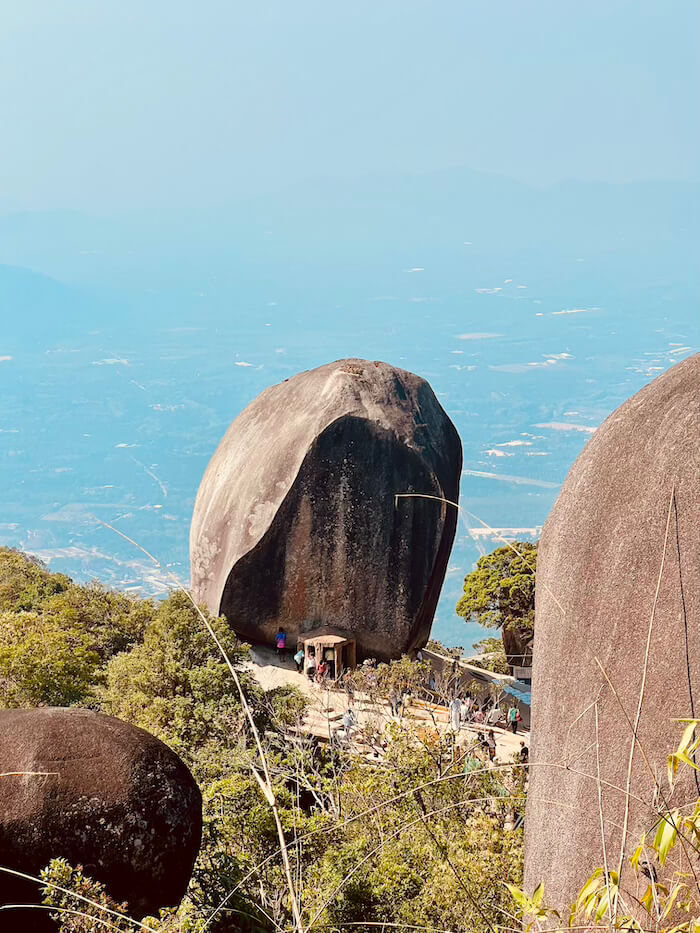
The destination lies beneath the shade of a black granite boulder so colossal, it has its own name: Hin Luk Phra Bat. Perched at the edge of a cliff, it is a striking formation even without the religious significance.
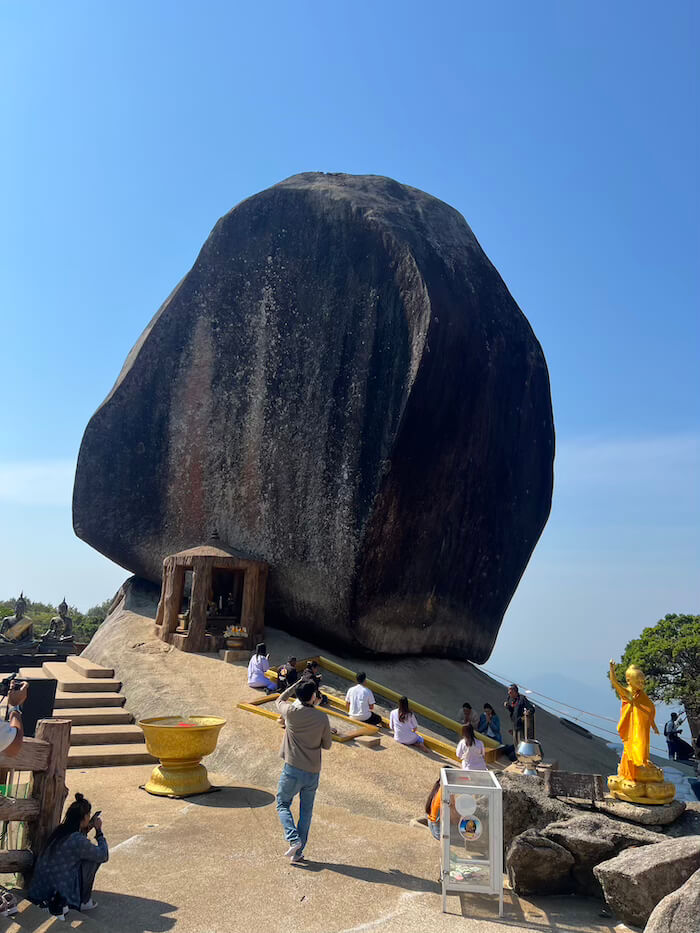
Beneath the boulder, protected by a low railing, is an imprint believed to be the footprint of the Buddha. In small groups, a monk guides pilgrims through the proper offerings and prayers.
We lingered for a time, observing the rituals, listening to the rhythmic chanting of the monk, and taking in the views over Chanthaburi from the mountaintop. It’s one of the more remarkable walks in the country.
Making Wishes at Pha Pa Daeng
Most visitors continue beyond the footprint to where the path climbs higher, offering a view over the shrines. Follow the path farther along a forested ridge and, after a few kilometers, you’ll reach a forest where nearly every branch and trunk is wrapped in red ribbons.
This is Pa Daeng, and it hints at animist beliefs that run even deeper than the formal Buddhism practiced at Khao Phra Bat.
According to local custom, you can write a wish (and only one) on a strip of red cloth and tie it around any branch you like.
Only Isobel could write at the time, and she took great pleasure in committing her wish to ribbon and tying it to a low branch. Still illiterate, Henry was content to help by wrapping red cloth around the base of the closest tree.
Will our wishes be granted? If you’re reading this, you can take it as settled that at least some already have been.
Namtok Phlio National Park
In the opposite direction from Chanthaburi lies Namtok Phlio National Park, home to a lovely waterfall that does what so few others in Thailand can: flow strongly even in the dry season.
Namtok Phlio is twenty minutes south of the city, only a short detour off Highway 3. Like many Thai national parks, it centers on a single main attraction, but this charming waterfall, set in a narrow canyon, is well worth the stop.
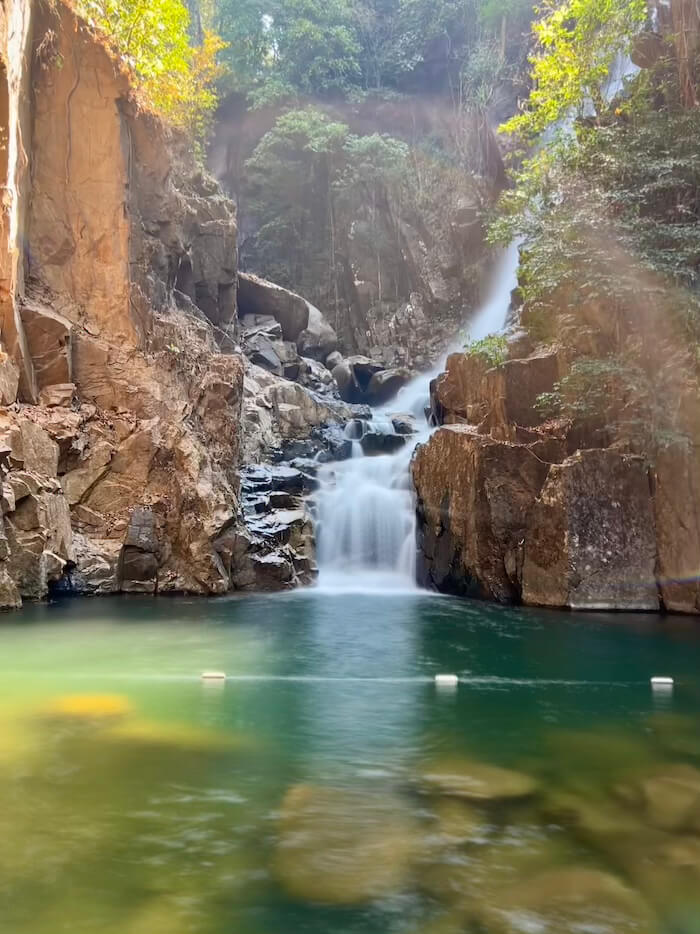
A short path leads to a shaded pool enclosed by steep cliff walls. Large fish seem almost to glide through thin air, so clear is the water. Across the narrow gorge, an energetic waterfall tumbles down a steep ravine into the pool below.
The kids had grown used to swimming in places like this and seemed a little put out that, at least when we visited, they couldn’t climb into the water. Instead, they sat at its edge, watching Soro Brook Carp swim beneath their feet.
To burn off some of that restless energy, we took them on a short hike that climbs above and around the falls before ending at a moss-covered stupa and a small pyramid.
These were built by King Rama V in memory of his wife, Queen Sunandha Kumariratana, and together they tell a tragic story. The stupa came first, built in 1876 to commemorate the couple’s visit. Several years later, Queen Sunandha and her young daughter drowned when their barge capsized on the Chao Phraya River. The king, devastated, chose this place they had both loved to build the pyramid that now houses some of her ashes.
After learning the story, a prohibition on swimming was much easier to accept.
Eastern Thai Food: Among Thailand’s Best
A quick note about the wonderful food that awaits visitors throughout the province. Chanthaburi’s cuisine blends Thai, Chinese, and Vietnamese influences, creating bold dishes that balance spicy, sour, and herbal flavors with coastal seafood freshness.
After my first day at work in Bangkok, my new Thai colleagues took me to dinner at Sri Trat, a restaurant specializing in cuisine from the eastern Gulf provinces. Among other regional dishes, we had moo chamuang, a stewed pork dish seasoned with slightly sour chamuang leaves, and I’ve been a believer ever since.
Eastern Thai is one of the best regional cuisines in the country. Moo chamuang easily makes my top five dishes to eat in Thailand.
So, I was quite excited to try some of these same dishes in their native setting. Chanthorn Restaurant, in Chanthaburi Town, is our top pick. It’s friendly and accessible, and unlike Sri Trat, you won’t need a reservation.
The kaeng moo chamuang is, as noted, a must-order: dark, rich, and balanced with a sweetness and acidity that will change how you think about both. Another classic is khao khluk prik kluea: rice stir-fried with chili, garlic, and salt, served with fried seafood of your choice.
Touch Grass Table for Five at Chanthorn Pochana
For an introduction so Eastern Thai food, here’s what we’d recommend ordering to feed a hungry family of five.
| English Name | Thai Name | Price |
|---|---|---|
| Pork Belly Stew with Chamuang Leaves | แกงหมูชะมวง (Gaeng Moo Chamuang) | THB 220 |
| Seafood Stir-Fried Rice with Chili & Salt | ข้าวคลุกพริกเกลือ (Khao Khluk Prik Kluea) | THB 185 |
| Deep-Fried Sea Bass with Fish Sauce | ปลากะพงทอดน้ำปลา (Pla Kapong Thod Nam Pla) | THB 450 |
| Stir-Fried Chanthaburi Noodles with Crab | เส้นจันท์ผัดปู (Sen Chan Phad Poo) | THB 150 |
| Green Peppercorn & Herb Salad with Pork | ยำหน่อกระวาน (Yam Nor Grawan) | THB 299 |
| For Dessert: Salak in Syrup | สละลอยแก้ว (Salak Loy Gaew) | THB 60 |
| TOTAL (without drinks) | THB 1225 |
Even by our standards, this is a bit much meat. For balance, you could swap one of the dishes (anything but the moo chamuang) for stir-fried morning glory (ผัดผักบุ้งไฟแดง Phad Phak Boong Fai Daeng) or cabbage with fish sauce (กะหล่ำปลีทอดน้ำปลา Galam Plee Thod Nam Pla).
If you’d like to see more of what Eastern Thailand offers, check out our overview of Isan and Thailand’s East. By reading this far, you’re proving you’re ready to step off the beaten path.
Plan Your Trip to Chanthaburi
Some links below are affiliate links. At no extra cost to you, we earn a small commission if you make a booking, which helps us keep our family on the road. Thank you for your support!
Getting There
Chanthaburi is a 3.5 to 4-hour drive from Bangkok. While public buses and minivans run from Ekkamai and Mo Chit in Bangkok, a car is highly recommended if you plan to visit the national parks and Khao Khitchakut, which are located 30–45 minutes outside the city center.
Where to Stay
Accommodation on Koh Libong is simple but comfortable, with most options clustered along Lang Khao Beach on the island’s western coast.
Chernchan Hostel We stayed here for its proximity to the gem district. What a pleasant surprise! It’s quite stylish and puts you right in the middle of the narrow-street charm of the old town. The value to cost ratio is very much in your favor here. We loved our stay.
Baan Luang Rajamaitri is a beautiful heritage stay on the waterfront. Note that some of these historic wooden mansions (including this one) have “no children” policies due to noise and safety, so verify before booking if traveling with the family.
Where to Eat
Most visitors eat at their hotels, which generally serve reliable Thai and Western dishes.
Chanthorn Pochana This is an essential stop for anyone wanting to understand the regional flavors of Eastern Thailand. It is a local institution that manages to be both approachable and deeply authentic. Scroll back up to see our recommended family menu.
Chanthaboon Rimnam Madeleines Located right in the heart of the waterfront community, this is less of a sit-down meal and more of a mandatory snack stop.
These small, oven-fresh cakes are the perfect fuel for a walk across the river to the Cathedral. Watch them being made in the traditional brass molds before grabbing a bag to go.
When to Go
The Pilgrimage Season (Feb–Mar): This is the only time the trail to the Buddha’s Footprint is open. It can be crowded, but the energy is unmatched.
The Gem Market (Weekends): Trading peaks on Friday and Saturday. By Sunday afternoon, the street activity drops off significantly (but you’ll still find more jewels than you can afford).
The Fruit Season (May–July): Chanthaburi is the fruit bowl of Thailand; visit during these months for the best durian, mangosteen, and salak.
What It Costs
Khao Khitchakut: Expect to pay roughly 200 THB per person for the round-trip songthaew ride up the mountain, plus a small National Park entry fee (200 THB for adults / 100 THB for children).
Namtok Phlio: National Park entry is 200 THB for adults and 100 THB for children.
Gem Market: Looking is free; “playing the game” with a few rubies can cost as much or as little as your bargaining skills allow.
Booking/Tours
You don’t need a guide for Chanthaburi. The town is very walkable, and the mountain transport is a highly regulated (if chaotic) system that you can navigate independently. For the best experience at the Cathedral, check for mass times locally to ensure you can view the gem-studded Mary sculpture without interrupting a service.