Planning a trip to Vang Vieng, Laos? Discover blue lagoons, the Nam Xay viewpoint, travel tips, and what to expect—plus one unforgettable hike.
Vang Vieng doesn’t make a great first impression. The town feels a bit cobbled together: low-slung guesthouses and dilapidated storefronts with faded signs advertising the same tubing and lagoon excursions.
And yet, that rough-edged, backpacker-built sprawl is exactly what gives Vang Vieng its peculiar energy. It’s a place that stays on the tourist map because people keep showing up, looking for something to do, and then inventing it.
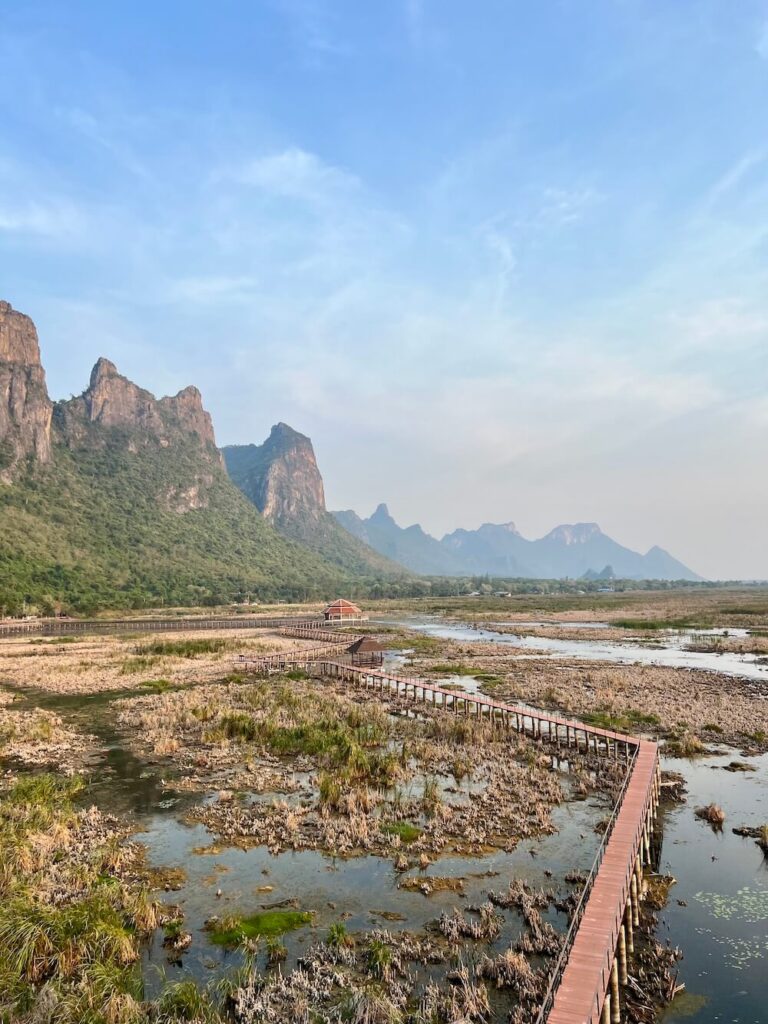
But it’s not the town that draws visitors; it’s the setting. Vang Vieng sits on a bend of the Nam Song River, surrounded by jungle-covered limestone peaks. Old-timers often describe Northern Laos as what Thailand was like thirty years ago. In the countryside around Vang Vieng, you believe them.
Arriving in Vang Vieng… by High-Speed Train?
One way in which Northern Laos is nothing like the Thailand of the last century is the high-speed rail line that runs from Vientiane, near the Thai border, to Boten on the border with China.
It feels like an improbable piece of modern infrastructure for a country at Laos’ level of development. The project has famously saddled the country with enormous debt, but as a tourist rather than a taxpayer, you can simply enjoy the greatly reduced travel time between northern stops like Luang Prabang and Vang Vieng.
The system for purchasing tickets is less modern. Tickets only become available a few days in advance and can sell out if you miss your window. We’d recommend using a service like 12go.asia. For a small mark-up, a local agent will purchase tickets on your behalf.
Tickets for the hour-long journey are only around $15, though the train stations are usually located well outside of town, so you’ll need to arrange ground transportation on both sides of the journey.
Bitten by a Dog in a Frontier Town
We clubbed together with some fellow passengers and hired a minivan to take us the three kilometers from the train station to town. As we picked our way through town, dropping passengers off at various hostels and guesthouses, it became clear that this is still very much a backpacker town. One of the more popular hostels would soon make international headlines after guests there were fatally poisoned by bootleg alcohol. Suffice it to say, Vang Vieng lacked the comforts of Luang Prabang.
The Riverside Boutique Hotel, right on the waterfront, was a clear exception. We try to travel modestly, but this is a town where booking the flashest hotel in town is just the right move. Having a full menu of G&Ts is always a credit to an institution, and we were looking forward to sampling it.
First, we went to organize the next day’s activities, including the rental of a couple of the little dune buggies that, for whatever reason, have become the preferred way to get around the area.
While we were working out the details, Henry’s soft heart led him to ignore warnings against petting street dogs and, sure enough, he got nipped.
I looked over his finger as he, more frightened than injured, cried softly in my arms. Laos is a high-risk environment for rabies, so when we found a small wound on his finger, we knew it would mean a shot.
The sun had already set as Henry and I made our way to Vang Vieng’s 24-hour emergency clinic. We arrived just as the on-call staff had settled into dinner. I tried to explain that while we needed a shot that night, we’d be happy to wait until after dinner.
I must have failed, because a nurse grumpily pushed aside her bowl of soup noodles and gestured for us to follow.
She took us to a spare room of tile and stainless steel. The only other occupant was a tiny elderly woman attached to an IV. She looked at Henry with completely expressionless eyes, which I think unnerved him a bit. It certainly did me.
A doctor soon arrived, and he must have had time to eat, because he was quite pleasant and patient with Henry, even when the needle came out and the crying started again. It was soon over, and in the calm that followed, we caught a shy smile from Henry’s fellow patient.
Climbing the Nam Xay Viewpoint
It hadn’t been a great first day, but the sun shone brightly over rice fields and wild jungle as we drove out to Nam Xay, a spire of sharp limestone karst that rose straight from the valley floor.
The path was certainly steep and the way uneven, but it was not unlike walks we’d taken in Northern Thailand. Charlie was still small enough that Kat carried him the whole way up, but the other two scampered from rock to rock, relying on guide ropes through especially steep and muddy sections. My sister and her daughters were with us, and I was pleased they got to see firsthand my tiny champs in action.
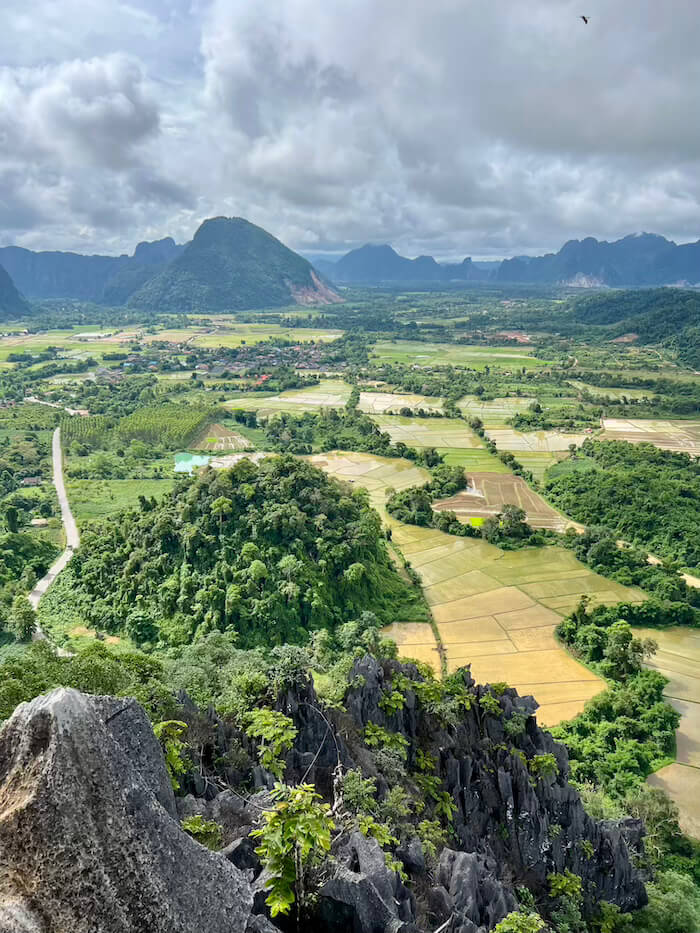
Thirty minutes later, we climbed onto the wooden platforms at the summit. For miles in every direction, the valley around Ban Napho stretched out beneath us, punctuated by limestone spires like the one we were perched on.
It was planting time in Vang Vieng, and many of the rice paddies were filled with water in preparation for planting. The flooded fields mirrored the morning sky, giving the illusion of even greater height.
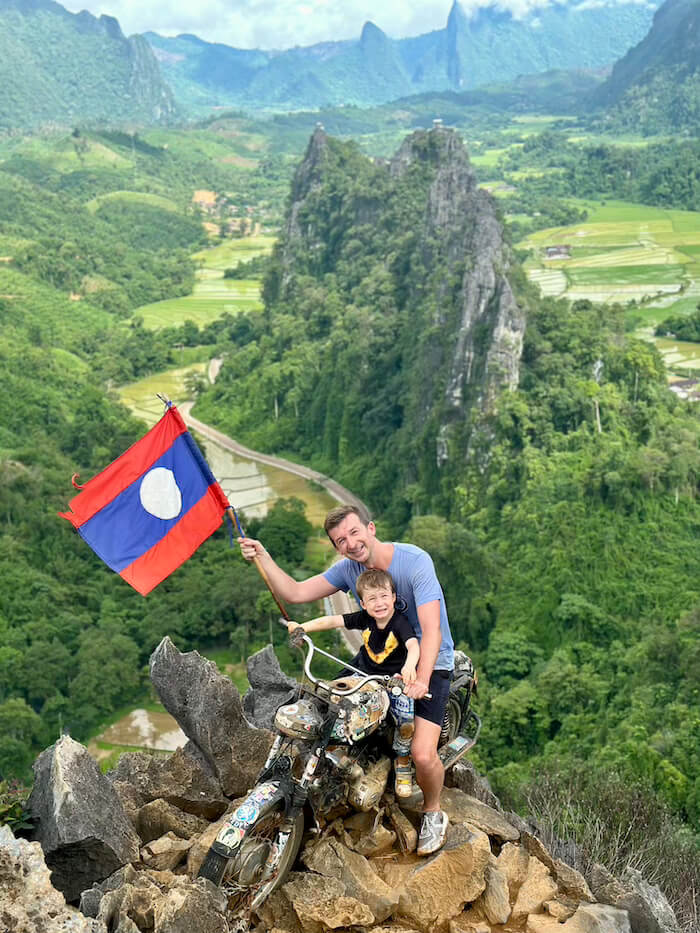
Some intrepid soul had, many years before, dragged a motorcycle up from the valley floor and bolted it to the edge of the cliff. I’m not really into staged photos, but one where it looks like I rode a vintage bike straight up a limestone cliff while holding my seven-year-old daughter in one hand and the Laotian flag in the other? Call makeup.
Dune Buggy to Blue Lagoon 4
After a quick lunch at Kiwi Kitchen, we climbed back into the racing buggy we had organized the fateful night before. Growing up, we knew these as “dune buggies,” overpowered machines completely unsuited to taking kids around. The buggies in Vang Vieng have much smaller engines—more golf cart than rally car.
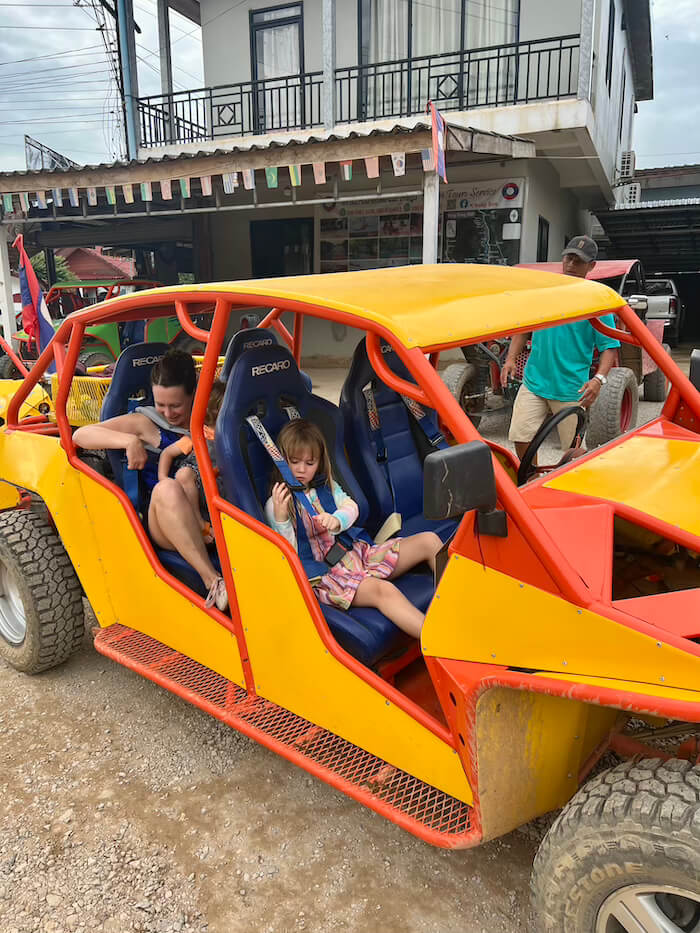
The kids fell for the illusion of speed, however, and thought the drive was magnificent. Stopping the buggy for a cow in the road was a lot more fun than doing it from the safety of the family car.
Our destination was one of Vang Vieng’s (at least) six “Blue Lagoons,” naturally occurring pools that have been popular with locals and backpackers alike for decades. Over the years, food stalls and other services have developed to cater to the crowds.
So, which of the lagoons to choose? They each have different characteristics, and you could make a day of driving your little buggy from one to the next. We chose Lagoon 4, which is further out but much quieter than the more popular options.
| Lagoon | Distance from Town | Vibe | Key Features |
| Lagoon 1 | ~20-25 mins (7km) | Crowded/Touristy | Large jumping tree, Phu Kham Cave, most facilities. |
| Lagoon 2 | ~35-40 mins (10km) | Spacious/Sunny | Multiple large pools, grassy lawn for sunbathing. |
| Lagoon 3 | ~45-60 mins (16km) | Adventurous | Zipline, bamboo rafts, balancing beams, limestone backdrop. |
| Lagoon 4 | ~30-40 mins North | Quiet/Hidden | Deeper turquoise water, zipline, very few tourists. |
When your means of transportation is a brightly colored buggy, thirty minutes of driving is time well spent if it means a less crowded place to swim.
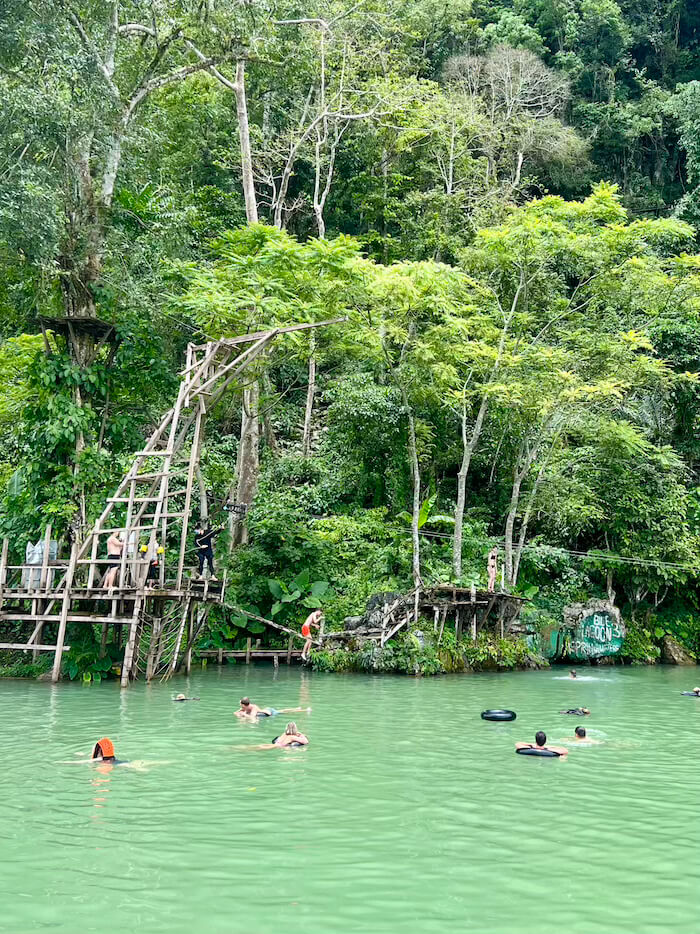
Lagoon 4 is a long, deep pool with dark, blue-green water. Like many limestone pools, the water is colorful but not clear—visibility is low. That hardly matters when the point is just to splash around for an hour or two. A large, wooden platform provides access to a zipline and rope swings. On a humid day, a few hours after a steep climb, it’s a lovely way to cool down.
“Less-crowded” is, as always, a relative term. I’m from the mountains of the western United States, and Kat is a New Zealander. We’re used to truly isolated places, which is not quite what this is. But, if you don’t mind sharing your blue lagoon with a few other swimmers (and why should you?), this is not at all a bad bet.
Sunset in the Rice Fields of Vieng Tara
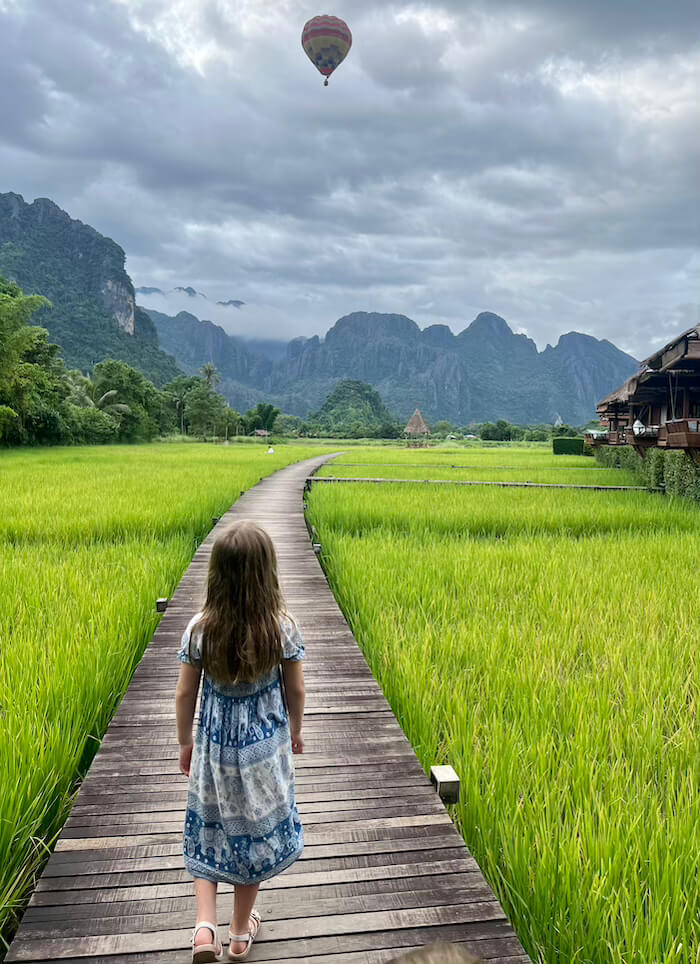
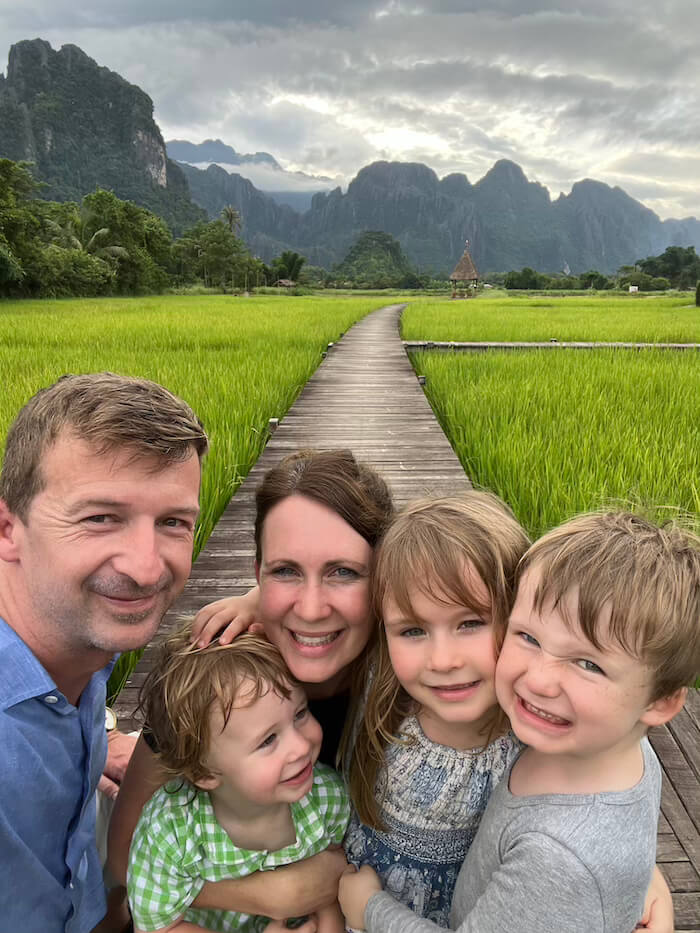
I’ve already claimed once that I’m not someone who likes to pose for pictures, but if there’s a place in Vang Vieng worth going just to take beautiful photos, it’s surely the rice fields of Vieng Tara.
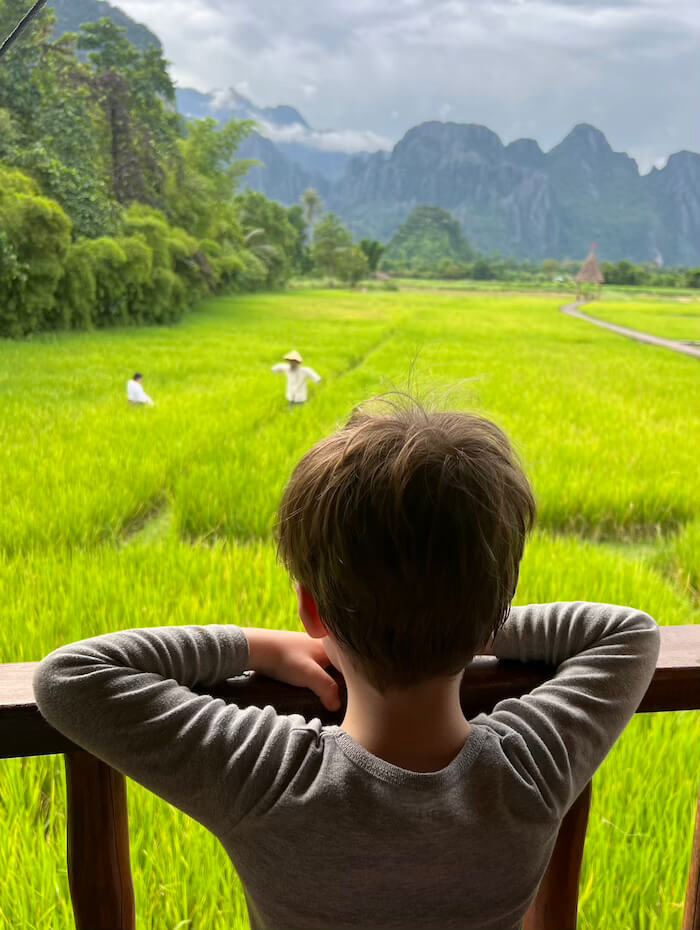
Located just on the edge of town, a few bungalows and a restaurant sit among the rice fields. We arrived early in the evening, well before anyone else was seriously considering dinner, and ordered sundowners: cocktails for us and fruit juices for the kids.
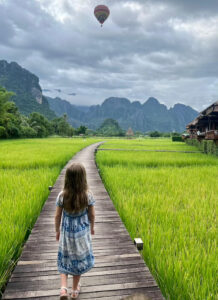
The light warmed and softened as the sun began to go down. Wooden boardwalks link the bungalows and restaurant, and, if the rice is at peak height and color, the play of light on the fields is simply magical.
By the time we turned for home, dark clouds had begun to gather overhead, but even they weren’t enough to upset the incredible scene. These storm clouds would have to wait another day before they could dampen our spirits. They wouldn’t wait long.
Paradise Lost at the Secret Eden
If something the family is doing is hard, dangerous, or uncomfortable, we might describe it as “almost as bad as the Laos hike.” So memorable was this ordeal that it has passed into family legend.
It wasn’t supposed to be that way. The trip was billed as a walk to a “Secret Eden,” entirely suitable for families. Under normal circumstances, that might even have been true. But the night before, a steady rain that began during happy hour was still falling at last call. By midnight, I was starting to worry.
The next morning, the famous karst cliffs of Vang Vieng were veiled in mist, the sun dim behind low clouds. It was, at least, no longer raining. I messaged the tour operators, who assured us the trip was still on and told us to be ready for a songthaew pick up soon.
Hiking Through Mud and Water
The hike began on flat ground that, after the night’s rain, was completely flooded. Twenty minutes in, we abandoned the muddy path. If we were going to get soaked anyway, the stream running alongside it at least had a sandy bottom.
I asked our guides again whether it made sense to go on. “Of course,” they said. “As soon as we start up the mountain, it will be a lot drier.”
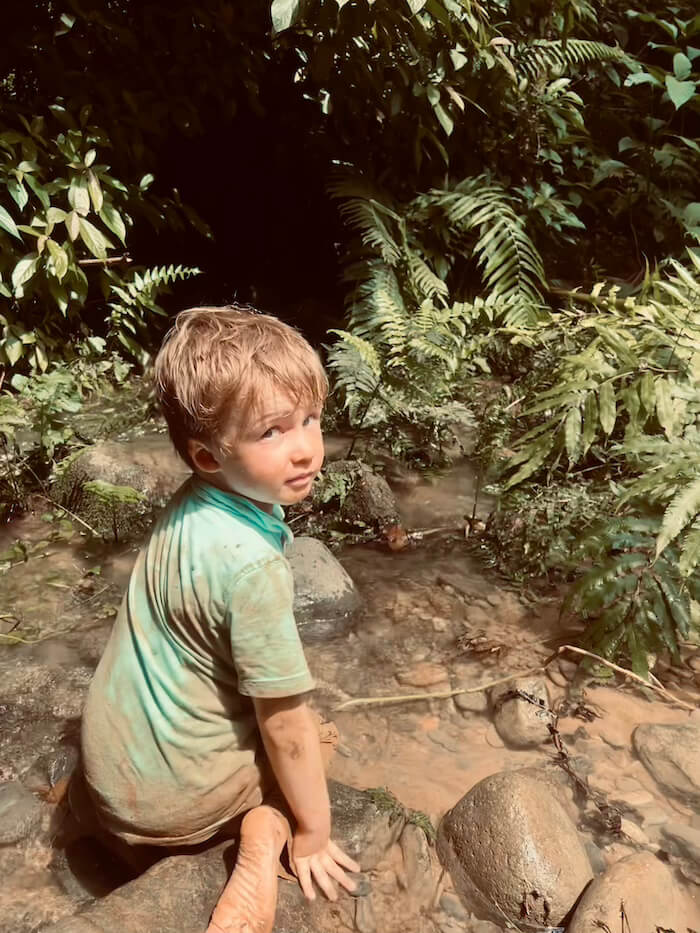
This was technically true, but “drier than knee-deep water” still left plenty of room for misery. On this steep cliffside, wetness turned into thick mud: when you weren’t slipping on it, you were sinking into it.
My sister and nieces were elsewhere, rock climbing in a different part of the valley. If I had really wanted them to see my kids’ toughness, this would have been the place, but they were struggling to slog up the steep cliff-face in these wet conditions. It was all the technical challenge of Nam Xay, but in far worse conditions.
The Valley of the Secret Eden
It was nearly two hours before we had climbed the ridge face and descended its far side. If there was ever a path to this obscure valley, the explosion of growth during the monsoon had long covered it in branches and vines. Our path, such as it was, soon joined a deep, fast flowing stream of clear water.
We reached a bend where the river broadened and split into several streams braiding through gravel and stone.

“This is the Secret Eden,” our guide declared. At that very moment, the sun broke through the clouds and the morning’s struggles vanished. Dozens of varieties of butterflies flitted in the dappled sunlight of the riverside. Anything we left on the ground was soon covered in butterflies, no doubt seeking the salt left behind from the sweat-soaked morning hike.
Isobel, soaked in mud from head to foot, had identified some article of clothing she wanted to clean. She stood, barefoot in the stream, washing and wringing it out in the current. This little task, undertaken with such a positive attitude despite its complete futility, charmed me to no end.
The Weather Turns Again: We’ve Made a Mistake
As lovely as this interlude was, it wasn’t to last. Black clouds began to form again, and this time with the energy of the afternoon monsoon. We still had to get out of the valley, but this time by a different route than the one by which we had arrived: up a steep ravine of sharp, dark limestone.
As the weather worsened, Kat decided it’d be better for me to take Charlie, as I’d be better able to protect him in a fall. He was unconvinced and wouldn’t stop calling for his mum. We had to tell him that too much complaining might attract hungry tigers, thus planting the seeds of a phobia that’s sure to grow into something interesting.
We had climbed back out of the valley and were descending the other side before the rain began to fall. It was not much more than a mist, but it was enough to complicate the climb down. This route was steeper than the one by which we’d entered the valley; we relied on bamboo ladders to navigate the steepest sections.
When our guide asked if we wanted to stop quickly at a cave just off the trail, we happily agreed, if for no better reason than to get out of the rain.
The cave was dry, but we weren’t the only creatures seeking shelter. Isobel was the first to shriek, but the panic soon became more general. Tiny red ants were crawling up our legs and biting any exposed flesh they found.
Escaping the cave meant descending another ladder in the rain. Carrying Charlie, I waited until the rest of the family had climbed down before following, all the while standing in a swarm of these tiny, aggressive ants. It couldn’t have been more than thirty seconds, but as the bites accumulated, it felt so much longer.
Back to the Flats, But Not Before Another Accident
The guides were clearly feeling a bit sheepish at how things were falling apart. We were moving quickly now, as we came closer to the valley floor and the terrain began to flatten out.
One well-meaning guide tried to carry Isobel on his shoulders, but slipped on a wet stone, badly wrenching his knee and dropping her onto the path below. She hit her head on a rock during the fall—not seriously, but it must have hurt.
Unusually for her at this age, she wouldn’t accept comfort, directing attention towards the guide who’d been carrying her. I felt equal parts pride and concern as we continued the walk through what were now fields and farmhouses.
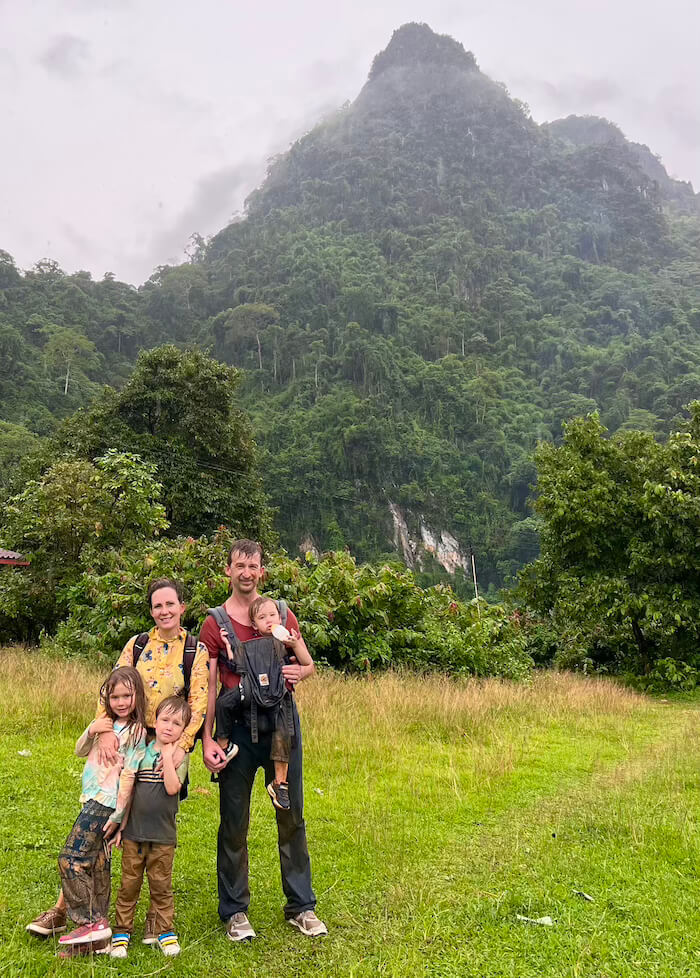
Another thirty minutes and we arrived on the football pitch of a village school. As the rain continued to fall, the guide asked if we’d like a picture. Tired, injured, and soaking wet—of course we wanted a picture. It’s one of my favorites even today.
Aftermath and Lessons Learned
I don’t think we were ever in serious danger during the walk, though any hike carries some risk, compounded by bad weather. Reflecting on the walk after, though, helped me set more firmly a few basic principles.
In life, but especially when traveling, you are solely responsible for your family’s safety. Guides support that, and you are almost always better off following their advice, especially if they are warning you against doing something.
Remember, though, that a tour company might have different incentives than you. Cancelling a tour because of bad weather might have serious economic implications for the guide and their family. That pressure can push them to accept more risk than you’re comfortable with.
Guides can usually be trusted not to endanger you, but there is a grey area where you must be willing to call it off if it doesn’t feel right. Even if you pay for a trip that never happens, it may beat the alternatives.
Am I glad we did this trip? I wouldn’t make the same decision again, but I’m glad we did—and that no one got hurt. The silver lining? Every hike since has been easier than the legendary Laos Hike.
Plan Your Trip to Vang Vieng
Some links below are affiliate links. At no extra cost to you, we earn a small commission if you make a booking, which helps us keep our family on the road. Thank you for your support!
Getting There
By High-Speed Train: The Laos-China Railway (LCR) connects Vang Vieng to Vientiane (1 hour) and Luang Prabang (1 hour). Tickets cost roughly $10–$18 depending on the class.
Booking Tickets: We strongly recommend using 12go.asia to book tickets 2–3 days in advance, as tickets sell out quickly and the physical stations are located several kilometers outside of town.
Ground Transport: A shared minivan or tuk-tuk from the Vang Vieng station to the town center typically costs around LAK 30,000–50,000 ($1.50–$2.50) per person.
By Road: Private transfers from Vientiane take about 2 hours via the new expressway. Expect to pay anywhere from $65–$100 for a private car.
Where to Stay
Vang Vieng has everything from $5 hostel bunks to high-end resorts. For families or those looking to avoid the “party town” noise, we recommend staying on the river.
Riverside Boutique Resort is the “flash” move we mentioned. It features elegant colonial-inspired architecture, a stunning pool with a view of the karst peaks, and a bar that knows how to make a proper G&T. It’s not outrageously expensive, but it prices out most of the backpackers.
Vieng Tara VangVieng Resort is for when you want that iconic “bungalow in the rice fields” experience. The wooden boardwalks are Instagram-famous for a reason, and the setting at sunset is hard to beat. If you don’t stay, you must at least visit.
Confetti Garden Hotel is a great mid-range family option. It’s located in a quieter part of town with a nice pool and clean, modern rooms that won’t break the budget.
When to Go
The Cool Season (November to February): The most comfortable weather for hiking and buggies. The skies are clear, but this is peak tourist season—expect company at the lagoons.
The Green Season (June to October): Our favorite time for photography. The rice fields are a vibrant emerald green, though as we learned the hard way, the mountain paths become a muddy technical challenge.
The Afternoon “Cool Down” (3:00 p.m. – 5:30 p.m.): If you’ve missed the early morning, head to the lagoons in the late afternoon. The midday crowds often start heading back to town for happy hour, leaving the water a bit more peaceful.
What It Costs
Blue Lagoon Entrance Fees: Most lagoons (1, 2, 3, and 4) charge a standard entry fee of LAK 20,000–30,000 (approx. $1.00–$1.50).
Nam Xay Viewpoint: The entry fee is LAK 20,000 ($1.00)
Dune Buggy Rental: A 2-seater buggy typically starts at $45 for 2 hours, while 4-seater “family” buggies are around $75–$95 for a half-day.
Booking/Tours
With a well-established tourism sector catering to backpackers, tours and trips are easy to find. You can book in advance or when you reach Vang Vieng. There is no shortage of providers ready to offer you as much (or as little) support as you like.
Namxay Viewpoint, Blue Lagoon 1 & Phoukham Cave
- Duration: 4 hours.
- Includes: Entrance fees, drinking water, and guides.
- Vibe: Small group. Children must be at least seven years old, with discounts available for kids.
- Flexibility: Reserve now, pay later. Free cancellation up to 24 hours before the trip starts.
- Cost: From USD $30 per person.