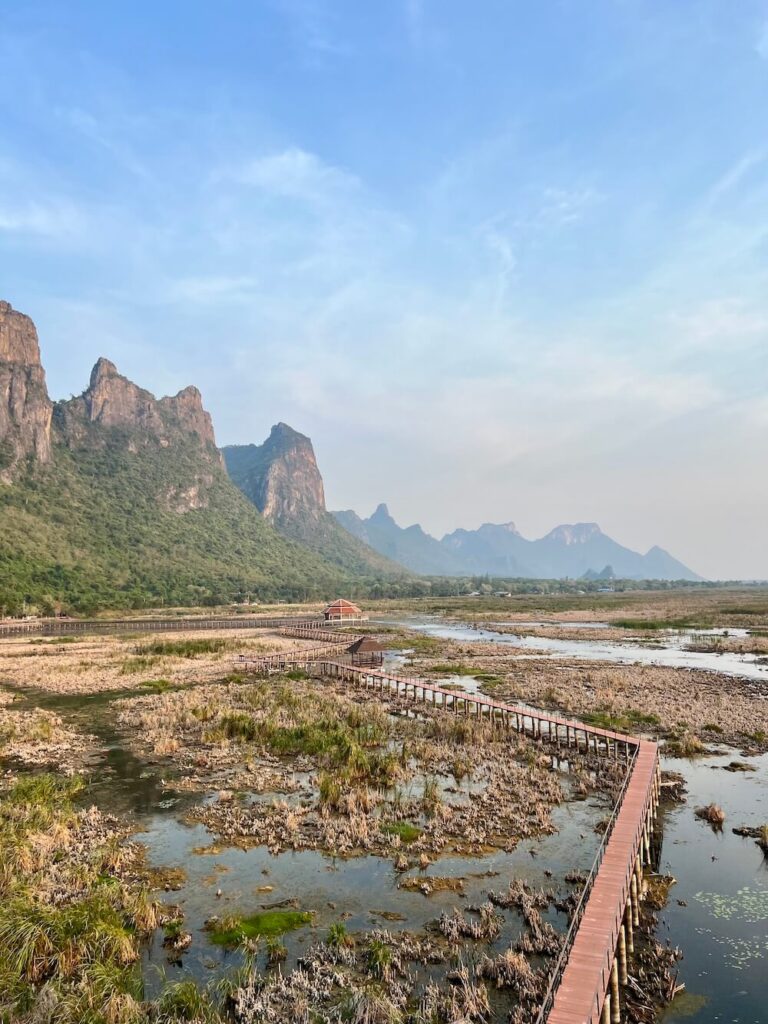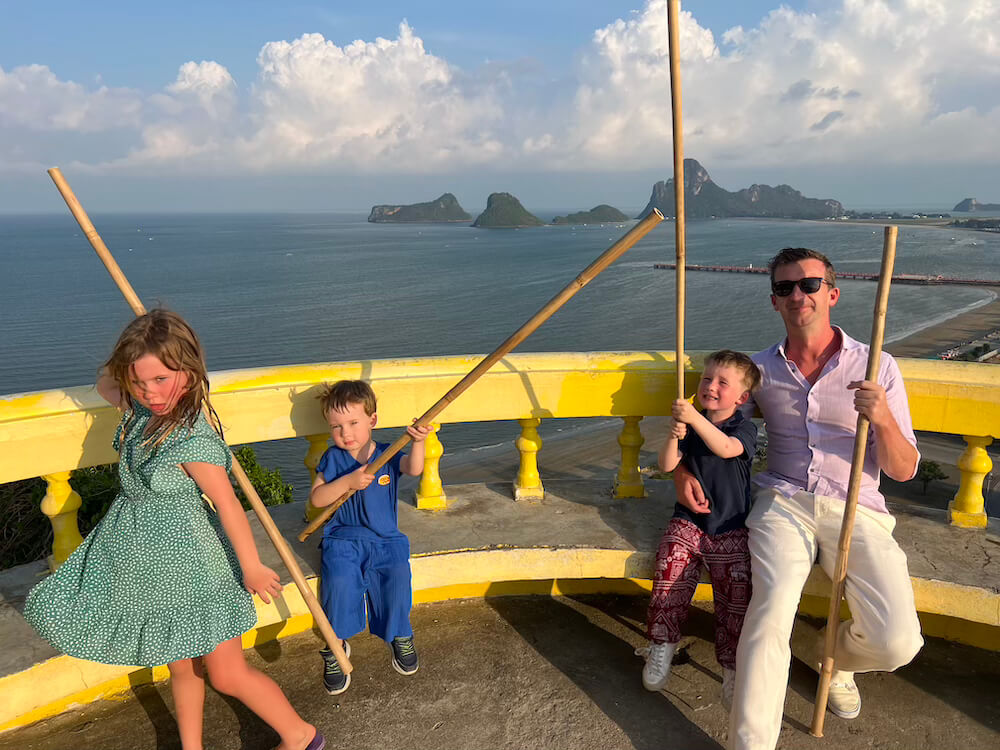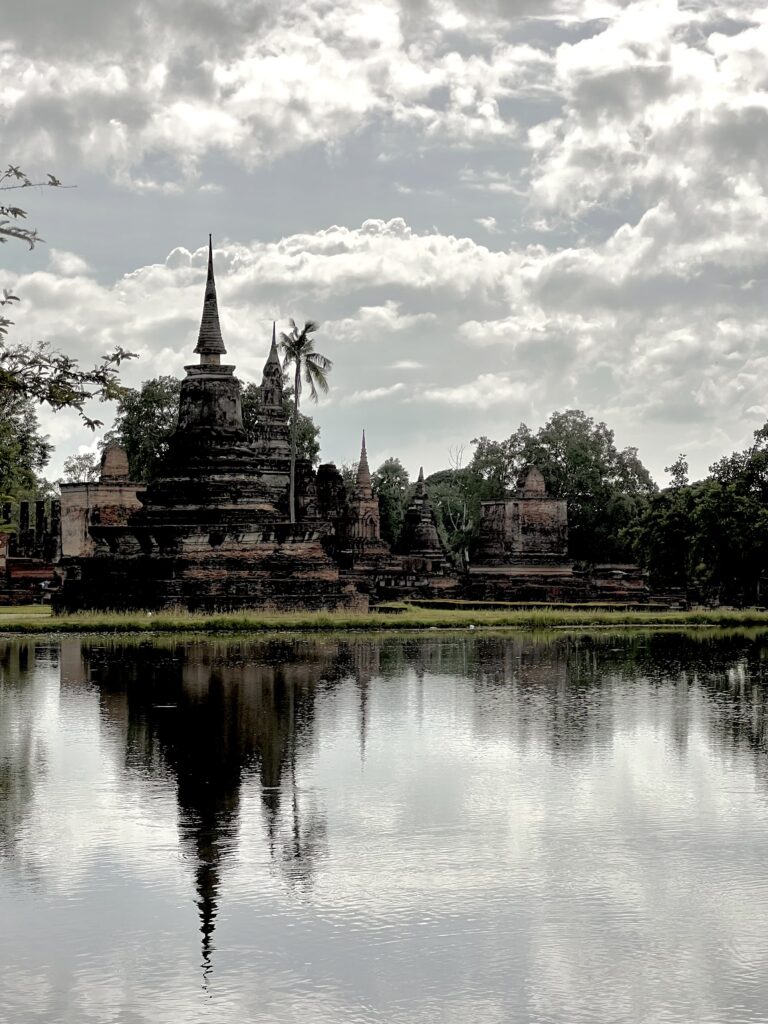
Easily one of Thailand’s most atmospheric locations, it also has the added advantage of being especially well suited to children. The core of the historical park is closed to motorized traffic, making it an excellent place for even the smallest cyclists to pedal around.
The Founding and the Fall of Sukhothai
In 1238 CE, the Khmer governor Sabat Khlon Lamphong found his city besieged. Along the banks of the nearby Yom River, two powerful Tai lords had gathered an army in open rebuke of his authority. Outnumbered and with no hope of relief, the royal governor prepared a final, desperate sortie. Leading the assault from the back of his war elephant, he met one of the Tai lords, Pho Khun Bang Klang Hao, beneath the city walls. In fierce single combat, the Tai prince struck down his rival. The Khmer governor slain, the victor adopted the majestic title King Sri Inthrathit, marking the birth of an independent Tai state.
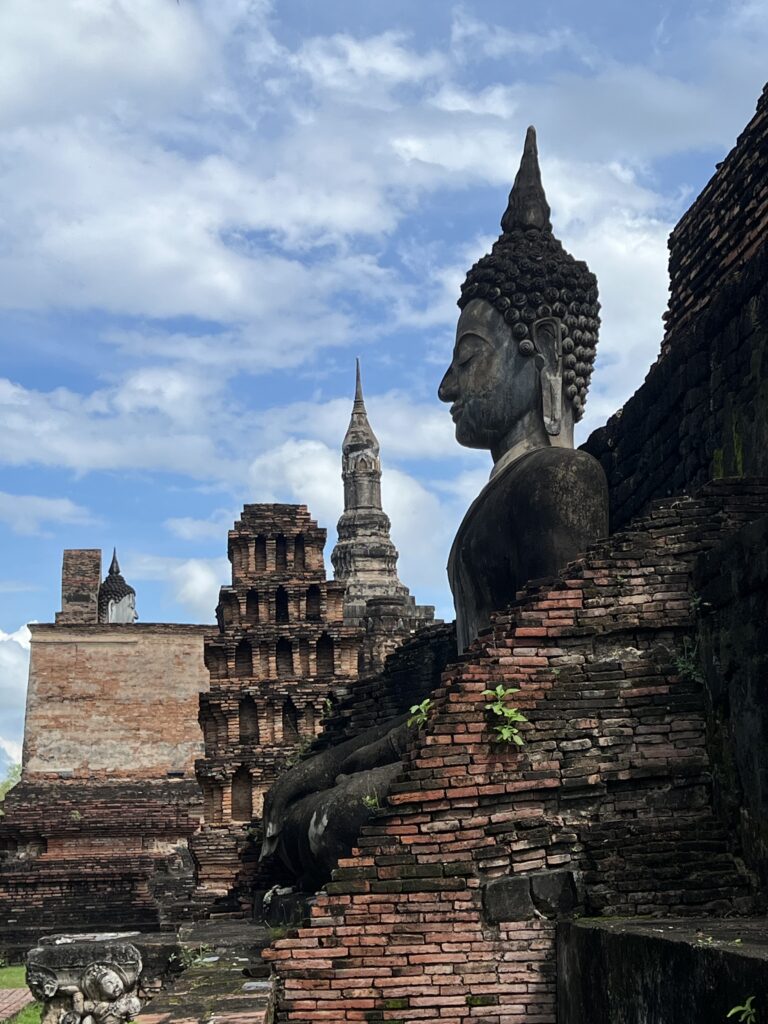
Sukhothai, the city over which they fought, served as his dynasty’s capital for another 200 years, before power shifted to southern rivals in Ayutthaya. Stripped of political and economic importance, the city quicky began to fade. By the time the Burmese destroyed Ayutthaya in 1767, the jungle had already reclaimed Sukhothai’s forgotten ruins.
From Battlefield to Bike Park: Why Sukhothai Is Perfect for Kids
Over the last century, Sukhothai’s ruins have re-emerged from the jungle and now form Thailand’s most park-like “historical park.” Despite featuring prominently on most Thai “must see” lists, the city is remote enough that crowds should generally not be a problem. While around two dozen temples, shrines, and palaces sit inside the popular “central zone,” there are nearly a hundred other archeological sites situated along the now-peaceful Yom River.
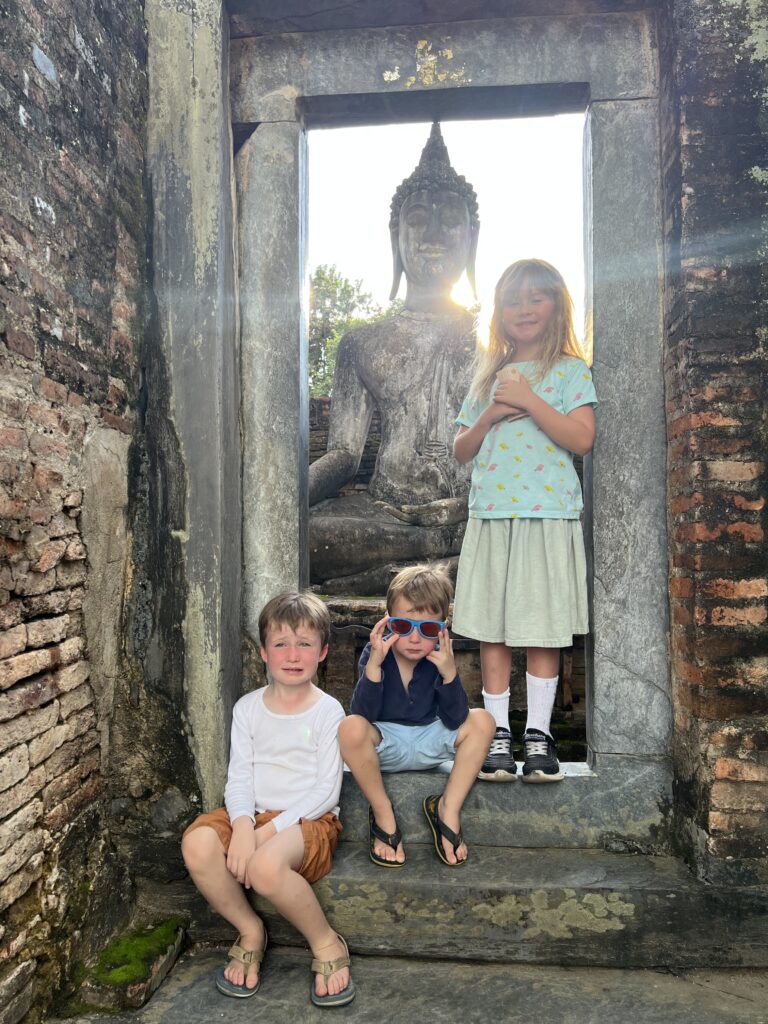
Beyond the major temples listed below, all that remains of many sites are foundations and the odd column. For that reason, Sukhothai’s primary charm lies in its atmosphere. I moved to the region more than a decade ago, and still nothing conjures Southeast Asia for me more vividly than wide expanses of electric green earth, ancient canals and reservoirs, all punctuated with stands of slender sugar palms. Sukhothai radiates that same vibe.
You could easily spend days exploring this city and surrounding countryside, but however long you spend, these three temples were huge favorites with the kids and can’t be missed.
Sukhothai Historical Park is a key pillar supporting a larger regional roadtrip. To see how it fits in, check out our Complete 9-Day Northern Thailand Itinerary.
Wat Si Chum and the Tale of the Talking Buddha
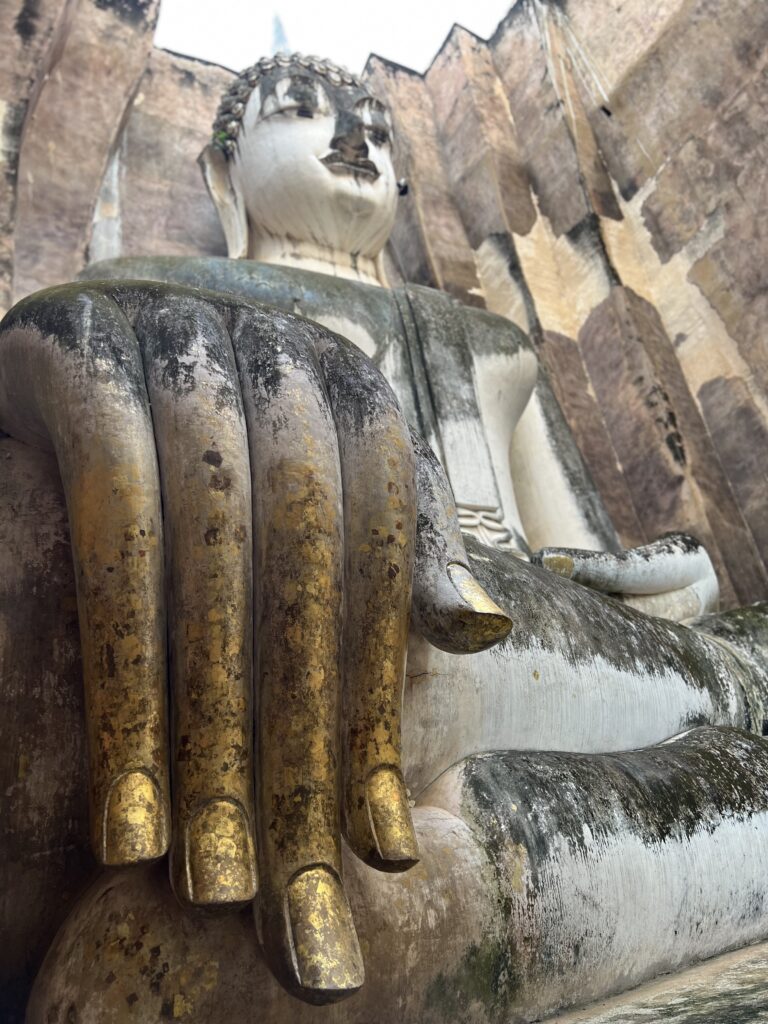
The colossus sits inside a mondop, a high-walled square pierced with a single narrow opening that runs from earth to sky. It is through this that you first see it: a 15-meter tall Buddha, all white but for where devotees have pressed gold leaf to a colossal hand, held in the Subduing Mara pose. The mondop itself could be the work of a brutalist architect or even something naturally formed from pillars of basalt. Except for the wingbeats of eternally restless pigeons echoing off the walls, the chamber is silent.
We arrived late in the day, racing the sun. To motivate the kids, I broke my rule against creating false drama, telling them they needed to hurry because “the walls seal shut when the sun goes down.” Honestly, this was the mildest of my inventions that afternoon, so I felt a bit guilty. I should have let the temple work its magic on them without my trivializing it. Using a cheap trick in such a place felt like sacrilege.
Fortunately for me, Wat Si Chum was built for cheap tricks. Inside the three-meter-thick wall behind the statue is a hidden staircase leading to a ventilation shaft near the Buddha’s head. Legend has it that King Naresuan the Great, needing to inspire his demoralized troops, sent a soldier up the passage to speak of their coming victory. Hearing the booming voice echo through the mondop, the army assumed it was the Buddha himself and marched on to win the battle.
Wat Si Sawai, an Angkor in Miniature
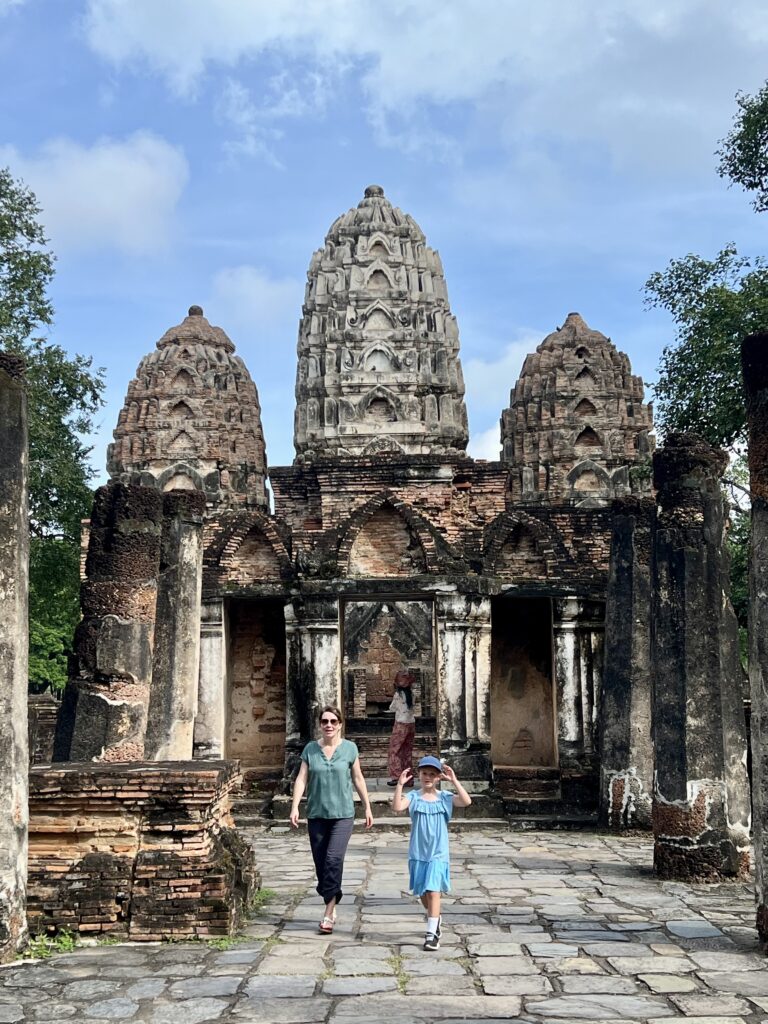
The oldest and the most “Khmer” of Sukhothai’s temples, Wat Si Sawai is instantly recognizable with its three prangs, the corn-cob shaped towers that evoke its forebear Angkor Wat. Most Sukhothai temples were explicitly established as Buddhist monasteries, but Wat Si Sawai is older and would originally have served as a Hindu temple built by Khmer patrons. Depictions of Garuda and Makara still survive in the remaining stucco as reminders of that past. Isobel, remembering her lessons from our visit to Prasat Muang Tam, even spotted a few Kirtimukhas (as fun to see as it is to say).
Like Angkor Wat, but on a far smaller scale, one of the pleasures of Wat Si Sawai is the sense that you’re visiting a complete universe in miniature. We parked our bikes under a tree, passed through the enclosure wall, and entered a world where every brick was significant. The towers represent mountains and gods, the canals and reservoirs are seas, and the various chambers are passages between worlds. Visitors can enter the central chamber and two smaller flanking chambers from separate courtyards. The kids can’t stay out of the chambers, always hoping to find something living in them.
Wat Mahathat – Golden Hour View
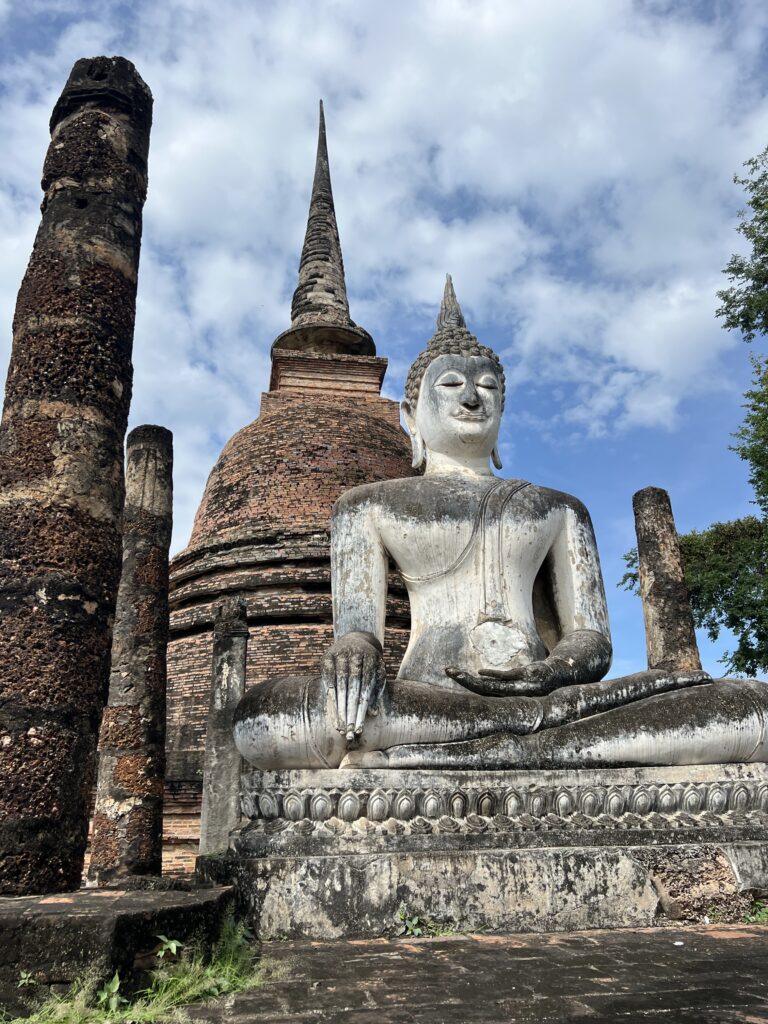
With Wat Mahathat, we’ve moved firmly into the Buddhist world, but a lot of the imagery is the same. Instead of a central prang to represent Mount Meru, we have a lotus-bud shaped chedhi, the bell shaped-structures sometimes referred to as stupas in other contexts. Contained in the chedi are the most sacred kind of relics. Some portion of the Buddha’s cremated remains is said to be sealed deep inside the brick and stone. Indeed, its very name, Wat Mahathat, means “Temple of the Great Relic.”
I’ve listed Wat Mahathat last, but it’s the first temple you’re likely to see when you enter the park’s central zone. Its setting on the bank of a reservoir makes it a popular place to catch the setting sun. This may be our most important tip for visiting Sukhothai (or almost any archeological site for that matter): go during the golden hour.
The late evening sun is magical, the swifts come out to wheel and dive among the ruins, the air cools… a little. I am so sure that this positively changes the way the kids experience these sites that I always try to plan visits after 4:00. Don’t go too late though, you need to move on before the mondop walls seal you in.
Sukhothai Historical Park: Logistics, Fees, and Bike Rentals
Admission Fees
The Historical Park is divided into five zones. The three main zones of interest, which contain the temples listed above, require separate entry fees.
| Central Zone | Wat Mahathat, Wat Si Sawai | 200 THB per person |
| Northern Zone | Wat Si Chum, Wat Phra Phai Luang | 120 THB per person |
| Western Zone | Aranyik Area | 120 THB per person |
As has been our experience in most national parks and archeological sites in Thailand, the kids enter for free. Isobel just turned eight, so this free ride may soon come to an end.
Bike Details
Biking is without a doubt the single best way to see Sukhothai. There are hop-on-and-off shuttles, and you can rent golf carts, but if you’re able we would strongly recommend bikes.
Rental shops are located near the main entrances, and you can find bikes of any type and size: tricycles, tandems, toddler, you name it. Bikes with child seats are available, but don’t count on working belts or straps. Because I can’t rely on three-year-old Charlie to not launch himself from an unsupervised seat, I opted for a bike with a child seat mounted between me and the handlebars.
Prices range from THB 20-50 ($1-2 USD) per day, so you should expect to get something that corresponds to that price. If you have a daughter like mine, she will choose a bike with strange gadgets on the spokes that make lots of noise. You won’t notice it for the first hour and then you will only notice it. Prevent this.
Having grown up in the hyper-urban megacities of Bangkok and Shanghai, the kids’ biking skills are… a bit weaker than is ideal. Mea culpa, we’re fixing that. Sukhothai is the perfect environment for kids to practice riding. The central zone is closed to vehicles other than park shuttles and golf carts and towering trees provide ample shade. If you are caught in the park during the hottest part of the day, pedaling the bike will be as cool as you get.
Opening Hours
Pro Tip
If you’re in the neighborhood anyway, it’s always worth checking to see if sites are open. Many parks remain open well past their posted hours.
Operating hours vary slightly, but the main zones allow for full-day exploration.
Main Zones (Central, North): Typically open from 6:00 AM – 6:00 PM (18:00).
Golden Hour Viewing: The Central Zone often stays open later, sometimes until 9:00 PM (21:00) on Saturdays, allowing you to catch the beautiful temple illuminations.
Plan Your Trip to Sukhothai
Some links below are affiliate links. At no extra cost to you, we earn a small commission if you make a booking, which helps us keep our family on the road. Thank you for your support!
Getting There
We drove, as we tend to do in Thailand, but recognize that might not work for everyone, so:
Fly from Bangkok (DMK/BKK) directly to Sukhothai Airport (THS) as this is the most convenient but priciest option.
Take the train from Bangkok to Phitsanulok (PLK), which is the closest station. From PLK, transfer to a local bus (about 1 hour) to reach Sukhothai’s New City terminal.
Bus (Direct)The most common budget route is a direct bus from Bangkok’s Mo Chit Terminal (approx. 7–8 hours) straight to the New Sukhothai Bus Terminal.
Book your tickets here
Where to Stay
Sukhothai is divided into the old town near the ruins, and the new town near the Yom River. For families, the hotels near (and among) the old city are hard to beat.
Sriwilai Sukhothai Resort & Spa A luxury Lanna-style retreat near the Historical Park, featuring an infinity pool with stunning rice field and ancient ruin views. It offers serenity, romance, and an authentic local experience. You’ll even find a few chedis on compound.
Legendha Sukhothai Hotel A charming “Thai Village” resort, which offers classic style and cultural activities like almsgiving. Situated near the Historical Park, it blends serene riverside tranquility with easy temple access. We booked a two-room family suite at a reasonable rate.
When to Go
The Cool Season (November – February) is ideal, offering comfortable temperatures (15°C – 32°C) perfect for cycling without intense heat.
Visit the Central Zone for sunrise (6:30 AM) and sunset (6:00 PM – 7:00 PM). The low, golden light on the ruins is unbeatable.
Generally open from 6:30 AM to 7:30 PM daily, with later hours on Saturday for the evening market and lights.
Booking/Tours
The park is divided into five zones. Foreigners pay THB 100 per zone. The Central Zone (Wat Mahathat, Wat Si Sawai) is the most critical to visit.
Cycling is mandatory! The park is too large to walk. Rent a bike for the whole day for only THB 20-50 from stalls outside the main gate. There is a THB 10 bicycle entrance fee per zone.
If you prefer a full historical context, book a guided bicycle tour that includes history and access to the best ruins.
Book here now!