Wat Chantharam was only the first stop of a much bigger trip, see how it all fits together in our comprehensive 9-Day Northern Thailand Road Trip Itinerary.
The Uphill Battle of Another Wat
“They’re going to take us to a temple,” one of them says with a mix despair and resignation. “It’s probably on top of a really steep hill,” says another, not yet resigned to anything. To be fair, these guys visit a lot of wats, and you can see how in the eyes of the under-eight set, a certain sameness can set in. So, at least until these toddlers and pre-tweens learn to appreciate the finer points of Theravada Buddhist architecture, it can make sense to justify why we’re stopping at yet another temple.
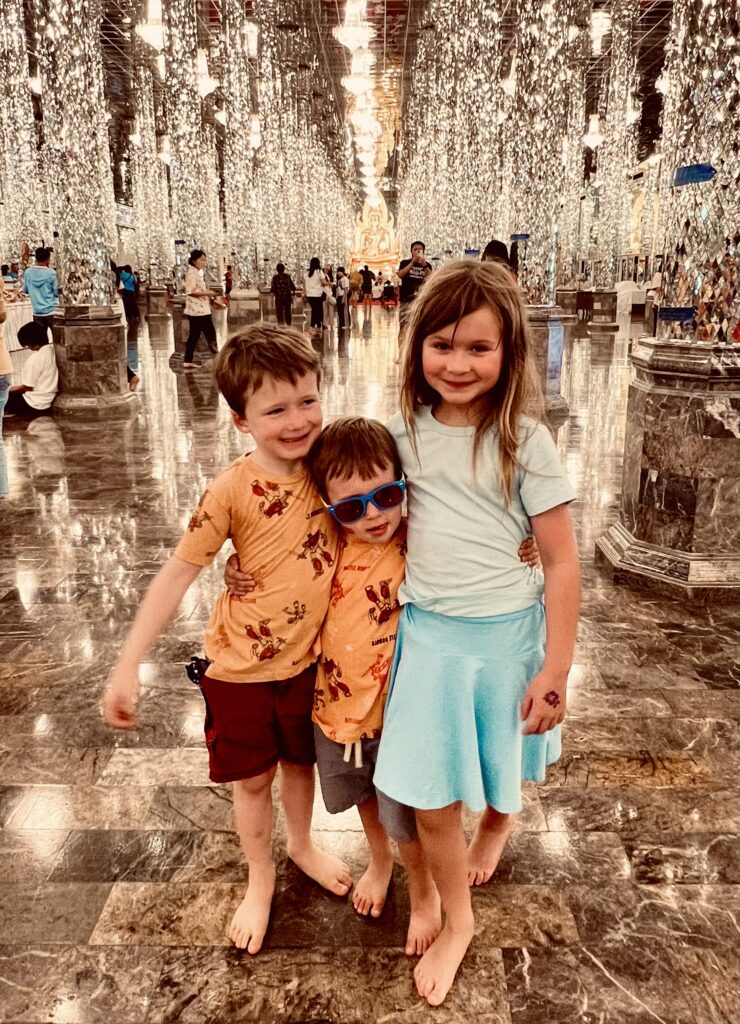
Fortunately, Thailand’s wats have such range and character that it’s not hard to break through even the most jaded front the kids can put up and convince them to strap on their shoes. Some wats are easier sells than others – almost nothing can compete with the morbid attraction of some of the gruesome temple murals depicting Buddhist hell, but the crystal-and-mirrored interiors of Wat Chantharam manages to fascinate without even a drop of gore.
Glitter Over Gore: The Hypnotic Interior of Wat Tha Sung
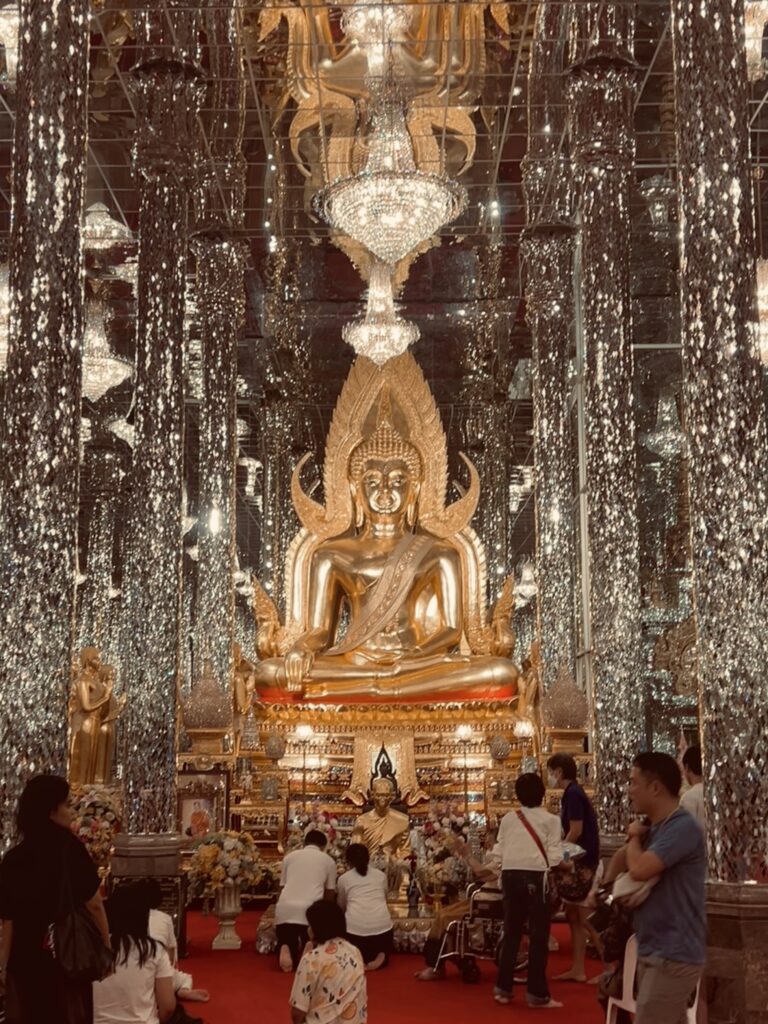
Located on the Sakae Krang river ten minutes south of Uthai Thani town, Wat Chantharam (also known locally as Wat Tha Sung) houses the famous Wihan Kaew, or Crystal Mandapa: a 100-meter-long room of mirror-studded columns and crystal chandeliers. As they recursively reflect off each other, the center and base of the columns vanish, and each seems to hang suspended from the ceiling. It’s a dazzling effect that forces you to put the camera down and simply look. Like so many of Thailand’s most extraordinary temples, though, the realization of Wat Tha Sung’s design is surprisingly modern. The last crystals were laid in the late 1980s, just as Bon Jovi’s “Livin’ on a Prayer” came out.
The Recursive Generosity of Merit
Whether the Bard of Sayreville NJ ever intended it, his nod to prayer touches on why a visit to Wat Tha Sung is so compelling: it remains exceptionally active as a spiritual center. The flow of devotees is constant, though never overwhelming. We noticed also a more than usual number of the elderly, the chronically ill, and the wheelchair bound, all making merit (tham bun) through range of donative acts.
This, we learned, is because the former abbot, Luang Phor Ruesi Lingdam, was widely believed to have the power to heal all manner of maladies. His powers have reputedly not diminished since his death in 1992. From a glass coffin where his body remains undecayed more than 30 years after his death, pilgrims say he still has the power to ease the suffering of pilgrims.
Whatever their condition, the Thai visiting the wat were as usual unbelievably kind. The family of an elderly woman in a wheelchair helped her pass handfuls of coins to the kids, who placed them in a series of bowls, making merit on her behalf. Like with the mirrors passing light back and forth in the crystal sanctuary, there’s a recursiveness in this kind of generosity as well. By creating an opportunity for Isobel, Henry, and Charlie to make merit by performing a good deed, these devotees are further rewarded by their generous encouragement of the kids’ virtuous actions. This specific practice—gaining merit by rejoicing in another’s good deed—is known as Pattānumodanā in Theravada Buddhism. It’s quite a nice idea.
Not more than forty-five minutes later, we were on our way again. If you find yourself on the drive between Bangkok and Sukhothai itching for a break but afraid the kids won’t leave the car, tell them that just off the main road, inside a palace of crystal so glittering that it makes a Swarovski store look like a Home Depot, lies the immortal body of a legendary monk with supernatural healing abilities. If that doesn’t get them out of the car, you’ve got bigger issues. No need to worry, maybe this same legendary monk, famous for solving chronic problems, can have a go at those kids.
Join us on our next stop, where we leave behind crystal halls and instead Explore the Lost World of Hup Pa Tat.
Planning Your Trip to Wat Tha Sung
Some links below are affiliate links. At no extra cost to you, we earn a small commission if you make a booking, which helps us keep our family on the road. Thank you for your support!
Getting There
Uthai Thani is approximately 3 to 3.5 hours by road from Bangkok. The easiest way is driving (or private taxi), as the temple itself is about 10 km south of the Uthai Thani city center. Realistically, you’ll be visiting en route to Sukhothai or further afield.
Where to Stay
We absolutely recommend spending a night in Uthai Thani, especially if you can make it a Saturday night when the Trok Rong Ya Walking Street is open. If you do stay, there’s really only one choice:
Uthai Heritage Hotel What a pleasant surprise! This unique boutique hotel was formerly the historic Uthai Withayalai School. Its colonial-style architecture retains original wooden beams and schoolhouse charm, offering families a nostalgic stay with modern amenities, including a lovely pool and central location. Absolutely loved it.
When to Go
The Cool Season (November to February) offers the most pleasant temperatures for walking the grounds and enjoying Uthai Thani’s river activities. Otherwise, any time is fine.
The main Wihan Kaeo (Glass Temple) is usually open from 9:00 AM – 11:30 AM and 2:00 PM – 4:00 PM daily. Plan your visit carefully to avoid the midday closure.
To experience the ethereal glow of the interior with minimal crowds, aim for a weekday morning right when the complex opens at 9:00 AM.
Booking/Tours
Entry to Wat Chantharam is, of course, entirely free. No reservations or tickets are required. Upon arrival, you’ll simply park your car and follow the crowds.
Visits to Uthai Thani are most easily accomplished by renting your own car and driving independently. Recognizing that this isn’t always possible (or desirable), we’re aware of at least one tour that will let you visit not only Wat Tha Sung, but the Jurassic landscape of Hup Pa Tat as well,
Uthai Thani Day Trip with Floating Temple and Hup Pa Tat Visits
- Duration: 15 Hours.
- Includes: Round-trip transportation from Bangkok and all park fees.
- Vibe: Private tour.
- Flexibility: Free cancellation up to 24 hours before the trip starts.
- Cost: From THB 16,799 per person.