We left Lampang early the next morning, driving about 90 minutes north to reach Wat Phraphutthabat Sutthawart. Our plan, and our strong recommendation to fellow travelers, is to begin the climb while the long path up the mountain is still in shadow. Even in Thailand’s coolest season, an exposed hike in direct sun can be punishing.
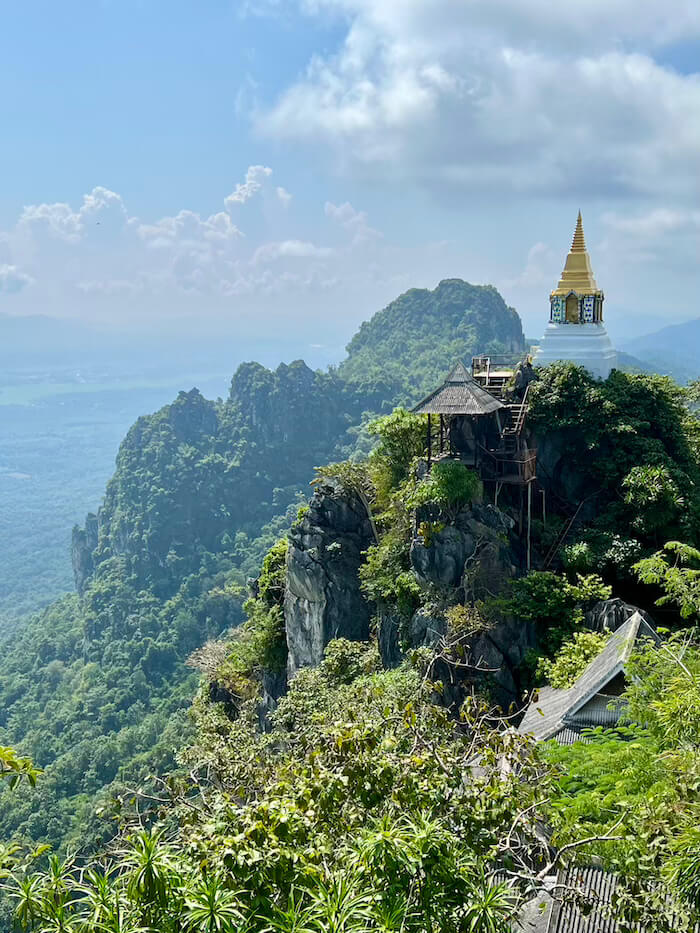
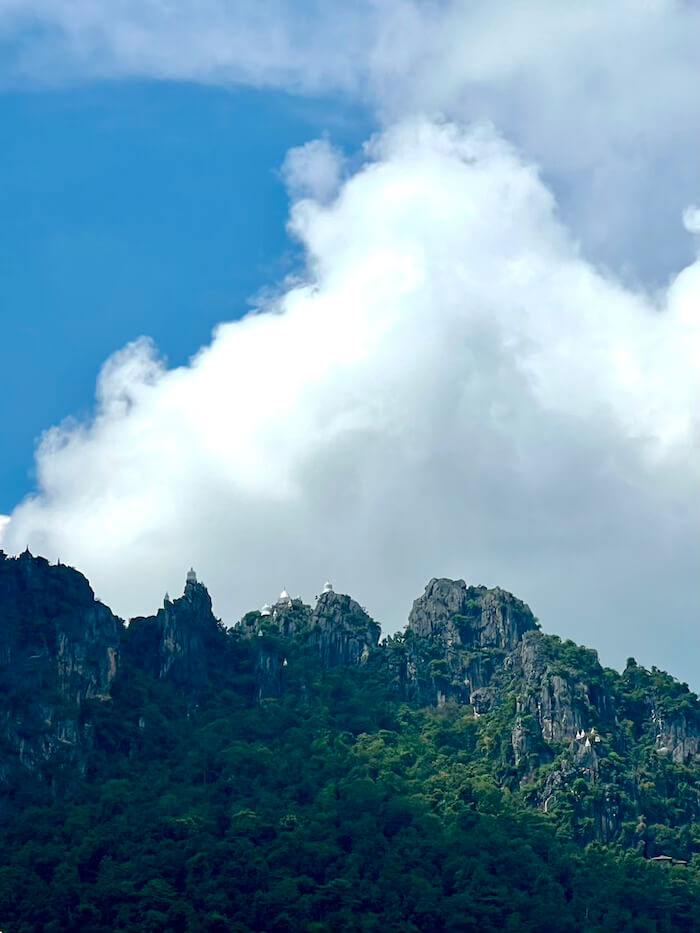
Just what’s at stake becomes clear when you turn off Highway 4023 and look west to the sheer walls of the Pu Yak mountains. Scattered across the highest pinnacles of the ridge, gleaming white, silver, and gold in the morning light, is your destination.
Officially known as Wat Chaloem Phra Kiat Phrachomklao Rachanusorn, this extraordinary site seems to hold almost as many names as the number of peaks its chedis crown. Locals also know it as Wat Phra Bat Pu Pha Daeng, Wat Phraphutthabat Sutthawart, or Wat Doi Pu Yak, and among foreigner visitors it’s simply, and aptly, called the “Sky Pagodas.”
Missed the last installment? Catch up with Lampang: Northern Thailand’s Most Effortlessly Cool City.
Songthaew Trip to the Trailhead
We parked at the base of the mountain and bought tickets for the mandatory songthaew transfer to the start of the hike. What this will cost a full family is anyone’s guess: adult tickets are THB 290, which includes transport, while small children are charged some varying but significantly smaller amount.
The drive up the mountain is steep and winding. Given that Isobel’s enjoyment of a ride generally correlates strongly with how dangerous it feels, her steady grin throughout the 15-minute ascent suggested a somewhat risky trip. The road only accommodates one-way traffic, so if you’ve just missed the last truck, expect a wait of up to thirty minutes.
Early on a weekday morning in mid-October, however, there was no wait at all, and we stepped off the truck as the first visitors of the day. A roughly 300-meter walk along a paved road follows the drive up. Walking in the cool morning shade, I was already glad at the early start.
Stairway to Heaven: 300 Steps to the Sky Pagodas
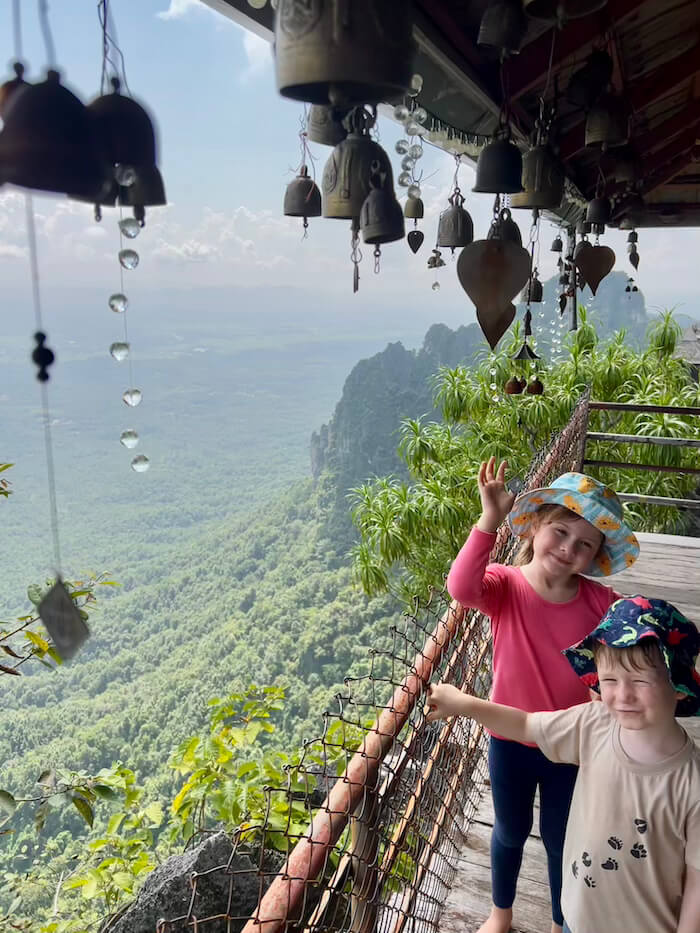
Glad soon turned to smug as the level path steepened and then turned into a series of steel staircases zigzagging straight up the mountain. The maintenance fees folded into the ticket price have been well spent. Despite the sharply vertical ascent, even our five-year-old handled the sturdily built path with nothing more than the occasional handhold.
Accounting for such a small walker, the climb took maybe 45 minutes—though it’s a pleasant ascent with excellent views, and I wasn’t checking my watch. You’ll arrive soon enough at a landing offering two paths: to the right and south, a wat housing the Buddha’s footprint; to the left and north, a final climb to the prayer hall and the best views of the whole complex.
The Stunning Views of Wat Chaloem Phra Kiat
Were this simply a hike to admire the views from the top of the Pu Yak mountains, it would already be worth it. The gleaming chedis ornamenting the gray limestone spires, the fluttering prayer flags, and the tinkling bells announcing the mountain breeze, all elevate the experience further.
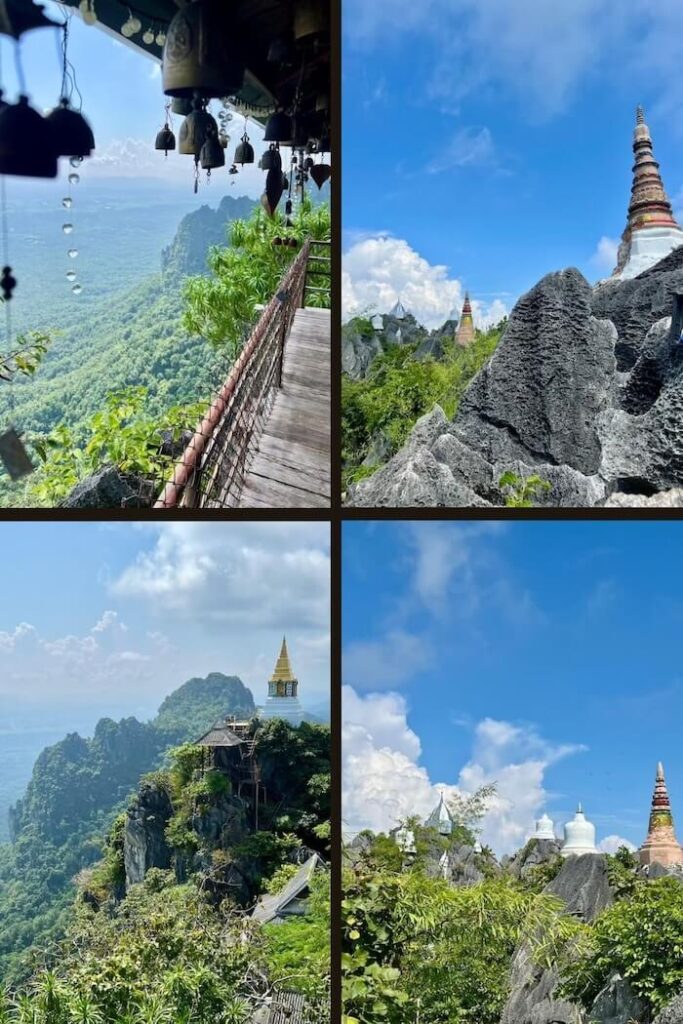
The views are stunning, and the varied sizes of the spires and chedis throw off any sense of perspective. Is that a massive peak crowned with a tiny chedi, or a tiny chedi atop an enormous spire? Most of what lies beyond the paths and prayer hall is inaccessible, so the illusion remains intact.
It’s a surreal creation, made even more remarkable for having been completed only in 2004. Before the steel staircases existed, monks and local workers spent years hauling bricks, mortar, and bags of concrete on their backs up the sheer cliffside to build all of this. What a delight that in the 21st century, people still create such things.
In Which Dad Makes a Mistake
The walk down was even faster, though we lengthened it as much as we could by taking every side path and suggested detour. By now, the sun had crept over the ridgeline and was shining onto the trail. As we passed other pilgrims just beginning their climb, the downside of a late start was evident in their sweat-soaked shirts.
At the bottom of the 300 steps, we were again in the shade. On the songthaew ride down, I held Henry in place with one hand and reviewed the rest of the day’s schedule with the other. A short drive, my itinerary promised, and then some time by the pool, only… what pool? There was no hotel listed and nothing booked.

Since the kids came along, Kat and I plan far more carefully. Sure, we miss the spontaneity, but spontaneity loses its charm when it means placing unnecessary burdens on kids who already shoulder a lot of extra challenges. I’d done a bit of violence to my self-awarded reputation as a master planner, but even if everything in the area was booked out (it was) we’d be fine.
The Boiling Springs and Foaming Falls of Chae Son National Park
Thanks to Thailand’s near-universal mobile phone coverage, I soon found a place roughly in the direction we were headed and, thanks to a cancellation, willing to take us. The bad news was that it was an hour further away and twice as expensive. The price of learning, I suppose.
A compensating treat was a stop at Chae Son National Park, conveniently located on the route. Chae Son is a field of natural hot springs, where mineral-rich water bubbles up from the earth at temperatures reaching 80°C (176°F). It’s hot enough to boil an egg and people do—17 minutes is said to make a perfect “onsen egg.”
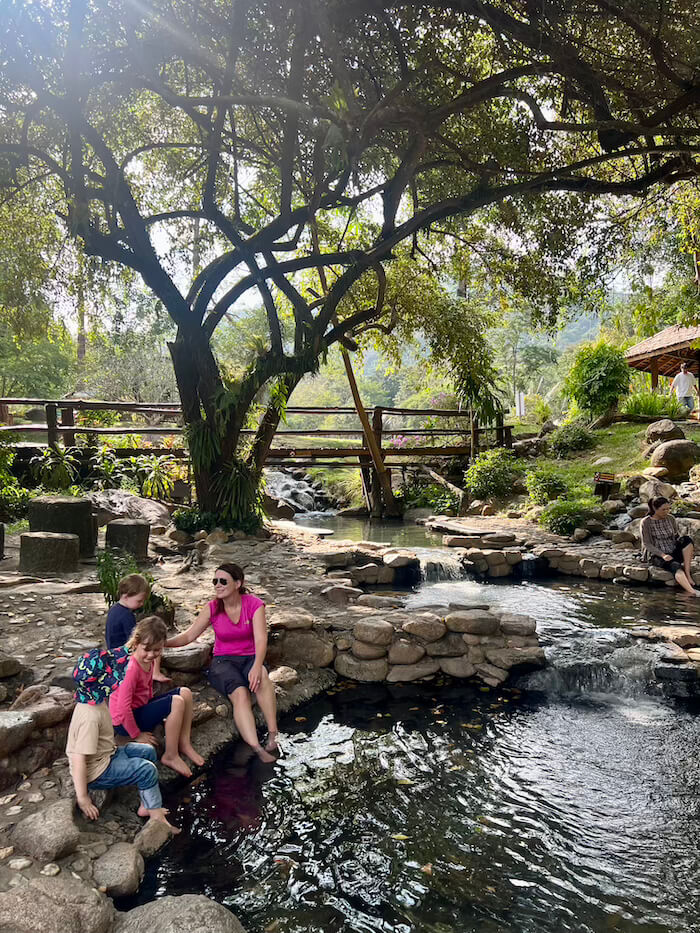
Set among manicured paths, the geothermal springs are about as park-like as a place filled with child-mutilating hazards can be. We even soaked our weary feet in one of the more survivable pools, which flowed into a cool river that offered instant relief whenever the heat became too much.
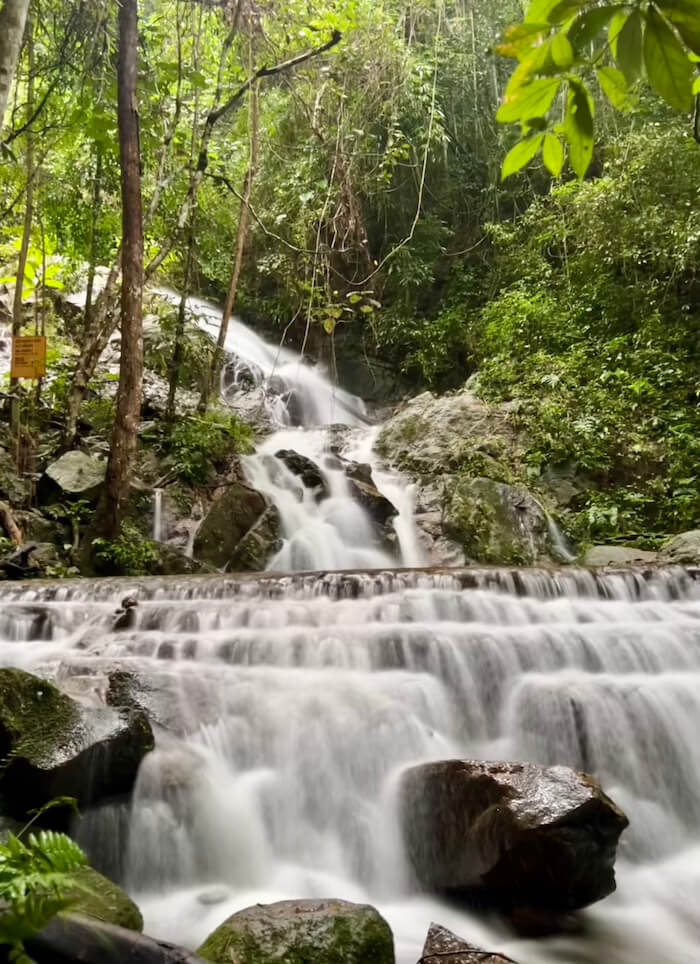
Farther up this same river is Chae Son Waterfall. When we visited, it was swollen with monsoon rains and running a deep, muddy brown. Recent rain had even transformed the stepped path beside the falls into a miniature version of Chae Son’s seven tiers. I hoped the rains feeding this torrent had passed, as we would soon need to drive over the mountains that drain into these falls.
Detour Over the Kiew Fin Pass, Northern Thailand’s Steepest Road
Route 1252 is one of the steepest paved roads in Thailand. In the 25 kilometers between Chae Son and Mae Kampong, it climbs at a sustained 15 percent gradient, steeper still at the summit switchbacks. I’d be lying if I said I wasn’t at all concerned, especially given the heavy rains of recent weeks.
It also turned out to be one of the most beautiful drives we have ever taken in Thailand. A damp road with such a steep gradient demanded careful driving, but rays of late-afternoon light cut through the canopy and illuminated the mist rising from the asphalt. The views down mountain ravines from absurdly sheer cliffsides were more exhilarating than they were terrifying—though, occasionally, a little terrifying for sure.
The road was surprisingly empty, with just enough traffic to reassure me the drive could be done. The sky had cleared by the time we reached the Kiew Fin viewpoint, which marks the border between Lampang and Chiang Mai. As we began our descent toward Mae Kampong, the road steepened further, but I’d found my stride and truly loved the drive.
Dad Vindicated: The Picturebook Village of Mae Kampong
As we drove further down the mountain, the wilderness gave way to scattered holiday homes. But it wasn’t until we reached Mae Kampong Waterfall that we really saw anyone else at all. Then they arrived in a flood. First, we braked for a man taking a selfie in the middle of the road. Soon, we were weaving through clusters of people doing the same. Before long, dozens of people milling around aimlessly had blocked the road entirely. We were in the center of a storybook village that could only have been Mae Kampong.
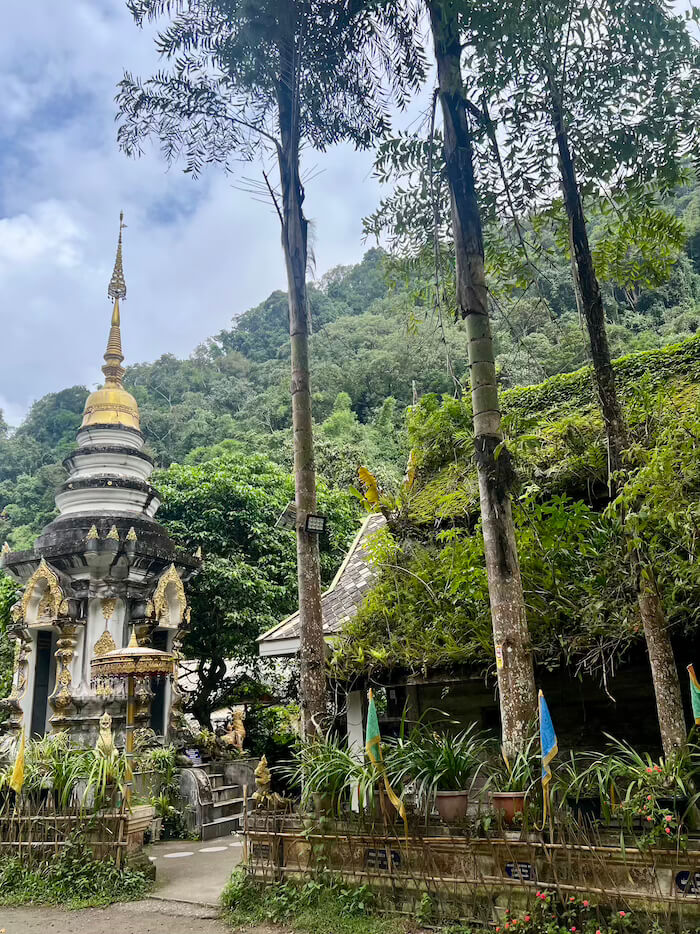
I couldn’t reconcile the bizarre scene we’d just stumbled upon with the loneliness of the drive that preceded it. I was vaguely aware of Mae Kampong as a popular day trip from Chiang Mai, but it hadn’t occurred to me just how popular. The reason was obvious—it’s a gem. We drove to our hotel past vignettes like a riverside wat covered in moss so thick it looked like an illustration from a fantasy novel.
That evening, we sat on our balcony overlooking the village. The smell of woodsmoke hinted at how cold the mountain air would become once the sun set. Few restaurants in Mae Kampong stay open once the day-trippers leave, so our hosts had arranged a hotpot for us on the terrace. As Kat and I shared a bottle of wine while the kids restored themselves with rich bowls of beef broth, I wondered whether this whole “having a plan” business was not seriously overrated.
Follow us as we drive south on stunning Highway 1048 in search of the Sea of Clouds at Phu Langka.
Plan Your Trip to Wat Chaloem Phra Kiat
Some links below are affiliate links. At no extra cost to you, we earn a small commission if you make a booking, which helps us keep our family on the road. Thank you for your support!
Getting There
By Car: The temple is about 90 minutes north of Lampang city. Follow Highway 1035 and turn onto the smaller mountain roads toward Chae Son. The drive is scenic but requires focus on the final winding stretch.
By Private Transfer/Grab: If you aren’t comfortable driving, a Grab car from Lampang typically costs around THB 550–600 one way. Many travelers negotiate with the driver to wait for a return trip for a total of roughly THB 1,200–1,500.
Chae Son National Park is about an hour north of Lampang and roughly 30 minutes from the base of Wat Chaloem Phra Kiat. If you are coming from the Sky Pagodas, follow Highway 1252. The road is winding but beautifully forested.
From Chae Son, you can continue another 90 minutes to Mae Kampong, but that would be a pretty weird itinerary.
Where to Stay
Most visitors to Wat Chaloem Phra Kiat are either coming or going from Lampang, in which case we recommend the wonderful Riverside Guest House.
Riverside Guest House Located directly on the banks of the Wang River, this is a collection of traditional teak houses on stilts. It offers a peaceful, authentic atmosphere with terraces stepping down to the water and is managed by a long-term expat who knows the city’s history intimately.
If you’d like to stay closer to the temple to ensure you arrive as early as possible, there are several good options. We recommend the following, but book early, as there are a limited number of rooms.
Stay cozy at Tiny House Homestay, an intimate collection of five minimalist wooden units nestled in nature. Enjoy artisanal coffee and panoramic mountain views.
Experience rural Thai hospitality at Kaewma Farmstay, a tranquil retreat set among lush rice paddies between Chae Son and the Sky Pagodas. Enjoy mountain views, home-cooked organic meals, and peaceful, family-friendly atmosphere in nature.
Finally, if you do find yourself in Mae Kampong, whether by accident or design, we are happy to recommend Portare Home, who really saved me.
Portare Home offers modern, elegantly designed suites with private balconies and mountain views. It’s Mae Kampong’s most peaceful retreat famous for its attentive service, excellent breakfast, and tranquil, nature-focused atmosphere.
When to Go
The Cool Season (November to February): Expect clear blue skies and crisp air, but be prepared for morning haze.
The Green Season (September to October): Our favorite time. The climb is humid, but the valley below is a brilliant emerald green, and you have a much higher chance of seeing the pagodas “floating” above low-hanging clouds.
The “Magic Hour” (7:30 a.m. – 9:00 a.m.): Arrive as the gates open to catch the pagodas in the morning light while the stairs are still in the shadow of the mountain.
What It Costs
Wat Chaloem Phra Kiat Entrance Fee: For foreigners, the total is THB 290 for adults and THB 150-200 for children (or nothing at all). This covers transportation up the mountain as well.
Chae Son National Park Entrance Fee: THB 200 for adults and THB 100 for children. There is also a small vehicle fee of THB 30 for cars
Onsen Eggs: A small bamboo basket of 3–4 eggs typically costs around THB 20–30.
Booking/Tours
Several operators offer day-trips to Wat Chaloem Phra Kiat from Chiang Mai. The first we recommend visits the Sky Pagodas and Chae Son Hot Springs, while the second tour substitutes the springs for a trip to Wat Phrathat Lampang Luang.
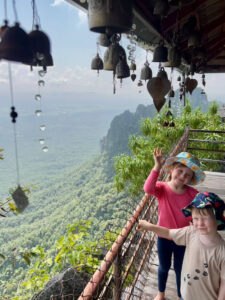
Wat Chaloem Phra Kiat and Chae Son National Park
- Duration: 10-11 hours.
- Includes: Round-trip Chiang Mai transfers; lunch and all fees included.
- Vibe: Private tour or small group options available. Children welcome, with discounts available.
- Flexibility: Reserve now, pay later. Free cancellation up to 24 hours before the trip starts.
- Cost: From THB 3,200 per person.
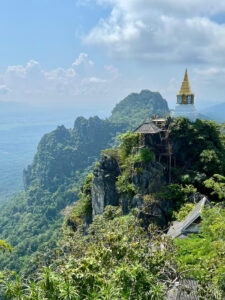
Tour of Wat Phrathat Lampang Luang and Wat Chaloem Phra Kiat
- Duration: 9-10 hours.
- Includes: Round-trip Chiang Mai transfers; lunch and all fees included.
- Vibe: Private tour, only your group joins. Discounts for children under 10.
- Flexibility: Reserve now, pay later. Free cancellation up to 24 hours before the trip starts.
- Cost: From THB 4,320 per person.