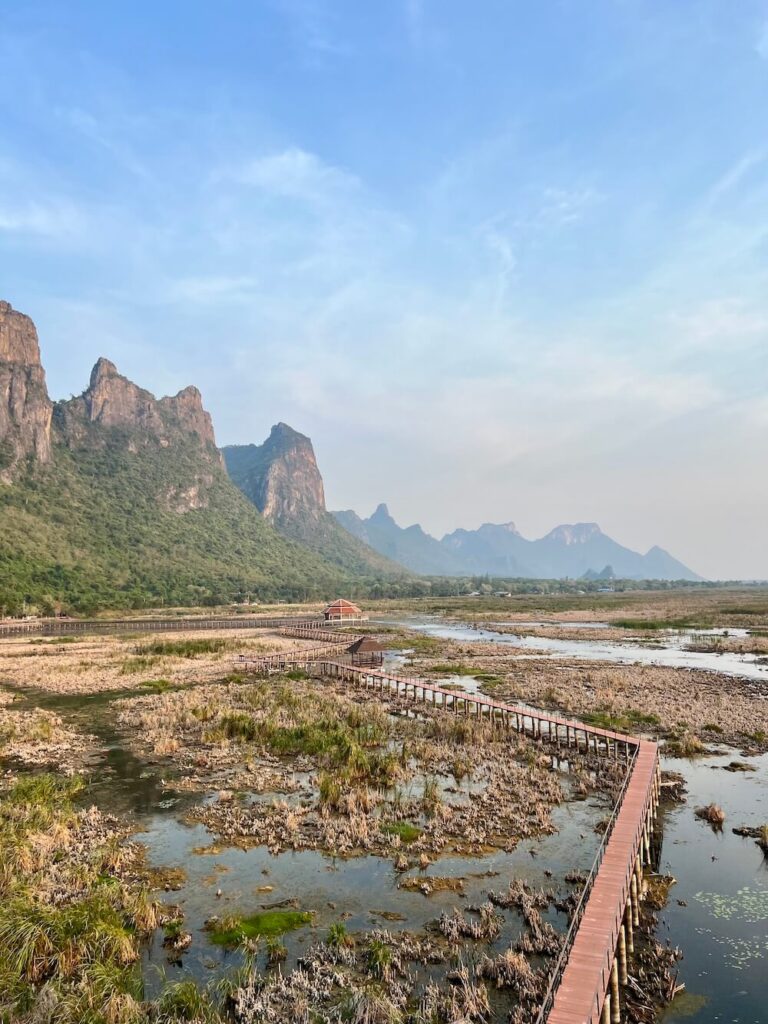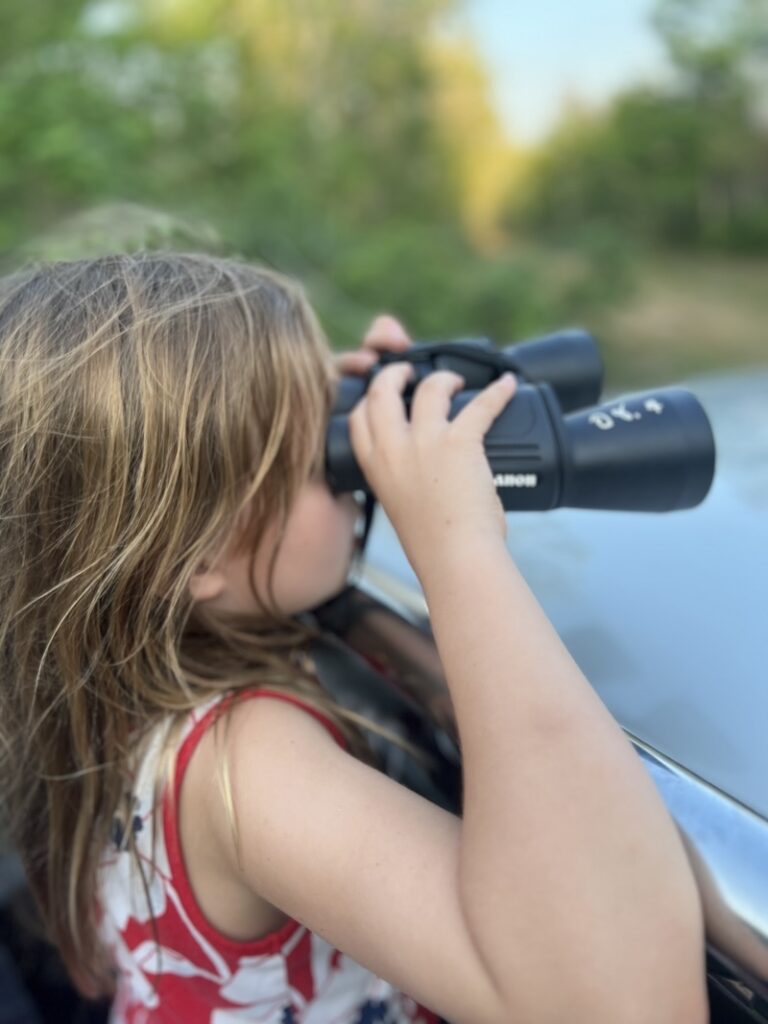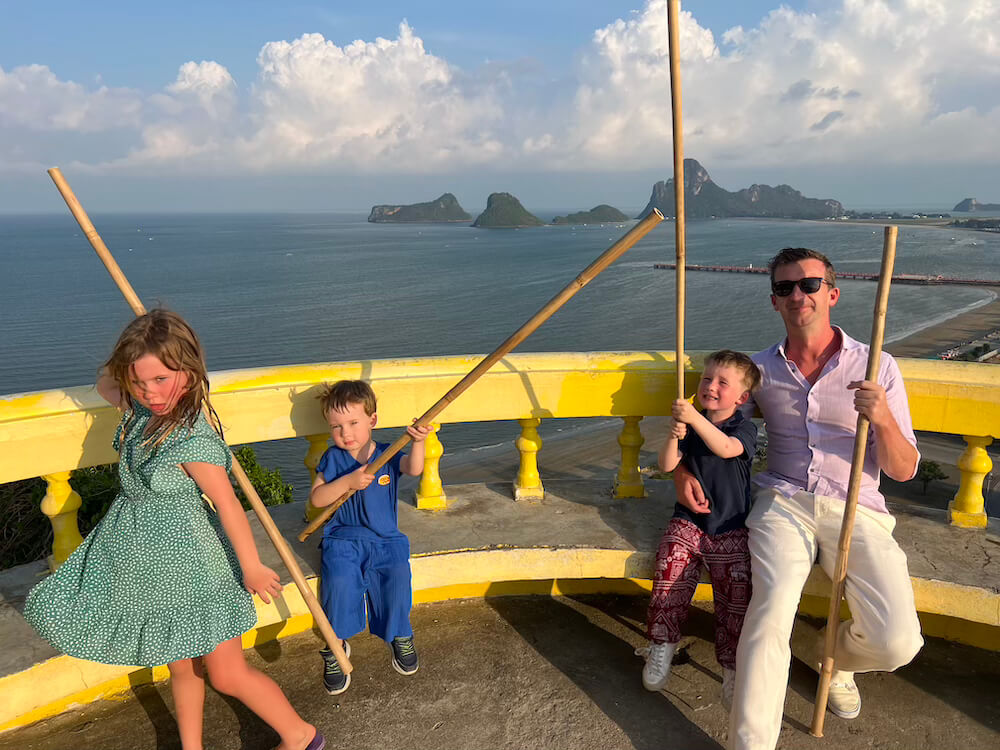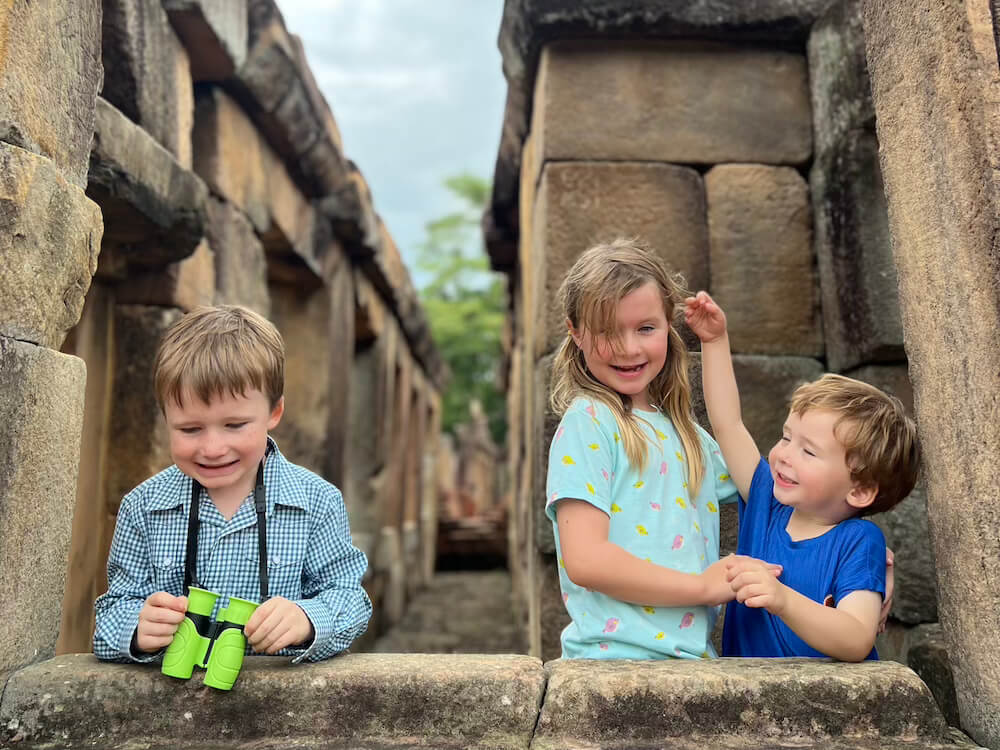
The borderlands between Thailand and Cambodia are homes to many dozens of archeological sites. The recent unfortunate hostilities between the two countries are often described in terms of the capture and recapture of temple-topped hills. Further from the border, and, at the time of writing, well away from the fighting, are two of the finest of these frontier temples: Prasat Muang Tam and Phanom Rung.
While these are incredible sites even with no context, we’ll also share a few techniques we used with the kids to draw them deeper into the magic of these amazing places.
Jump Ahead
The rain poured down as we drove northeast toward Buriram. May can be a wonderful time to visit Thailand: still hot, but refreshed by the first monsoon rains after the long dry season. Today, though, black clouds stretched across the horizon. We were going to get very wet exploring these ancient Khmer temples.
The road runs along the Dangrek Mountains, an enormous sandstone escarpment that forms part of the contentious border between Thailand and Cambodia. On the Thai side, the range appears as little more than a gentle swell in the earth, barely perceptible as a mountain at all until you reach the cliff-edges that plunge into Cambodia. As we drew closer to Buriram, we saw solitary spikes of rock scattered across the plain–the vents of extinct volcanoes.
Phanom Rung: Climbing Toward the Gods
If there’s one archeological site guaranteed to hold a child’s attention, it is surely at a thousand-year-old temple perched on top of an extinct volcano. We arrived late on a Friday afternoon, the few open stalls near the lower parking lots already shutting for the evening.
Once past the ticket booths and the information kiosks, something frankly magical happened. We found ourselves walking down a 160-meter promenade paved in ancient flagstones, the first growth of the monsoon season sprouting from the gaps between the stones. Thirty-five upright stones, called sao nang riang and carved in the form of ornamental lotus buds, lined each side of the path.
The walkway represents the transition from the earthly realm to the heavenly abode of the gods, and as you close in on the five flights of the grand staircase that leads up to the main temple sanctuary, you feel what Phanom Rung’s architects must have intended.
Here, as in other Khmer temples, the final crossing of the naga bridge completes the journey to the spiritual world. These nagas rose to great heights, their multiple heads flaring into a hood that towered over the kids and was nearly as tall as me. This was more than a motif; it felt almost like a warning.
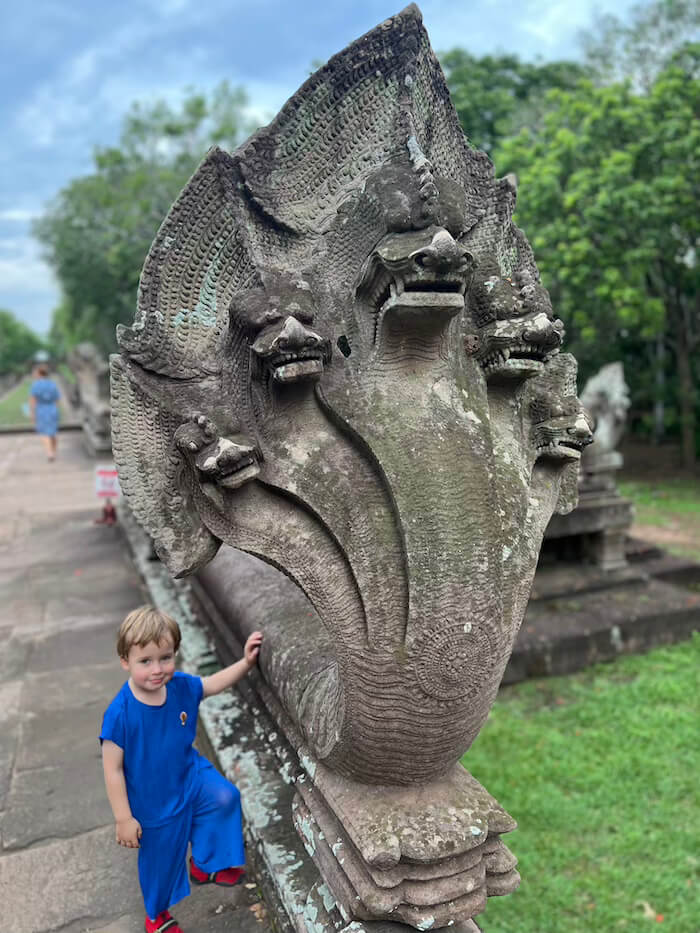
Across the naga bridge and at the top of the staircase are the primary temple structures, including the libraries (bannalai) and the towers of the main sanctuary. The carvings on these are exquisite, with Shiva Nataraja, the god performing the dance associated with the destruction and dissolution of the universe a real highlight.
Not Just Interesting Archeology, But Living Faith
At certain times of the year, the sun aligns perfectly with the east-facing doors of the temple, and rays of light pierce the entire structure. This event which happens twice yearly for the sunrise and the same for the sunset, draws enormous crowds.
The next alignment will come in early April, during the Phanom Rung festival. Since sharing some of the clips of our own visit, we’ve received many warm invitations to join the upcoming celebration and would have been delighted to do so if able.
We’re decidedly secular in outlook, but it’s fascinating to see what a spiritually alive place this is for so many people. One local woman shared with us her belief that every stone is imbued with magic: spells that few can see, understand, or counter. To step directly on the threshold stones, she warned, is to invite the wrath of guardian angels.
If you want to pique a child’s attention, show them an adult who is almost frightened by their own awe of a thing. The spiritualists of Phanom Rung embodied the very wonder I’d hoped to spark. As we watched the golden hour spread across the Isan plains from this mountaintop abode of the supernatural, I was half-convinced I believed myself.
Prasat Muang Tam and the Watchful Kirtimuhka
The 1,000-year-old temple complex of Prasat Muang Tam sits at the foot of one of those extinct volcanoes beside an ancient reservoir–a barai, typical of Khmer architecture. The central tower, visible even from a distance, represents the mountain home of Shiva, the Hindu god to whom the temple is dedicated. The water lay perfectly still when we arrived; the rain had finally stopped.
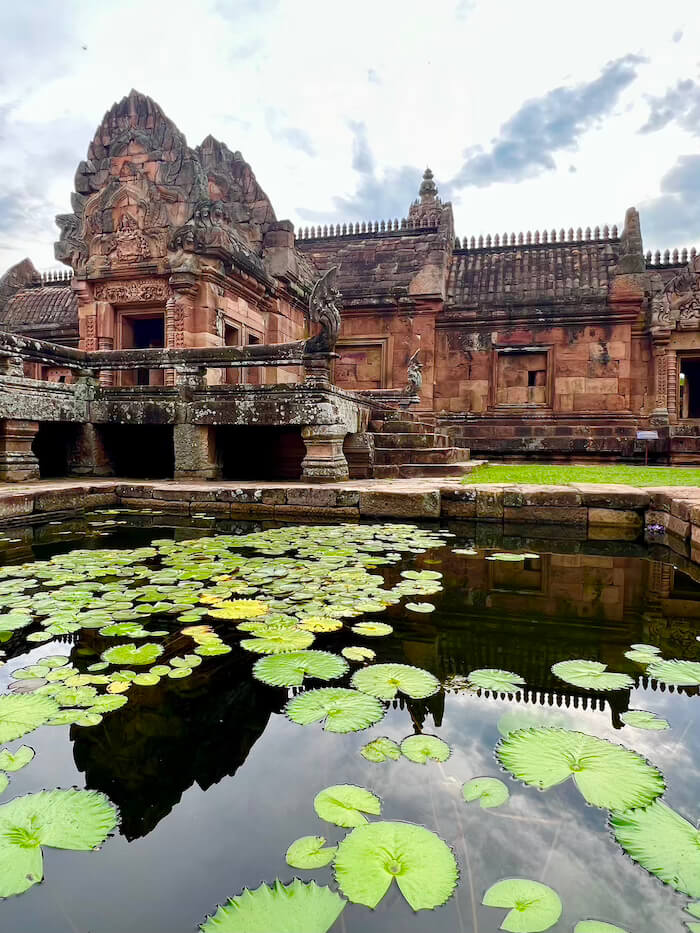
Long, low walls enclose the temple complex. At the center of each stands an ornate cruciform gate, opening onto paths that lead to the heart of the complex. Along these paths, dark pools thick with waterlilies reflect the caramel-colored stone.
I take a great deal of delight in walking such places. Asking three small children to sustain the same level of enthusiasm across multiple sites over several days, however, would have been ambitious. In the hope of sustaining their interest as long as possible, I’d created illustrated “temple packs” to build up their excitement.
It was our first formal attempt to integrate learning with travel—one of the early seeds that would later grow into our worldschooling adventure. Creating the lessons gave almost as much pleasure as teaching them, an early sign that this was something we should take seriously.
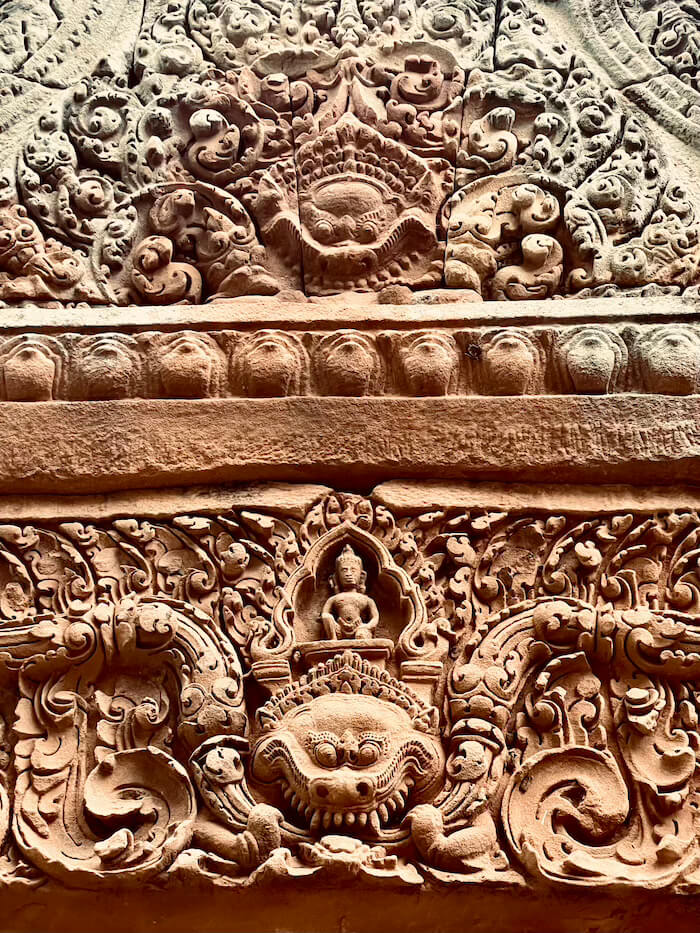
I’ll spare you the details of our little primer, but as an illustration of how it supports travel with kids, I offer you the Kirtimukha. In ancient Hindu architecture, you’ll often find a grotesque face carved into the lintel above a doorway—sometimes devouring its own tail. This is the Kirtimukha, sometimes called a Kala Mask, and there’s a reason for his fearsome face to appear so regularly in these holy places.
Explaining the legend to the kids has transformed them into Kirtimukha watchers, bringing to life an image that, while interesting, might otherwise blend into a hundred other such carvings. Context elevated the experience for the children, but telling the story, and truly understanding it myself, made the trip infinitely more fun for all of us. I intend it to be a regular feature of our travels.
It’s one thing to tell the kids the story of the Kirtimukha, quite another for them to hear that for some people, these angels and demons of legend are not only alive but warily watching those who visit their mountaintop abode. To walk among these strange stones is marvelous, sure, but perilous too.
Join us as we continue northwest to visit Thailand’s Largest and Best Preserved Khmer Archaeological Site at Phimai.
Plan Your Trip to Buriram and Phanom Rung
Some links below are affiliate links. At no extra cost to you, we earn a small commission if you make a booking, which helps us keep our family on the road. Thank you for your support!
Getting There
The Isan plains are vast, and while public transport exists, it isn’t always the most comfortable or efficient way to organize a journey to the specific temples.
By Car (Recommended): Having our own car is the only way to comfortably manage the heat and the distance between Muang Tam and Phanom Rung. Roads in Buriram are excellent and well-signed.
By Air: Buriram Airport (BFV) is the quickest gateway, with daily flights from Bangkok. From the airport, it’s about a 1.5-hour drive south to the temple sites.
By Train: The overnight sleeper from Bangkok to Buriram is a great adventure for kids. We recommend the #23 Special Express for the newest carriages. Once you arrive at Buriram station, you are still about an hour from the temples, so you’ll need to arrange a driver or a rental car.
Where to Stay
While there are places to stay closer to the temples, we’d recommend staying in nearby Prakhon Chai, which is just big enough to have everything you’ll need for a night on the road. There’s one obvious choice to stay here:
Experience surprising French-inspired luxury at Hotel de l’Amour, Buriram. This romantic retreat is built around a lake ornamented with lilies and lotus. It features an outdoor pool, premium spa, elegant suites, and a number of good restaurants.
Where to Eat
Prakhon Chai has a number of good options too, but after a long day of driving and visits to a national park and two archeological sites, dinner near the hotel isn’t a bad idea either. Watashi Japanese Restaurant is a solid choice.
When to Go
We’d recommend visiting Prasat Muang Tam first, followed by Phanom Rung. The latter is the more engaging of the two, and we find that increasing escalation of excitement works best for us.
The Solar Phenomenon: Four times a year (usually April and September for sunrise, and March and October for sunset), the sun aligns through all 15 doorways of Phanom Rung. It is spectacular, but extremely crowded.
The “Green” Season (May–October): As we experienced, the rains make the stone look incredible and the surrounding plains neon-green, but be prepared to get wet.
The Cool Season (November–February): The best time for walking the long promenades without melting, though this is also peak tourist season.
What It Costs
Entrance Fees: Joint ticket for adults is THB 150. Children are often free or half-price depending on height.
Parking: There is a small fee (usually THB 30-50) to park your car at the upper lot of Phanom Rung. I wouldn’t. Park at the bottom lot and enjoy the approach along the ancient promenade. I can’t image why you’d do it any other way.
Booking/Tours
Buriram is still very much off-the-radar for major tour operators. Your best bet is to rent a car at BKK or DMK airport or arrange a private driver to ensure you can craft an itinerary best suited to your interests and timeframes.