Driving to the Summit of Doi Inthanon
Doi Inthanon, the “Roof of Thailand,” is a two-hour journey from Chiang Mai. That sounds like a haul, until you realize that by the time you step out of the car at the end of the drive, you’ve already covered most of the climb to the 2,565-meter summit of Thailand’s highest peak. If you hadn’t noticed, the chill air will remind you of how high you’ve risen.
It’s fast and convenient, but as you speed up the slopes, it’s worth pausing to recognize that flying past your window is the most diverse range of forest types and bird species in the entire country. If you have the leisure, finding a way to spend more time in these highland ranges would certainly repay the effort.
This entry is part of our 10-Day Journey across Northern Thailand from Laos to Myanmar. To catch up on the previous leg of the trip, check out The 1095 to Pai: Fantastic Family Stops On Thailand’s (Fourth) Curviest Road.
Doi Inthanon’s Cloud Forest, Royal Pagodas, and Summit Trails
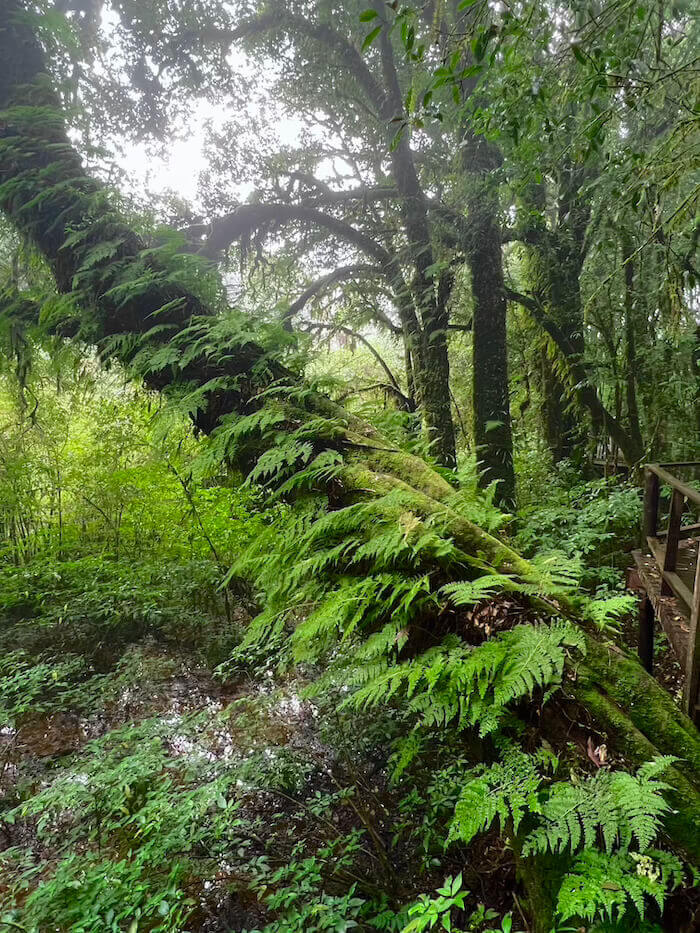
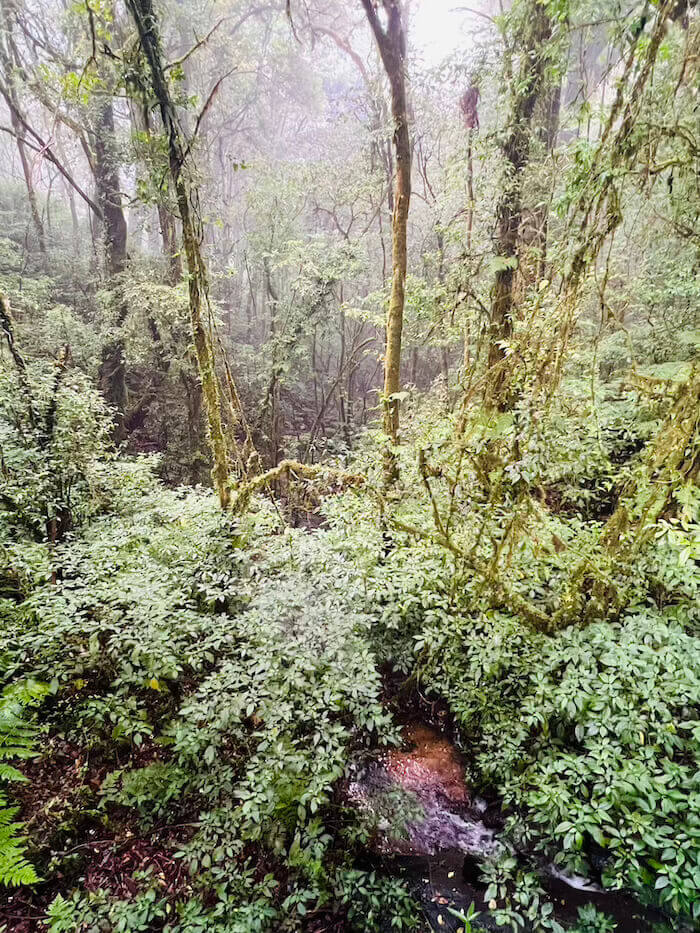
Near the summit, we first walked the Angka Nature Trail. It’s an easy amble through trees covered in deep moss and epiphytes. At this elevation, the cool of the mountain peaks condenses water-laden tropical air into rolling mists that never entirely lift. This feeds a riot of growth: from every surface, layers of green upon green, to who knows what depths.
You’ll also see the shrine of “Grand Prince” Inthawichayanon at the summit of Doi Inthanon. This 19th-century Prince of Chiang Mai dedicated himself to preserving Thailand’s highland forests and requested that he be buried at Thailand’s highest peak. The mountain now bears his name, though with a slightly more manageable transliteration for non-Thai speakers.
His burial shrine is a relatively modest stone structure that houses the chedi holding his ashes. It suits my tastes better than the Twin Royal Pagodas that are usually included as part of most Doi Inthanon tours. These were built in the 1980s and look every bit like it.
Hmong Market Along the Road to Doi Inthanon
On your trip to Doi Inthanon, you’re very likely to stop at one of several Hmong markets along the road, mostly selling locally grown produce like strawberries, cape gooseberries, and nuts, along with local spirits, crafts, and souvenirs.
If you’ve lived in a country for many years, no matter how novel it once was, the local market leg of any guided tour is not likely to be the most interesting stop. The “local” market has just become the shops down the road. It’s like going to a more localized version of Sainsbury’s.
To get the most out of these sometimes-unavoidable stops, I’ve started treating them as provisioning stops for our Touch Grass Cocktail Hour. The irony of these markets is that when you’re on the road, you rarely need fresh produce. Lovely aubergines, but you can’t always cook them at the homestay.
Shopping for a few things to build, garnish, or complement a cocktail later that evening puts you in the position of a genuine customer at the market. Not for a kilo of carrots, sure, but maybe for a decorative sprig of carrot greens? Decide to make a jug of mead, and suddenly you’re in the market for a few liters of wild honey.
Hiking the Pha Dok Siew Nature Trail with Kids
After lunch, we started down the 5.3-kilometer Pha Dok Siew Nature Trail. Given its downhill slope, we even had a fair chance of finishing it in the allotted 90 minutes. Not that there was any reason to rush; the trail passed through dense jungle that invited you to see what you could find.
I’ve mentioned before that walking with a local guide reminds how much we might be missing on independent hikes. Within fifteen minutes, he had pointed out three green pit vipers hidden in the jungle canopy—we’d seen only one in two hours at Doi Luang. Do I want to know that I’m surrounded by venomous snakes? Not really, but someone might.
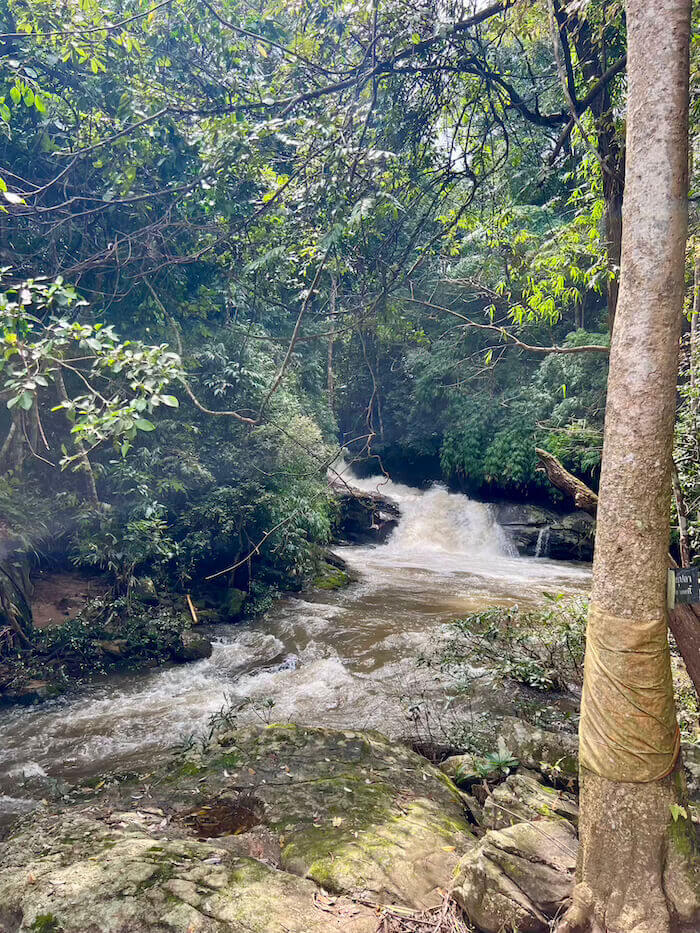
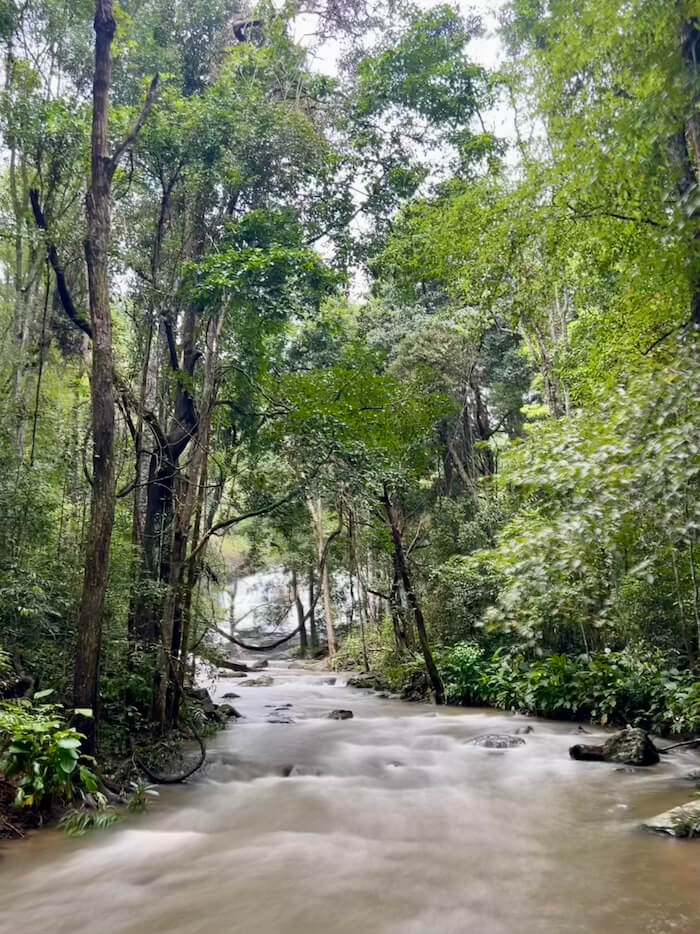
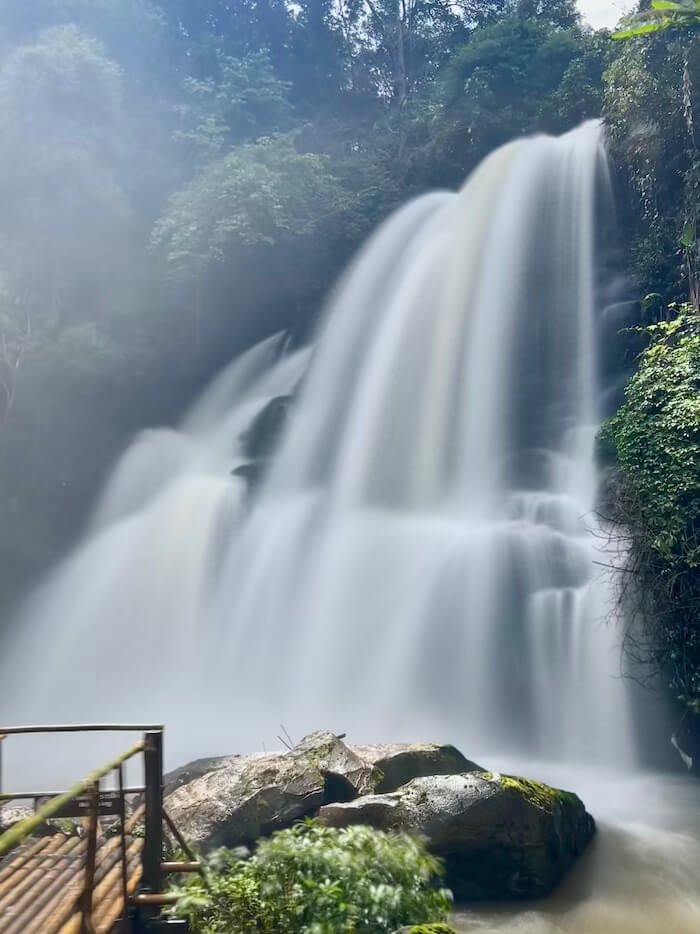
A distant roar announced that the mild river we’d been following was about to change its mood. The path grew steeper and soon became bamboo-banistered stairs running alongside a gathering waterfall. The river had become a cataract coursing through a narrow valley.
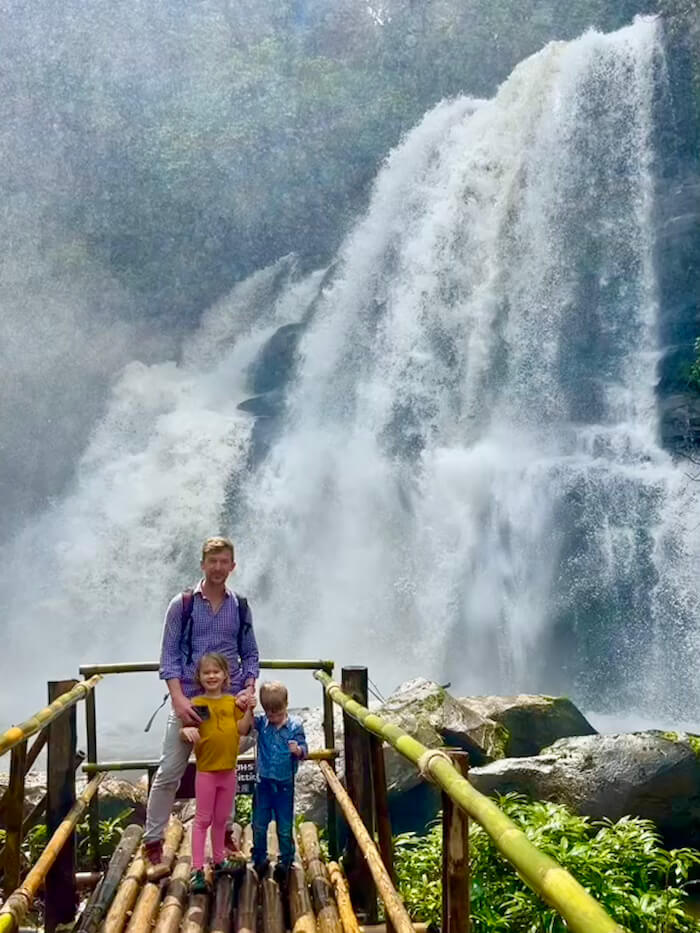
We climbed down the last set of stairs and stepped onto a bamboo walkway that extended over the foaming river. In mid-October, Pha Dok Siew was in full flood, and the bamboo bridge hardly seemed adequate to withstand the flow. It held, of course, but a constant mist left every surface slick with water, warranting extra caution with the kids.
We stood on this fragile construction with water thrashing beneath us and spray raining down from all sides. The roar was something you could feel in your chest. Short of falling in and joining the flow, we couldn’t have had a better demonstration of the river’s power.
From Waterfalls to Rice Fields: Walking to Ban Mae Klang Luang Village
The path soon turned away from the violence of the falls and entered gentler terrain. We followed a pleasant path that threaded its way through terraced rice fields and softly rolling hills. In so tame an environment, no harm could possibly befall… oh wait, Henry just fell off the road into a ditch. The current is slowly carrying him away. I’ll just quickly fetch him out of the water. Anyway, as I was saying…
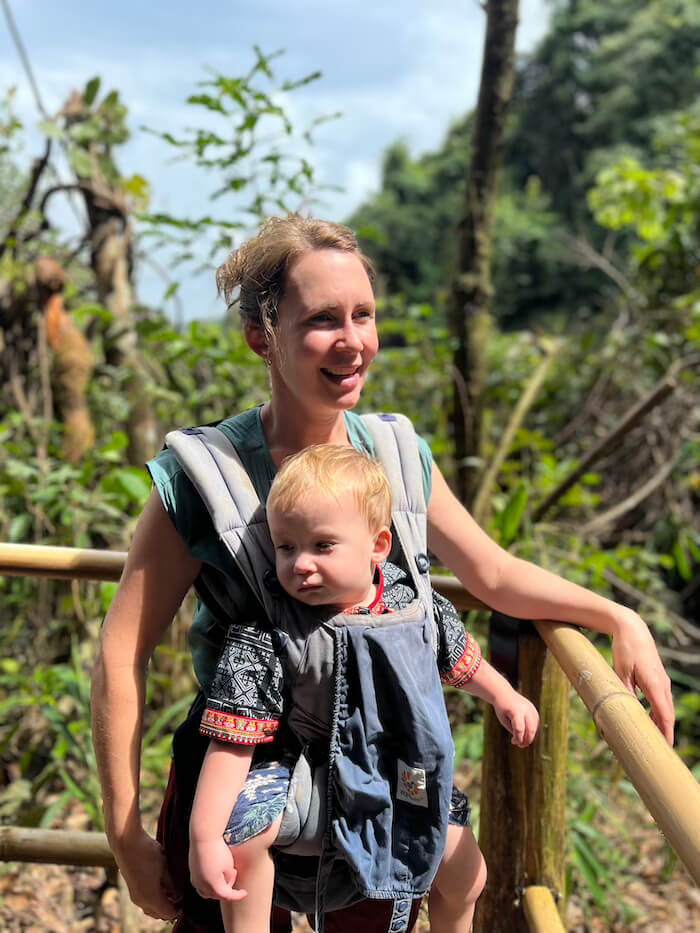
Comfort yourself knowing that my poor boy isn’t entirely safe anywhere: only a few weeks earlier, he fell neck-deep into the koi pond of a hotel lobby. This latest mishap aside, the whole route is ideal for family trekking. An easy path, mostly downhill, through jungle, among mountain cliffs and valleys, and past waterfalls. The final few kilometers provide an idyllic countryside setting which surrounds the charming village of Ban Mae Klang Luang.
Ending the Day Over a Cup
We sat on long benches in a dark room. Coffee roasting equipment of every kind, black from soot and the burned oils of coffee, surrounded us. As long-time admirers of Chiang Mai coffee, Kat and I eagerly agreed to sample a hand-brewed cup.

Our host ran arabica beans, roasted on site, through a manual crank grinder to produce a fine grind. This went into a long filter, over which he poured boiling water from a tin kettle. The result was a strong, slightly bitter brew which reinvigorated us after the long walk.
I’d have had another, but I could see to whom our Karen baristas had given their hearts. The coffee equipment set aside, our hosts focused instead on preparing sugary-sweet teas for the kids. I’d normally limit sugar and caffeine to some and none, respectively, but as the color came back to Henry’s still-damp cheeks, I thought maybe we’d let this one slide.
Plan Your Trip to Doi Inthanon
Some links below are affiliate links. At no extra cost to you, we earn a small commission if you make a booking, which helps us keep our family on the road. Thank you for your support!
Getting There
By Car: From Chiang Mai, the drive takes approximately two hours. Follow Highway 108 towards Chom Thong, then turn right onto Highway 1009. The road is well-paved but involves a significant, sustained climb to the 2,565-meter summit. Ensure your brakes are in good condition for the descent.
By Tour or Songthaew: If you aren’t driving, you can hire a yellow songthaew from the Pratu Chiang Mai Market or book a private driver. Most organized tours follow a standard “Top of the Mountain” circuit, which usually includes the summit, the Twin Pagodas, and a short nature trail walk.
Where to Stay
In Chiang Mai: With so many great hotels, you hardly need our recommendation for Chiang Mai, but we’re happy to provide one anyway. Below are a couple of our favorite old city hotels, both family-friendly.
99 The Heritage Hotel Located in the heart of the Old City, this elegant boutique hotel blends colonial grandeur with modern luxury. You’ll find an oasis of calm, chic black-and-white interiors, and a stunning pool just steps from the famous Sunday Walking Street.
The Chiang Mai Old Town Hotel Tucked inside the city’s ancient walls, this boutique sanctuary offers a peaceful family reset. Steps from golden temples and night markets, it’s the perfect base for exploring Chiang Mai’s vibrant historic heart. A straightforward Italian restaurant on the hotel grounds offers a nice change for when you’ve been on the road for the last week straight.
When to Go
The Cool Season (November to February): This is the peak time for clear skies and the famous “sea of clouds” at the Kew Mae Pan nature trail. Temperatures can drop to near-freezing at night, so pack accordingly.
The Lush Season (October): We visited in mid-October, and while the trails are likely to be a bit wetter, the waterfalls are at their most violent and spectacular. The rice terraces are a vibrant, neon green during this window before the harvest.
The Hot Season (March–May): This is the ultimate escape from the city’s 40°C heat, with summit temperatures rarely exceeding 25°C. While “smoky season” haze can obscure long-distance views, the trails are much drier and safer for kids than during the monsoon. You’ll trade thundering waterfalls for gentler flows and blooming orchids before the high-altitude trails close for recovery on June 1st.
Entrance to the national park costs THB 300 for adults and THB 150 for children, with an additional THB 30 fee per car. Keep your ticket handy, as it also covers entry to most other site in the park. The mandatory local guide for the Pha Dok Siew Nature Trail costs THB 200 per group, which supports the local S’Gaw Karen community. Note that the Twin Royal Pagodas are managed separately and require an additional 100 THB entry fee if you choose to visit them.
In the likely event you hire a guide, check the fine print to see which tickets and entry fees are covered as part of your booking.
Booking/Tours
Hiring a guide is mandatory for the Pha Dok Siew Trek. Fortunately, good options abound! Click below to schedule your Doi Inthanon visit:

Doi Inthanon Trip with Guided Pha Dok Siew Trek
- Duration: Full Day.
- Includes: Round-trip Chiang Mai transfers; set lunch, and park fees.
- Vibe: Small group tour. Children aged 1+ welcome.
- Flexibility: Free cancellation up to 24 hours before the trip starts.
- Cost: From THB 1,650 per person.