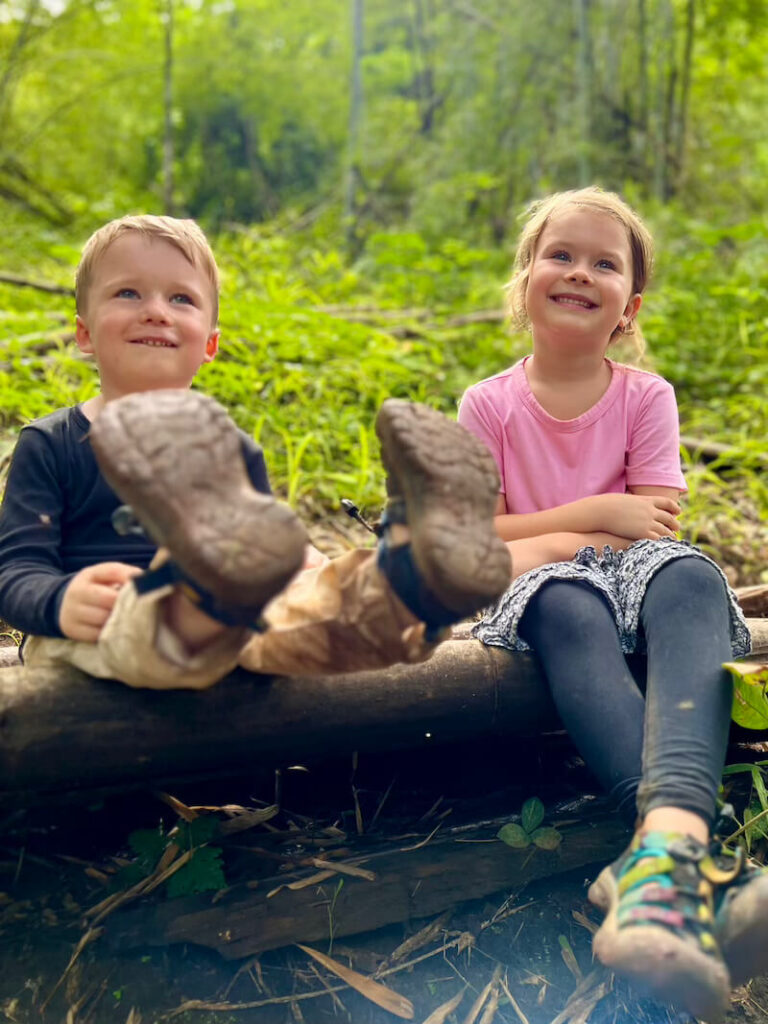
As we ate lunch in the Palong village of Pang Daeng Nai, just before beginning our walk through the Chiang Dao foothills, I ran through the cast of characters again. There were two adults in reasonably good shape, one of whom—let’s be honest, it was Kat—would carry infant Charlie. Isobel, aged five, already a reliable walker unlikely to complain any more than her parents.
The real wild card was Henry. Not yet four years old, he was still such a tiny thing. He’d shown his grit on long walks before, though, so I was optimistic he’d get through this one. The walk was only about three hours, but that’s a long way to carry a boy in your arms through the jungle, no matter how tiny he is.
This post is part of our 10-Day Journey across Northern Thailand from Laos to Myanmar. To catch up on the last leg of the trip, check out Chiang Dao Beyond the Summit: Golden Temples and Jungle Trails.
The Trek Begins: Machetes and Monsoon Paths
Because of school and work schedules, we’ve developed the questionable habit of planning long jungle treks during the mid-October break. While this suited our schedules very well, there’s no promise that the weather or conditions will cooperate.
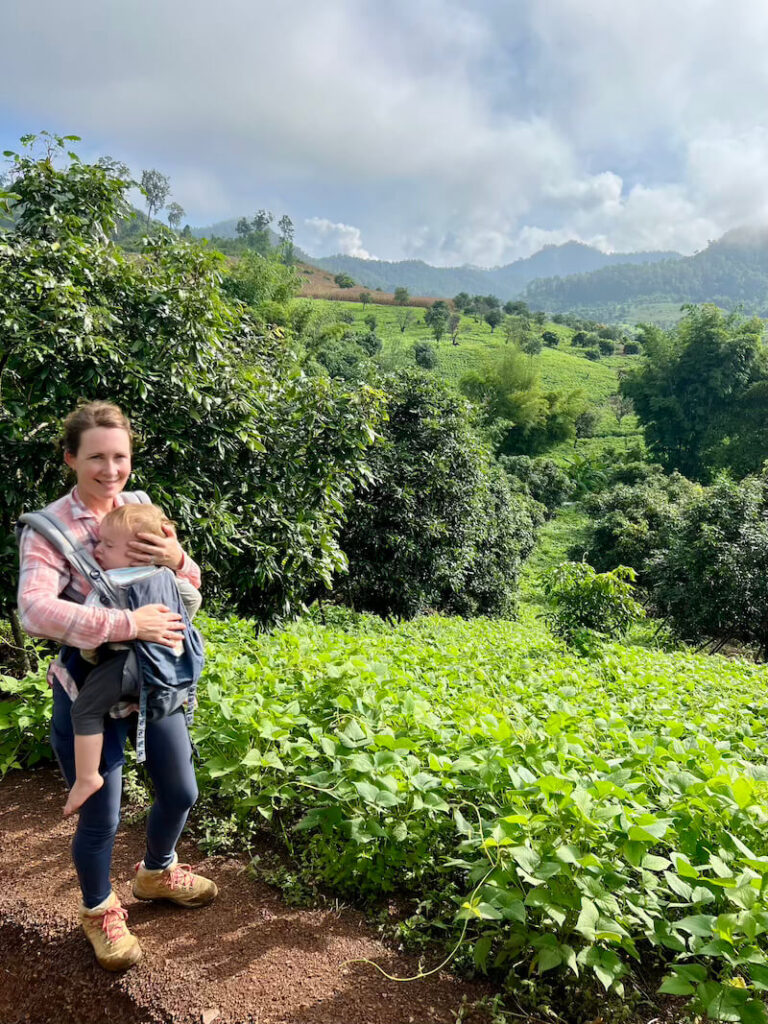
October is the end of the monsoon season, and you can expect occasional showers, though much lighter than those in August and September. Fed by monsoon rain and left undisturbed for months, the forest surges forward again, reclaiming the trekking paths hacked out during the high season.
Fortunately, we had a man for hacking. Along with our guide from Green Trails, a Dara-ang guide met us at the start of the walk, carrying a newly sharpened machete. Dressed all in black with a jaunty wide-brimmed hat, he looked magnificent. The kids gazed in awe as he chopped through vines and stands of fallen bamboo.
Dragon Blood and Gnome Hats
The path’s steepness began to increase, but so did the undergrowth. Our guide certainly had his cutting work cut out for him, but that meant plenty of rest for the rest of us. These proved to be perfect opportunities for the English-speaking guide to share the “secrets of the jungle.”
At one stop, the guide turned to us in mock horror, his hands apparently dripping with bright red blood. Before the kids could panic, he showed that he wasn’t the source, but that the “blood “came from the stems of a spiky, palm-like plant. The Dragon Blood Tree has sap that oxidizes when exposed to air, turning a convincing blood-red. It’s one of three plants native to these mountains that can delight children in this way.
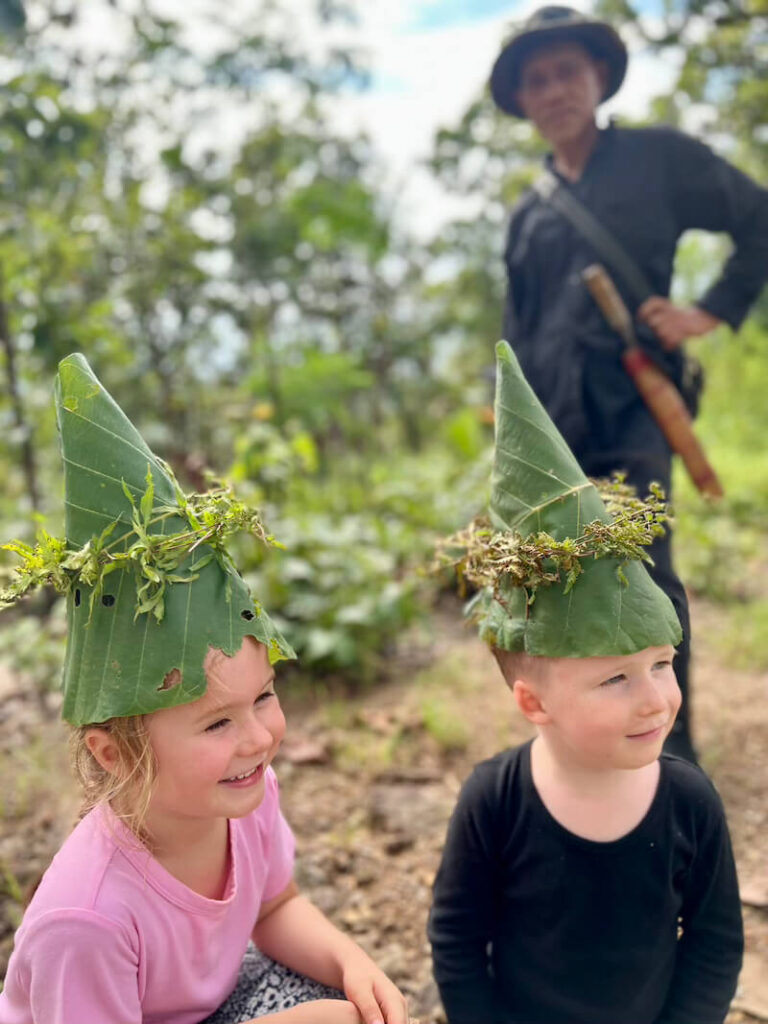
At another, he fashioned the kids’ first-ever broad-leaf gnome hats. Different guides across the region have since made half a dozen more of these for us, but I still maintain these first were the best. I wonder how every guide has come to learn these tricks, though given how useful these skills are in motivating the smaller hikers, it’s not surprising they are so widely shared.
Arriving at Mae Chon Village
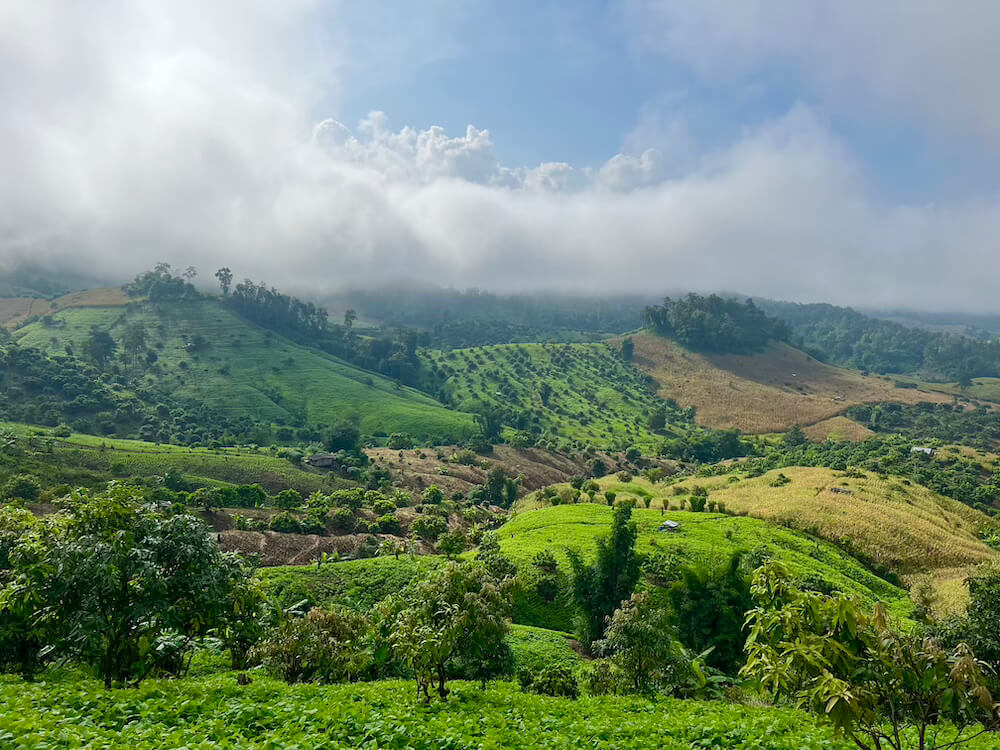
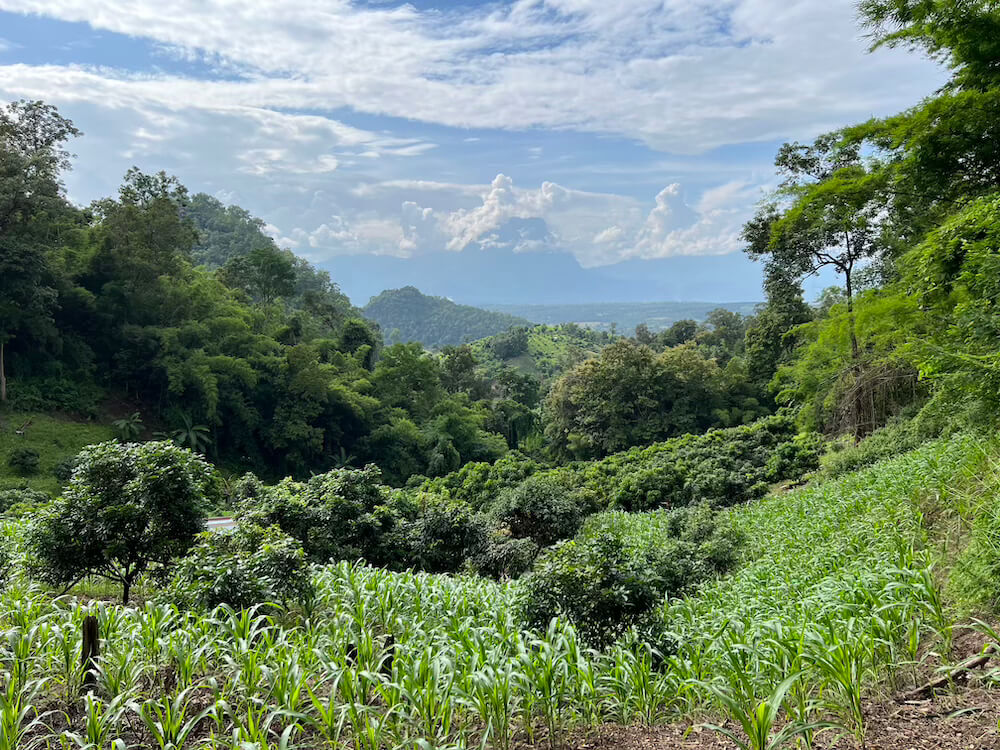
We crested a ridge, and the forest began to give way to corn and cabbage. In the distance, the massif of Chiang Dao was visible in the late afternoon haze. On these walks, I love nothing so much as the final hour, coming out of a jungle or a hard scramble into tame fields; walking through gardens and orchards to find a pleasant village set in a beautiful place.
This was Mae Chon, a small village set on a stream just on the border of Sri Lanna National Park. This was the home of our black-clothed guide, and the village was also Dara-ang (Palong), a group whose people emigrated from Myanmar’s Shan State in the 1980s.
This is the off-season, and the people of Mae Chon do not perform for us. They go about their work. Nobody wears the traditional red dress with silver belts and rattan hoops around their waists. If anyone is using the traditional “backstrap” looms, they’re not doing it for us to see. Whatever silver the Palong people are famous for working is stowed safely away.
This is fine. Wouldn’t it be amazing to walk into a village frozen in time, with clothes and customs unchanged for generations? Sure, but far better to see people as they are. I’d rather meet someone comfortably wearing a tracksuit than reluctantly wearing what, for the younger generations, has become a costume. Still, I’m a romantic, and to see some of the older women in the village wearing tall, hand-wrapped turbans, worn to soften the dig of a tumpline, speaks to what one would once have seen.
It is all vanishing so fast. As has always been, exciting new things will take their place, but I urge you to go right now and see what you can while it lasts.
An Overnight Homestay in Mae Chon Village
We unpacked our bags and set up our beds in a long room with a row of mosquito-net crowned mattresses. The mattresses in the long house are thin, but the rattan beneath them has enough give to promise a good sleep. Across the courtyard, our hosts prepared dinner over a kitchen fire.
Arrivals always follow the same pattern. The children of hosts and guests watch each other skeptically. Early attempts at contact misfire or are misunderstood. Within an hour, they’ve usually (but not always) bridged the gap and come to some kind of understanding. Often, actual playing breaks out.
They’re very young still, but our kids are remarkably shy. I’m proud of their work today, though, and fall asleep thinking of all the new places we can go with their expanding range.
Roosters and the Morning Market in Mae Chon
Rural villages have many charms, but roosters are not one of them. You see them stalking proudly around the village during the day and somehow forget that in only a few hours, they’ll wake you up well before any hint of the sun. How farmers the world over don’t leave them to the foxes, I’ll never know.
As we ate breakfast, I saw the same women and girls who the evening before had played with our children were now dressed in traditional Palong clothes. From large plastic bins, they pulled out hundreds of items and arranged them in rows on low tables all around us.
Maybe it was grumpiness from my avian alarm, but the only people who seemed less happy to be facing a traditional market this quiet morning were the women setting it up. They must surely have recognized that even if we were the most eager shoppers imaginable, we couldn’t buy more than we could carry down the mountain.
It would have felt different, no doubt, if we had been among a troop of happy customers. But there was only us. The market was here, and I didn’t see how we could escape it. Well, we couldn’t escape it, but I could. Through no fault, interest, or if I’m honest, skill of her own, we had appointed Kat as our commercial representative and she would handle it.
Something is Sold
This would not be an easy transaction. The items for sale were familiar from any Thai night market: small bags, jewelry, scarves, and hair accessories. Each vendor sat behind an array of barely distinguishable goods. We would have to visit each and then choose whom to disappoint as much as whom to please.
The rubber elastic of the bracelet we bought for Isobel broke less than an hour later, scattering colored plastic beads into the dirt. She cried for a piece of jewelry she didn’t need, that we hadn’t wanted to buy, and that I suspect the seller took little pleasure in offloading.
This too is a part of travel: the awkwardness of assuming a role, and the awkwardness of others assuming a role because of you. I don’t always know how to handle these moments gracefully, caught between the fear of exploiting and wariness being exploited. It’s an immensely valuable lesson to learn, and, eventually, to teach. The price of a bracelet is tuition we can happily afford.

Up next: The family continues towards Myanmar, braving (the decidedly unfearsome) Highway 1095. Read about our trip to Pai and the Fantastic Family Stops On Thailand’s (Fourth) Curviest Road.
Plan Your Trip to Chiang Dao
Some links below are affiliate links. At no extra cost to you, we earn a small commission if you make a booking, which helps us keep our family on the road. Thank you for your support!
Getting There
The Drive: Chiang Dao is approximately 72 km (1.5–2 hrs) north of Chiang Mai via Highway 107.
Transport: While local buses run hourly from Chiang Mai’s Chang Phueak Bus Station (~THB 60), we highly recommend renting a car or hiring a driver (like our curious friend Sumo) to reach the more remote trailheads like Sri Sangwan or Doi Mon Ching.
Navigation: Mobile reception is notoriously spotty near the national park boundaries. Download offline maps before leaving town.
Where to Stay
Most independent travelers stay in the “Ban Tham” area near the base of the mountain. It offers a ghostly quiet atmosphere in the off-season but provides easy walking access to the Temple Caves and Wat Tham Pla Pong.
Sky The Campers This is the “luxury” option, but it’s not the amenities your paying for, it’s the location and the kitschy cool of sleeping under the starts at the base of the mountain that reaches the stars.
Yang Tone Farm Stay One of many quality farmstays in the Chiang Dao foothills. Simple but comfortable accommodation with stunning views of the mountain. Baan 2 Dao is another good variation on this theme.
Marisa Resort and Spa Popular with the trekking companies, this resort offers more amenities than the farm stay, but also more variation in the quality of accommodation. Very quiet in the off-season.
When to Go
Cool Season (Nov–Feb): The best time for clear views of the peak and comfortable hiking.
Rainy Season (June–Oct): The jungle is at its most vibrant green. While some summit trails close for safety, the Sri Sangwan waterfall is at its most impressive. Note: Sections of the caves may be inaccessible if water levels rise too high.
Wat Phra That Doi Mon Ching is typically open all day, but best visited during daylight hours, of course. Entry is free.
Sri Sawang Waterfall is inside Pha Daeng National Park, which costs THB 100 for adults to enter. The park is generally open daily from 8:30 AM to 4:30 PM.
Chiang Dao Caves are open daily from 7:00 AM to 5:00 PM. Entry is THB 40. Exploring the deeper, unlit chambers with a local guide and kerosene lantern costs an additional THB 200 per group.
Wat Tham Pla Pong is officially open 24 hours, though visiting between 6:00 a.m. and 5:00 p.m. is recommended for daylight on the forested path and respect for the monastery grounds. Free, but you may wish to make a small donation.
Booking/Tours
For multi-day treks, it’s hard to beat the Chiang Dao (and wider Northern Thailand) specialists at Green Trails. They can arrange private tours on virtually any basis.
Other operators arrange longer-term trips as well, and the best reviewed (and most interesting itinerary) that I’ve seen so far comes from ForeverVaction via Get Your Guide:
Chiang Dao Trekking & Hidden Village Adventure
- Duration: 2 Days.
- Includes: Round-trip Chiang Mai transfers; 2 lunch and 1 dinner, and overnight in Ban Mae Maeh village included.
- Vibe: Private tour and private transfers. Approximately 3-4 hours of trekking and a simple overnight homestay.
- Flexibility: Reserve now, pay later with free cancellation.
- Cost: From THB 15,508 per person, half-off for children, and infants free.
For those with tighter schedules, it might make more sense to book a day trip out of Chiang Mai. Like this well-regarded Temple Cave and Hill Tribe excursion:

Chiang Dao Cave and Hill Tribes
- Duration: 8 Hours.
- Includes: Round-trip Chiang Mai transfers; meals not included.
- Vibe: Group travel, children welcome.
- Flexibility: Reserve now, pay later with free cancellation.
- Cost: From THB 1,600 per person, discounts available for children.