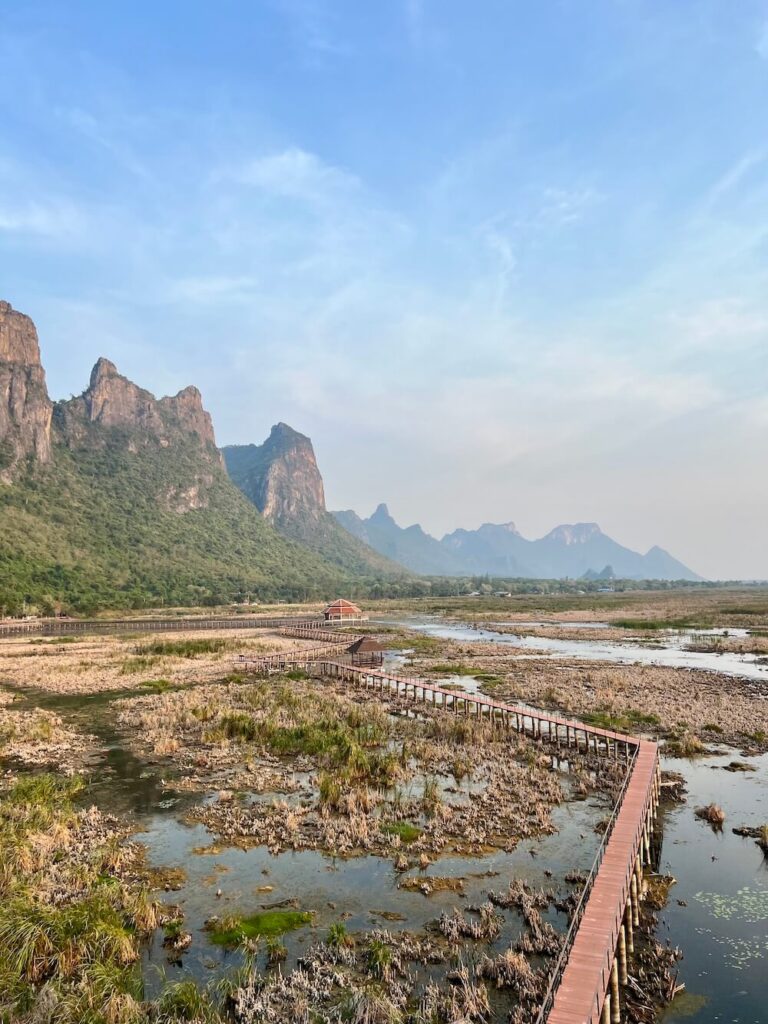
Doi Luang Chiang Dao may only be Thailand’s third highest mountain, but it is easily the country’s single most impressive peak. A limestone massif towering above the tropical lowlands, Doi Chiang Dao’s dramatic rise inspired locals to give it its original name: Doi Piang Dao, the Mountain That Reaches the Stars.
With three kids between the ages of one and five, we wouldn’t be climbing to the stars for a few more years yet, but the Chiang Dao Wildlife Sanctuary and the neighboring Pha Daeng and Si Lanna national parks are rich with activities for non-mountaineers.
This post is part of our 10-Day Journey across Northern Thailand from Laos to Myanmar. To catch up on the prior leg of the trip, check out The Wild Solitude of Doi Luang: Hiking Phu Kaeng Waterfall.
Chiang Dao and its foothills are studded with gilded temples and laced with glittering caves. Fields carved out of mountainside jungle support hill tribe villages willing to welcome visitors for an overnight stay. Here, physics feels more like suggestions than a rule; golden boulders balance on single strands of hair and water flows over rocks that grip rather than slip. Sticky waterfalls like Bua Tong and Sri Sangwan may not reach the stars, but what a climb all the same.
Myanmar in Miniature: Chiang Dao’s Wat Phra That Doi Mon Ching
The promise of trekking in Chiang Dao brought us two hours north from Chiang Mai. My love of rugged peaks grew from a childhood spent in the United States’ Rocky Mountains, and while I knew I couldn’t climb this one yet, I could at least gaze at it while we walked around its gentler reaches.
Before we started walking, though, our guides at Green Trails wanted to share the culture of those who had made Chiang Dao home. I had always regretted that during my years in Cambodia, I never made the effort to visit Myanmar. In the decade since then, the trip has only grown more fraught. Fortunately, Wat Phra That Doi Mon Ching offers a glimpse of the romance of old Burma from the safety of Northern Thailand.
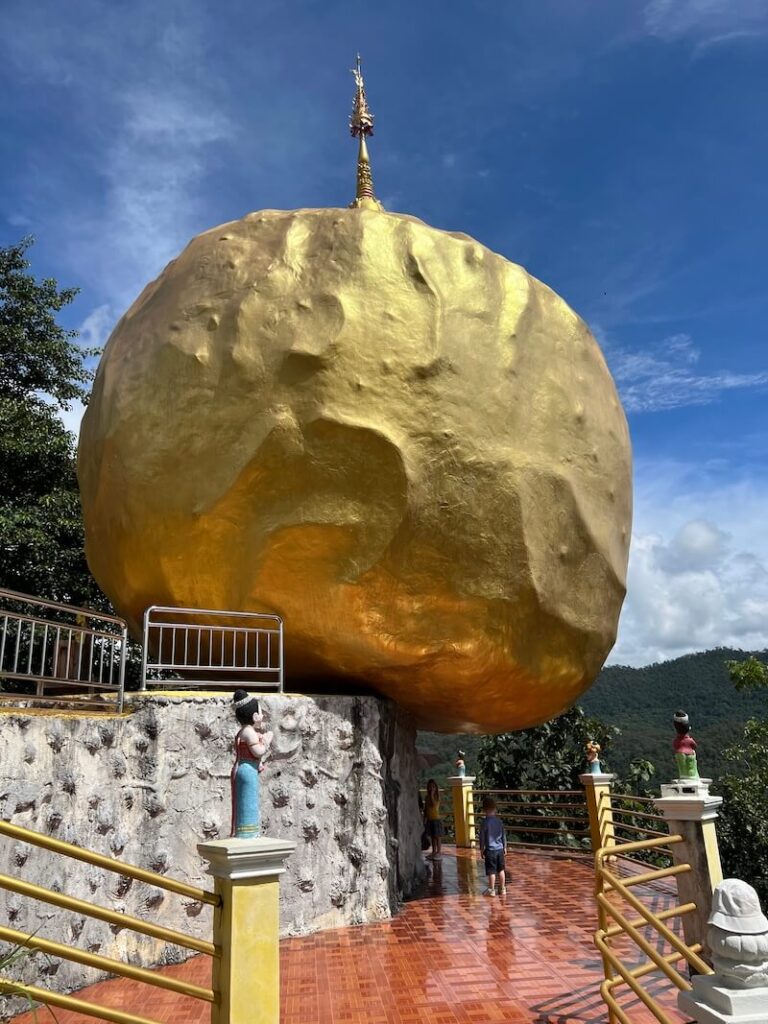
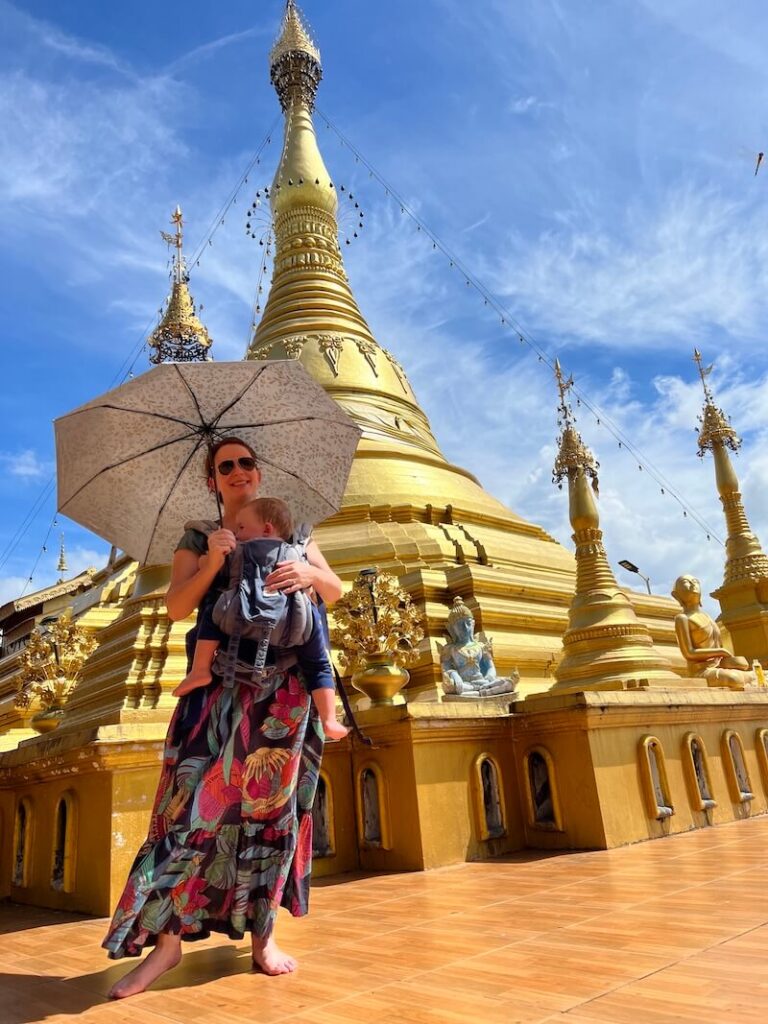
The Tai Yai people, who migrated here from Myanmar’s Shan State centuries ago, have honored their heritage by constructing a temple complex that includes a golden chedi strikingly reminiscent of Yangon’s Shwedagon Pagoda. On the same site stands a precariously balanced golden stone that mirrors the Kyaiktiyo Pagoda.
These Thai counterparts are more than ersatz copies. If they lack the full splendor of the originals, they are genuine places of worship. The golden, umbrella-shaped crowns atop the chedis, known as hti, make clear that these can be nothing other than Burmese temples.
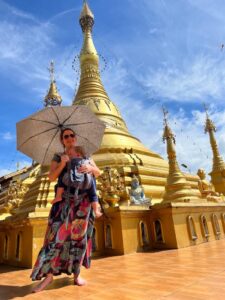
Kat was clearly swept up in the romance. In the photos, she is carrying a parasol, though I don’t recall her having one at the time and can’t imagine where she found it. Unlike the original golden stone in Myanmar, this is one you can walk fully around, and even under. The kids were happy to do so, not at all bothered by the legend that the only thing keeping it from crashing to earth is a single strand of the Buddha’s hair.
The Sticky Waterfall of Sri Sangwan, Where Gravity Takes a Holiday
We continued the theme of physics-defying stones at the Sri Sangwan waterfall, where sheets of water pour over travertine terraces ten meters high. Despite the continuous flow of water, the microporous limestone “grips” hands and feet, allowing you to walk right up the nearly vertical face of the living falls.
Henry, four years old at the time and undercoordinated even on dry pavement, was overjoyed at his newfound ability to scale walls of water. He could hardly believe it was happening. On the lip of the highest terrace, with a beaming face, he very literally danced a jig.
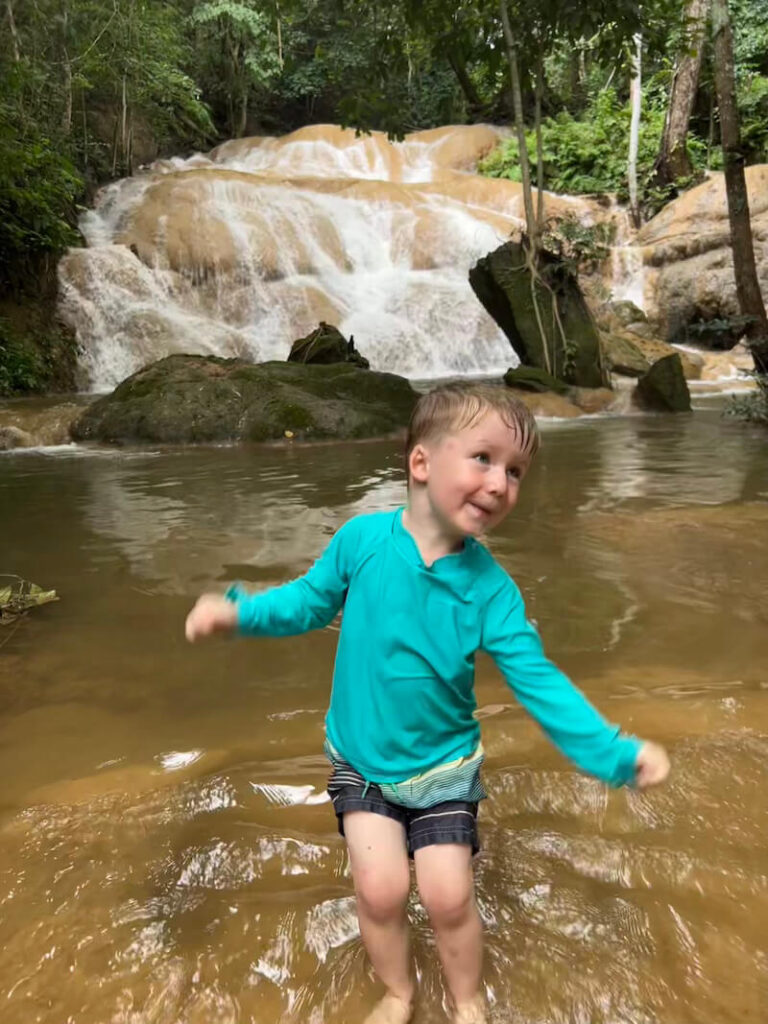
If you also plan to visit the more famous Bua Tong sticky waterfall, try to arrange to see Sri Sangwan first. It is the more modest of the two, but that doesn’t mean it isn’t worth visiting. It is a tamer experience with less traffic and more room to play freely without getting in anyone’s way.
There’s no better introduction to the peculiar pleasure of the sticky waterfall. It makes no sense that the easiest path through a steep jungle bank is straight up a wall of rushing water, but so it is. It’s enough to drive a person to dance.
Chiang Dao Temple Caves: Big Bugs in Perpetual Darkness
After a night spent in the ghostly quiet of an off-season resort, we headed straight for another slightly eerie setting: the Chiang Dao Temple Caves. Beneath the cave entrance, the path skirts the base of the limestone cliff. The immediate surroundings are crowded with stone chedis in various states of repair. Many are heavily weathered and covered in thick, green moss. Niches carved into the cliff face shelter spirit houses and images of the Buddha.
A short, covered path leads into the cave and its main chamber, Tham Phra Nawn, where a large sleeping (rather than reclining) Buddha lies gilded in gold leaf. Other religious statuary surrounds him, their white faces and tiered hti crowns suggesting Burmese origins. Much of the pleasure of this cave, and the adjacent Tham Seua Dao, or Star Tiger Cave, lies in the scattered shrines and images tucked among glittering stalactites.
By this point, it was clear our guide had not expected us to dare the unlit parts of the cave. Accessible only when accompanied by a local guide carrying a kerosene lantern, Tham Maa (Horse Cave), Tham Kaew (Crystal Cave), and Tham Nam (Water Cave) offer a grittier experience. We are very much in favor of grit.
The guide, usually a woman from one of the surrounding villages, carries a kerosene lantern. The lanterns cast a less steady, but far more dramatic light onto the dark cavern walls. Reaching these deeper chambers requires squeezing through a narrow, twisting passage, for once turning the kids’ size into an asset. For Kat, carrying a distinctly unimpressed Charlie, it was a bit trickier.
On the other side, the passage opens to soaring heights, but for the kids, the fascination was more immediate. Our guide to the cavern was quite skilled at identifying and, with her flickering lantern, illuminating the cave’s various inhabitants. Giant cave crickets with spindly legs and antennae three times the length of their bodies navigate the darkness. True to their name, cave huntsman spiders build no webs, but instead stalk their prey in perpetual blackness.
Wat Tham Pla Pong: Wisdom Wasted on the Kids
Returning to the light, I am amazed at my children’s resilience in the face of these troglophilic insects and arachnids. I would have been terrified at their age, but more amazing is that these are kids who not so long ago ran screaming from butterflies in a meadow in Zhejiang. They have come a long way from their early childhood in Shanghai, where even bees and ants struggle to survive the city’s vast stretches of concrete.
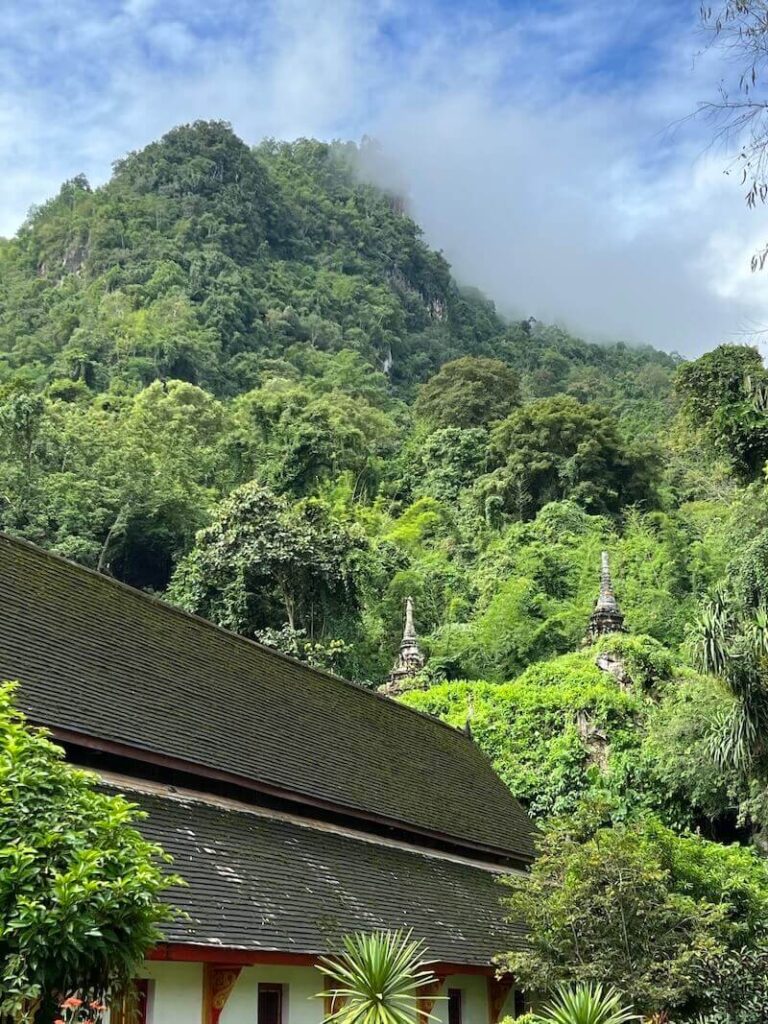
The 510 steps to Wat Tham Pla Pong zigzag up a forested cliff face. Plaques affixed to the trees bear inscriptions that are more clichéd than profound, but reading them aloud breaks up the walk. “He who knows how to be content is the richest person,” I say, sharing out fewer rice crackers than the kids would like. While Henry takes his time with the shared water bottle, I remind Isobel that “patience is the most beautiful ornament of a human being.” These proverbs do not inspire them, though this might be a case of the medium undermining the message.
As we count down the final steps, a golden chedi set on a limestone outcrop comes into view. Near its base, a small vent in the rock houses images of monks and more golden Buddhas. But it is the view over the Chiang Dao valley that inspires most here. Tomorrow, we will hike through these jungle hills.
But first, we must descend. The kids ask for more rice crackers, I respond with a question of my own: “Where does suffering dwell? Nowhere else but in the minds that grasp and cling.” I enjoy the walk down very much.
Continue on the next leg of our journey and learn What We Carried Through the Chiang Dai Foothills.
Plan Your Trip to Chiang Dao
Some links below are affiliate links. At no extra cost to you, we earn a small commission if you make a booking, which helps us keep our family on the road. Thank you for your support!
Getting There
The Drive: Chiang Dao is approximately 72 km (1.5–2 hrs) north of Chiang Mai via Highway 107.
Transport: While local buses run hourly from Chiang Mai’s Chang Phueak Bus Station (~THB 60), we highly recommend renting a car or hiring a driver (like our curious friend Sumo) to reach the more remote trailheads like Sri Sangwan or Doi Mon Ching.
Navigation: Mobile reception is notoriously spotty near the national park boundaries. Download offline maps before leaving town.
Where to Stay
Most independent travelers stay in the “Ban Tham” area near the base of the mountain. It offers a ghostly quiet atmosphere in the off-season but provides easy walking access to the Temple Caves and Wat Tham Pla Pong.
Sky The Campers This is the “luxury” option, but it’s not the amenities your paying for, it’s the location and the kitschy cool of sleeping under the starts at the base of the mountain that reaches the stars.
Yang Tone Farm Stay One of many quality farmstays in the Chiang Dao foothills. Simple but comfortable accommodation with stunning views of the mountain. Baan 2 Dao is another good variation on this theme.
Marisa Resort and Spa Popular with the trekking companies, this resort offers more amenities than the farm stay, but also more variation in the quality of accommodation. Very quiet in the off-season.
When to Go
Cool Season (Nov–Feb): The best time for clear views of the peak and comfortable hiking.
Rainy Season (June–Oct): The jungle is at its most vibrant green. While some summit trails close for safety, the Sri Sangwan waterfall is at its most impressive. Note: Sections of the caves may be inaccessible if water levels rise too high.
Wat Phra That Doi Mon Ching is typically open all day, but best visited during daylight hours, of course. Entry is free.
Sri Sawang Waterfall is inside Pha Daeng National Park, which costs THB 100 for adults to enter. The park is generally open daily from 8:30 AM to 4:30 PM.
Chiang Dao Caves are open daily from 7:00 AM to 5:00 PM. Entry is THB 40. Exploring the deeper, unlit chambers with a local guide and kerosene lantern costs an additional THB 200 per group.
Wat Tham Pla Pong is officially open 24 hours, though visiting between 6:00 a.m. and 5:00 p.m. is recommended for daylight on the forested path and respect for the monastery grounds. Free, but you may wish to make a small donation.
Booking/Tours
For multi-day treks, it’s hard to beat the Chiang Dao (and wider Northern Thailand) specialists at Green Trails. They can arrange private tours on virtually any basis.
Other operators arrange longer-term trips as well, and the best reviewed (and most interesting itinerary) that I’ve seen so far comes from ForeverVaction via Get Your Guide:
Chiang Dao Trekking & Hidden Village Adventure
- Duration: 2 Days.
- Includes: Round-trip Chiang Mai transfers; 2 lunch and 1 dinner, and overnight in Ban Mae Maeh village included.
- Vibe: Private tour and private transfers. Approximately 3-4 hours of trekking and a simple overnight homestay.
- Flexibility: Reserve now, pay later with free cancellation.
- Cost: From THB 15,508 per person, half-off for children, and infants free.
For those with tighter schedules, it might make more sense to book a day trip out of Chiang Mai, Like this well-regarded Temple Cave and Hill Tribe excursion:
Chiang Dao Cave and Hill Tribes
- Duration: 8 Hours.
- Includes: Round-trip Chiang Mai transfers; meals not included.
- Vibe: Group travel, children welcome.
- Flexibility: Reserve now, pay later with free cancellation.
- Cost: From THB 1,600 per person, discounts available for children.