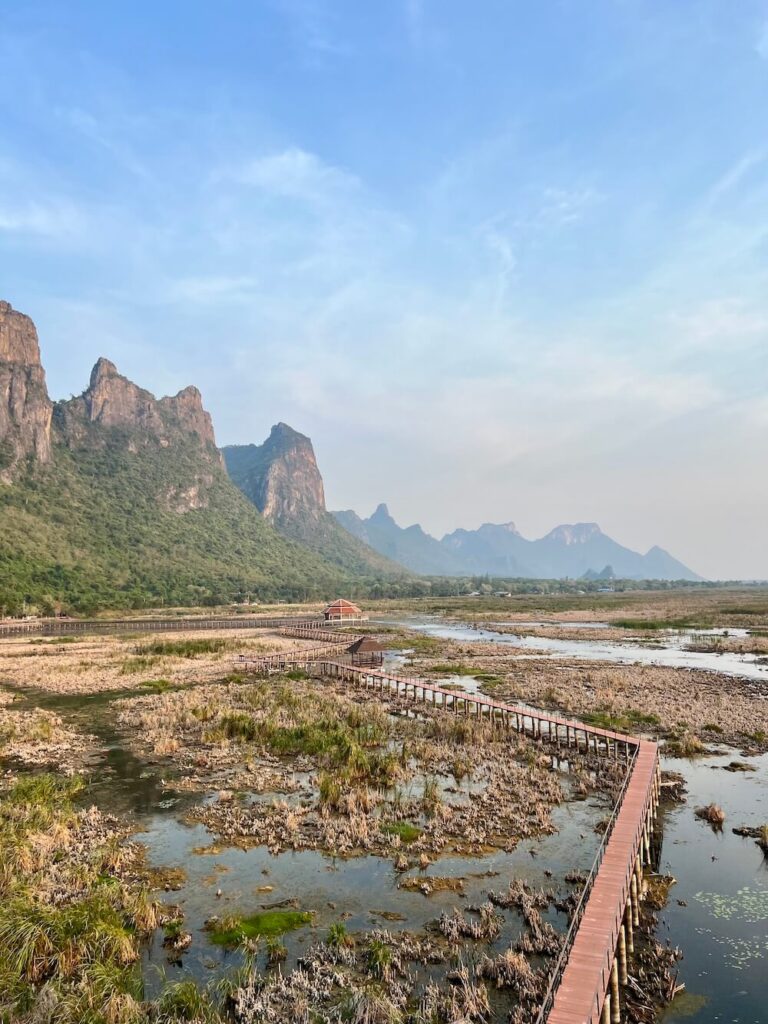
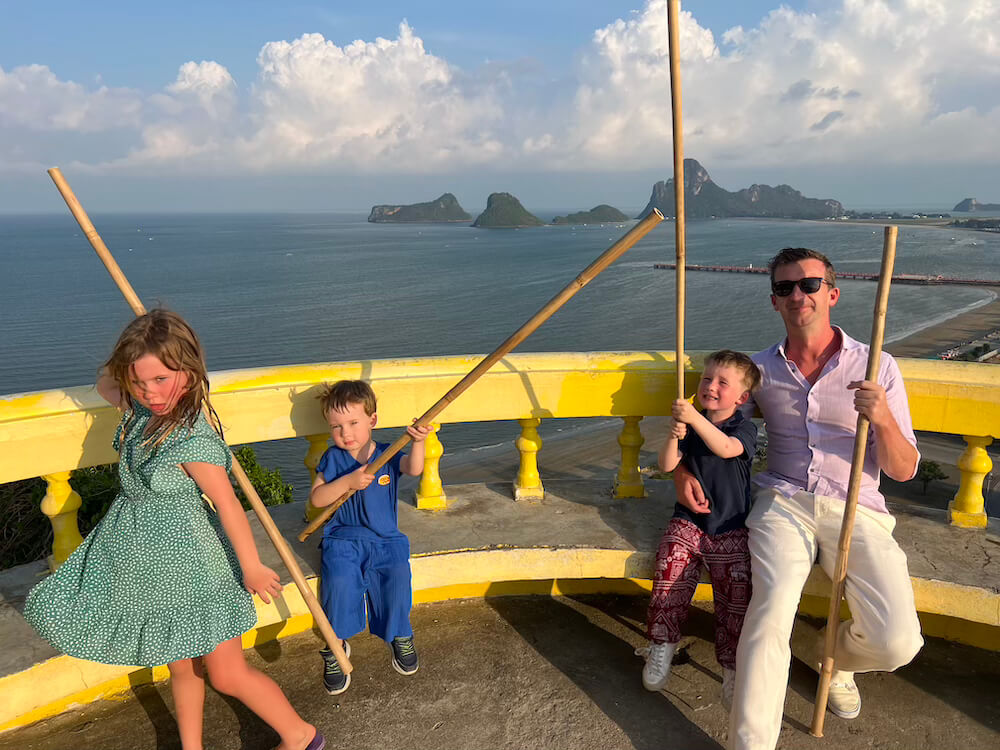
Tucked into the far northeastern corner of Thailand, Nan Province lies well beyond the usual travel circuits. It is a long, green valley hemmed in by high mountain ranges on either side, with the Nan River meandering gently through the lowlands between them. At the center of it all sits the ancient city of Nan, quiet and unassuming, but rich with history.
We spent three days and two nights exploring the city and the surrounding hills and valleys. From the Tai Lue-style murals at Wat Phu Min to chocolate plantation tours at Cocoa Valley Café, there’s plenty here to justify the journey.
By the end of our first day, sharing evening cocktails while the kids ran through the rice fields behind Nan Seasons Boutique Resort, we had already fallen for the place.
Just joining the trip? Catch up by Chasing a Sea of Clouds at Phu Langka.
Lunch at Huanam Mushroom Farm
Our drive to Nan began just after the sun had burned away the last morning mists of Phu Langka. We were in no hurry to leave this remarkable view and lingered over coffee at Magic Mountain Café. Only when Henry fell off one of the elevated, Instagram-facilitating photo platforms did we agree to get on the road again.
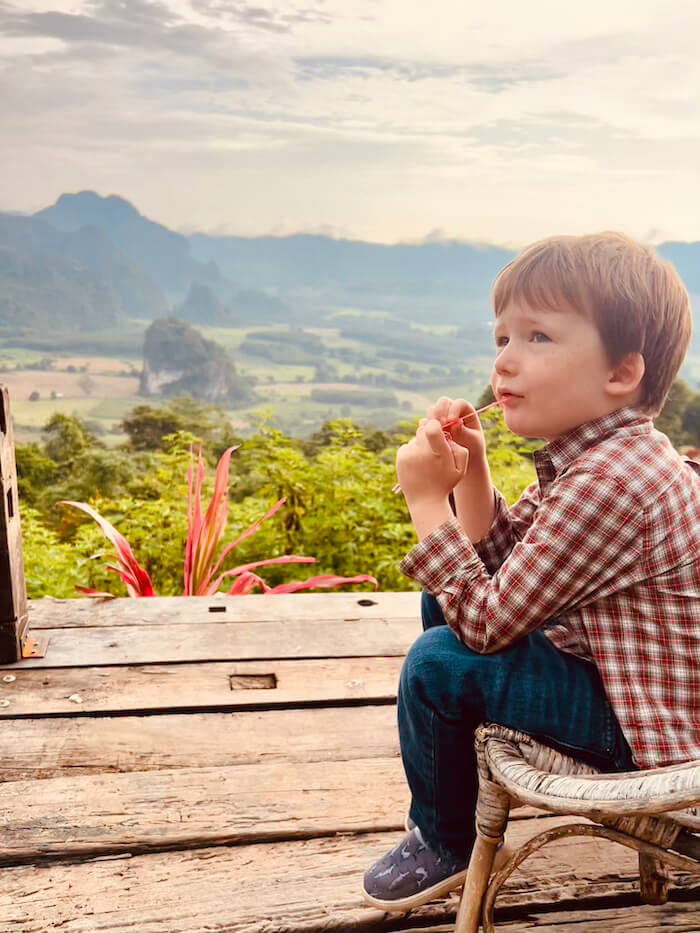
There was no need to rush. The drive along Highway 1148 continued to thrill, reinforcing its reputation as one of the world’s great motoring roads. With so late a start, this was a drive straight to lunch, which we’d planned at Huanam Mushroom Farm simply because the idea of a mostly mushroom meal was too fun to skip.
As it turns out, you can probably skip it. While all the dishes featured mushrooms, none seemed especially interested in letting their flavors shine. The grounds are pleasant, though, and the hillside setting offers lovely views. We’ve found that in Thailand, most restaurants will offer at least one of the three: excellent food, good views, or friendly service. You rarely lose entirely.
Rice Valley Views from Wat Phuket
Continuing south toward the city of Nan, the river valley began to broaden. Steep highland slopes gave way to rice fields which, in mid-October, were still a vibrant green. One of the best vantage points for this marvel of color is Wat Phuket, where elevated platforms look out over the valley floor.
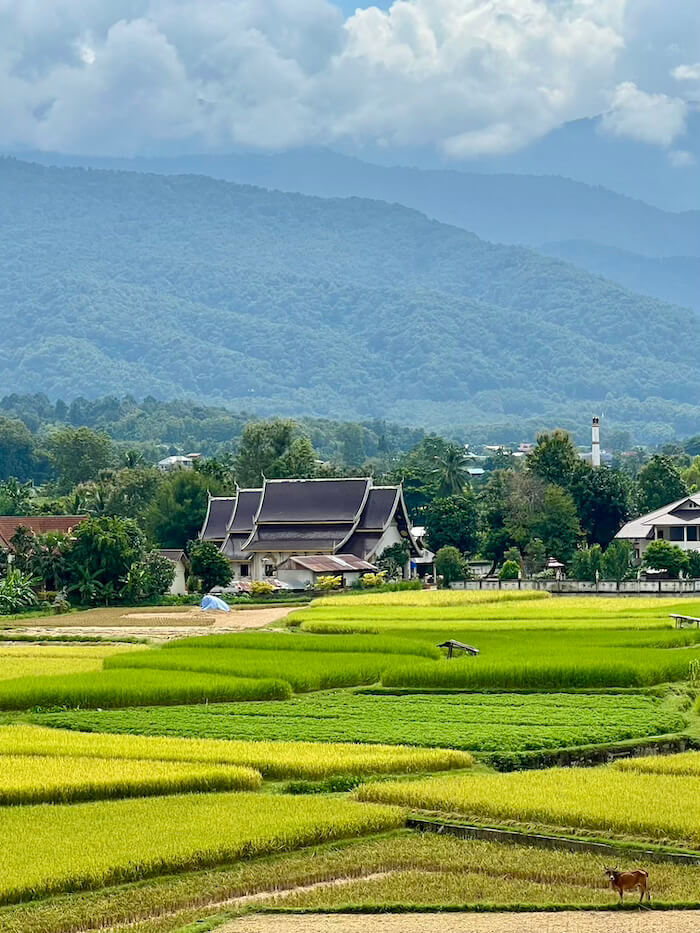
Pro tip: To capture the most dazzling photos of rice paddies, timing often matters more than location. At noon, Wat Phuket’s famous fields were outshone by the rice paddies behind our hotel later that evening, when the light had finally softened.
I confess, I couldn’t tell you much about Wat Phuket itself, though I do recall an active compound and a friendly welcome. This is primarily a photo stop, but a short wander through the busy temple complex is not a bad way to spend half an hour.
Chocolate in the Hills: Cocoa Valley Café
We decided to give chocolate a chance to do for theme restaurants what mushrooms could not, and booked a tour and chocolate-making class at Cocoa Valley Café. Chocolate, like coffee, is a relatively recent arrival in Thailand, but one that is finding a home in the country’s temperate north.
The tour began with a songthaew ride from the café to a small patch of farmland just outside town. Donning straw hats and carrying baskets, we walked through the plantation as our host described the process of growing cacao in Thai. She clearly wanted to include us, but condensed her detailed horticultural explanations. “These,” she said, gesturing to the trees, “are for chocolate.”
Back in the workshop, we were invited to make our own chocolate bars. After working melted chocolate over a chilled countertop until it reached the right consistency, we poured it into moulds. The kids then decorated theirs with whatever toppings they didn’t eat outright.
Was this easy-to-work chocolate as good as the finished bars for sale in the café shop? No, and it was significantly uglier too. But the kids were quite proud of their creations, which they consumed over the following days.
Wat Phu Min Murals: Temple of the Whisper of Love
In the center of Nan stands a small, white-walled wat with an unusual cruciform design. Even the most modest rural village in Thailand is likely to boast a larger or more ornate temple, but Wat Phu Min is older than most, as the sag in its 400-year-old roof beams attests. Yet it is not size, shape, or even age that has made Wat Phu Min one of the most admired temples in northern Thailand. It is the remarkable murals waiting just inside its doors.
Enter through any of the four doorways at the end of each cross-shaped arm and you are immediately met by vivid scenes of 19th-century life in Nan. Ordinary people, clad in indigo and red that identify them as Tai Lue, go about lives that feel entirely relatable. In one panel, a group of tattooed teenagers flirt along the riverside. In others, villagers play music or work the fields. Many of the figures smoke traditional cigarettes—tobacco wrapped in banana leaves and sweetened with tamarind and palm sugar.
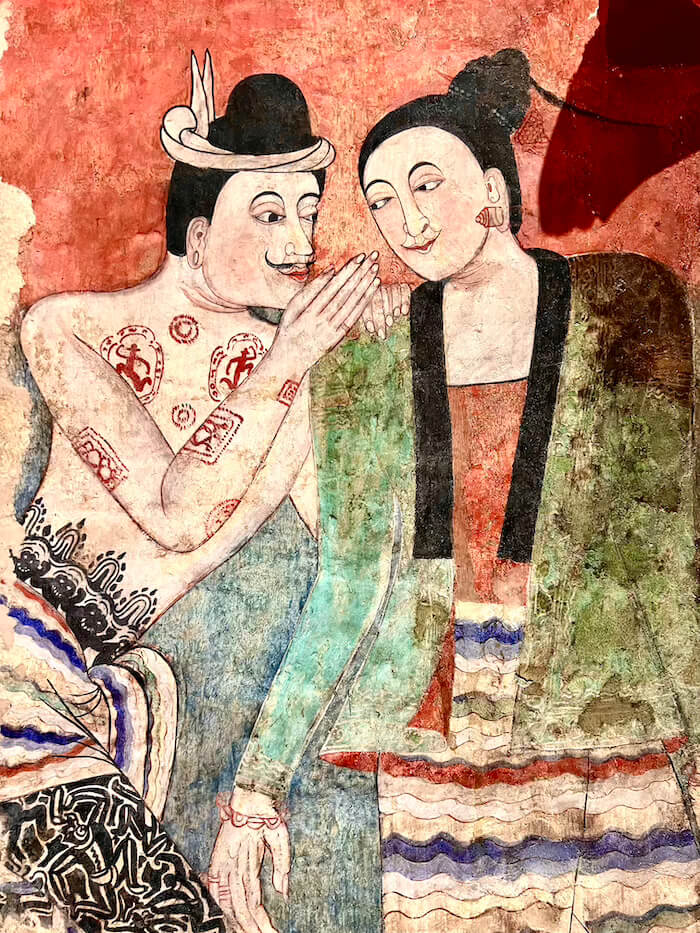
The most famous image, however, is the delightful Whisper of Love, perhaps the most reproduced work of temple art in Thailand. A shirtless man, his torso covered in red and black tattoos, leans in to whisper into the ear of a woman standing beside him. Like the Mona Lisa, her expression is ambiguous. Is it desire reciprocated, tolerant bemusement, or something else entirely? What it is not is passive: she clearly has views on what is being said.
These are scenes that grip the children’s attention—stories I can explain, and that they can understand. My grasp on epic Jataka narratives is pretty shaky, and while I have ambitions to learn them, for now the most I can usually offer is something along the lines of “if that guy is a monkey guy, he might be Hanuman.” Smoking a cigarette and flirting by the river, though? I have material.
Wat Nong Bua: Tai Lue Murals Beyond the City
Located in a quiet village 45 minutes north of Nan, Wat Nong Bua is another masterpiece by the same hand that gave us the interiors of Wat Phu Min. The artist brought the same close observation to these murals, but here he expands the subject matter in unexpected directions.
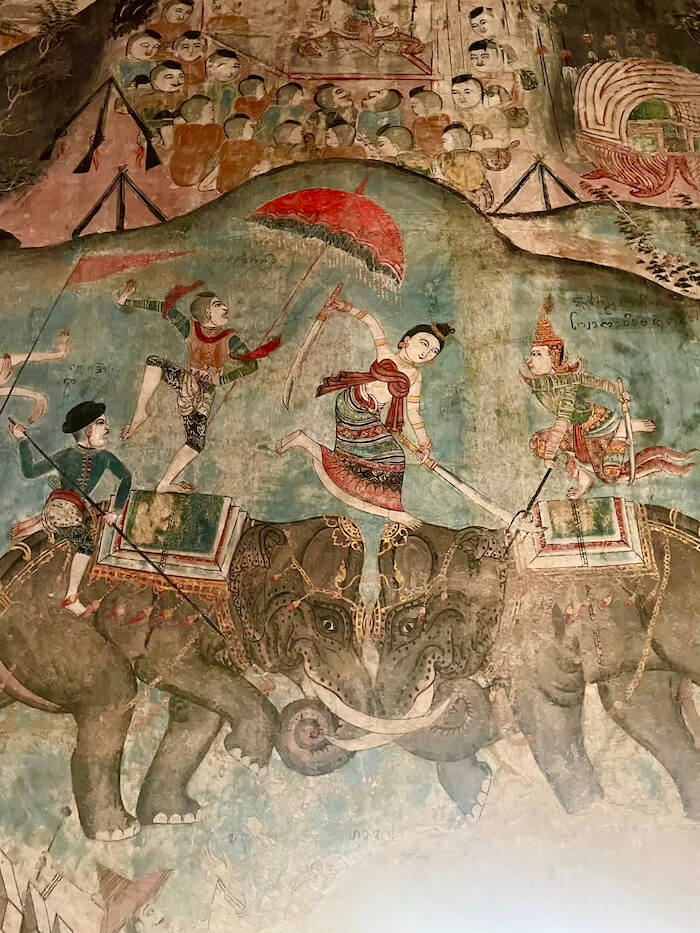
The most dynamic image depicts an epic battle scene. Two elephants lock tusks as their riders engage in combat. The action is not easy to parse: a woman in traditional Tai Lue dress leaps between the elephants, a sword in each hand. Her presumed opponent, a kingly figure astride the other elephant, parries her leading blade with a trident. Two camps look on: women on her side, armed men on his. What it all means, none can tell me.
Also on the temple grounds is a traditional Tai Lue house, where weaving demonstrations are sometimes offered. On the afternoon of our visit, however, the only soul around was a young boy, sitting in the upper story and plucking at a sueng for an audience of exactly one cat.
Nan Provincial Museum and the Black Ivory Tusk
That Nan was once an independent kingdom allows its museum to tell a more interesting story than is usually the case at these provincial-level affairs. Well-organized exhibits, particularly on Buddhist iconography and local history, should keep the attention of most visitors. Most adult visitors, at any rate.
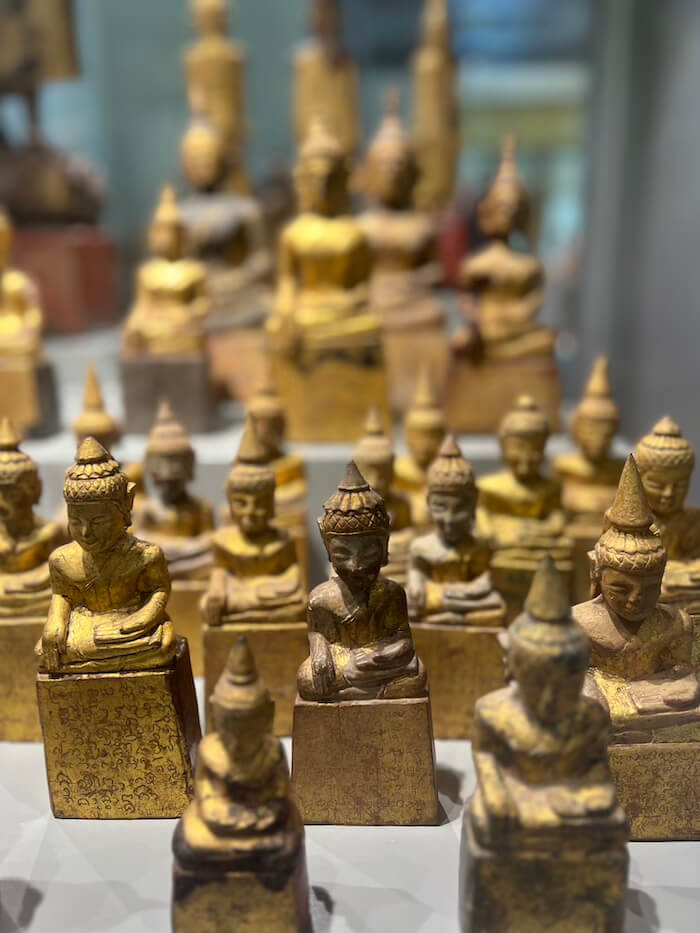
The kids, I must admit, are sometimes less engaged than their parents, even when presented with truly excellent exhibitions on Lanna ceramics or folk utensils. To stretch those attention spans a little further, we’ll sometimes assign “tasks,” like finding a particular object somewhere in the galleries.
For this visit, we chose a particularly compelling one: a massive black elephant tusk, held aloft by a carved blue-and-gold Garuda. As the centerpiece of the museum’s collection and an icon of the province, it took no effort at all to locate—and did little to buy mum and dad any extra peace.
This is the Nga Chang Dam, or “Black Ivory.” Despite the name, the tusk is not obsidian-black, but a deep, weathered reddish-brown: a meter-long curve of ivory that weighs nearly 20 kilograms. Local tradition holds that it was a gift from the ruler of a Burmese kingdom more than three centuries ago, but its real power lies in its origin story. The tusk is said to have come from a male elephant that died while still standing—a sign of immense strength.
Staying Among the Rice Fields at Nan Seasons Boutique Resort
One advantage of basing ourselves in Nan while exploring the surrounding region was staying at the wonderful Nan Seasons Boutique Resort. This garden resort backs onto broad expanses of open rice fields. From comfortable perches around the grounds, we watched each evening slowly give way to night across the Nan valley.
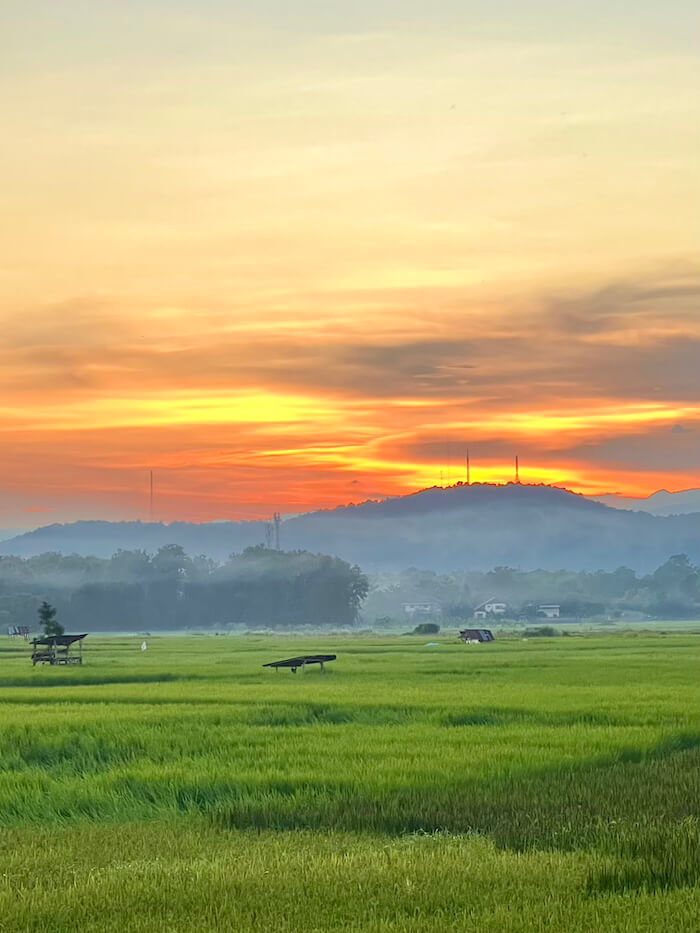
After the sun had set, we retired to a wooden bungalow tastefully decorated with Lanna artefacts, an immense Persian carpet on the floor tying the whole design together.
Only one detail wasn’t quite perfect: the hand-painted reproductions of Wat Phu Min’s most famous murals hanging on the walls. These were fine attempts, but they succeeded most as a testament to the skill of the original temple artist. His lines appear simple, even untutored – an art historian might say rustic – yet try to arrange them yourself without passing into the cartoonish. Here, genius is revealed in the impossibility of faithful reproduction.
Continue the journey with us as we explore a Thansawan Waterfall, a true gem in Doi Phu Nang National Park.
Plan Your Trip to Nan
Some links below are affiliate links. At no extra cost to you, we earn a small commission if you make a booking, which helps us keep our family on the road. Thank you for your support!
Getting There
By Car: Nan is one of northern Thailand’s more rewarding road trips. We drove in via Highway 1148, widely regarded as one of the country’s most scenic routes. The road is well paved but winding in places, with long mountain stretches that demand attention—and reward it with extraordinary views. If you enjoy driving, this is very much part of the experience.
By Plane: Nan Nakhon Airport (NNT) has several daily flights from Bangkok, making it the quickest way to reach the province. From the airport, it’s a short drive into town and an easy base for exploring the surrounding valleys.
Where to Stay
Nan makes an excellent base for slow exploration, and staying just outside town allows you to fully appreciate the valley landscape.
Nan Seasons Boutique Resort Set among rice fields on the edge of the valley, this garden resort is a peaceful retreat after a day of exploring temples and back roads. Evenings here—watching the light soften over the fields—were a highlight of our stay. Comfortable bungalows, thoughtful design, and plenty of space for kids to roam make it particularly appealing for families.
If you prefer to stay in town, Nan has a good selection of small guesthouses and boutique hotels within walking distance of Wat Phu Min and the museum.
When to Go
Cool Season (November to February): The most popular time to visit, with cooler temperatures and generally clear skies. Mornings can be crisp, evenings cool.
Green Season (September to October): Our favorite time. Rice fields are a vivid green, the valley feels alive, and crowds are thin. Expect occasional rain and higher humidity.
Hot Season (March to May): Very warm, but still manageable if you plan temple visits for early morning and late afternoon.
How Long to Stay: Nan rewards unhurried travel. While it’s possible to see the main sights in a day, we recommend at least three days and two nights to enjoy the pace of the place—time for murals, museums, scenic drives, and evenings that don’t feel rushed.
What It Costs
Entrance to Wat Phu Min, Wat Nong Bua, and Wat Phuket is free, though small donations for the upkeep of the murals and grounds are always appreciated.
Nan Provincial Museum: Admission is THB 120 for foreigners. (Note: The museum is generally closed on Mondays and Tuesdays, so plan accordingly).
Cocoa Valley Café Workshop: A combined plantation tour and chocolate-making workshop typically costs around THB 350–500 per person, depending on the specific package and whether you are staying at their resort.
Nan Seasons Boutique Resort: Depending on the season, bungalows generally range from THB 2,500–4,500 per night. This usually includes an excellent breakfast overlooking the rice fields.
Booking/Tours
Phu Langka is difficult to reach via organized group tours from Chiang Mai due to the distance. It is best enjoyed as a self-drive stop on a loop between Nan and Chiang Rai.