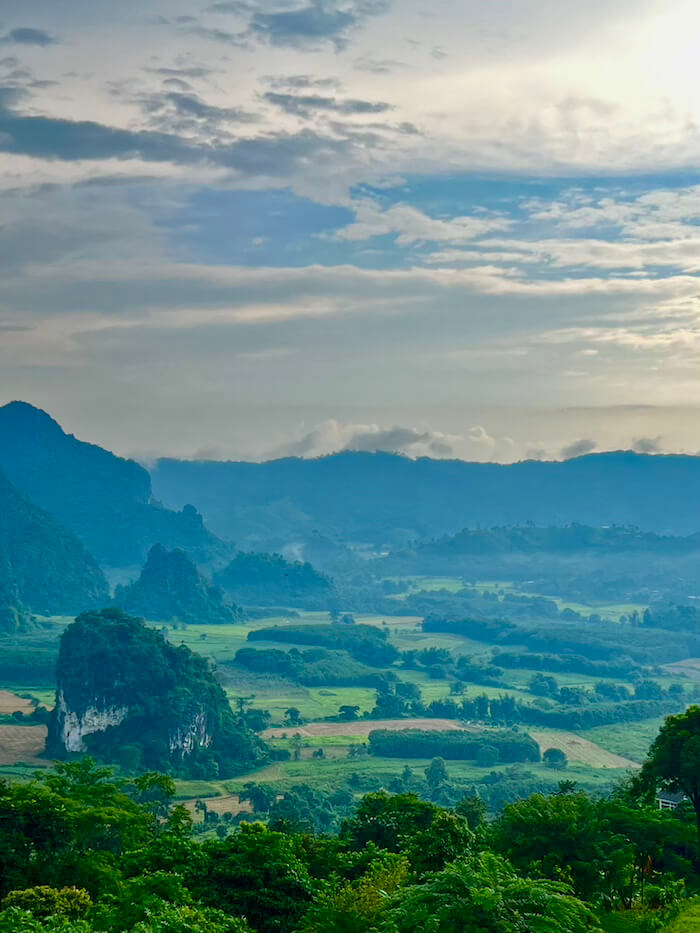
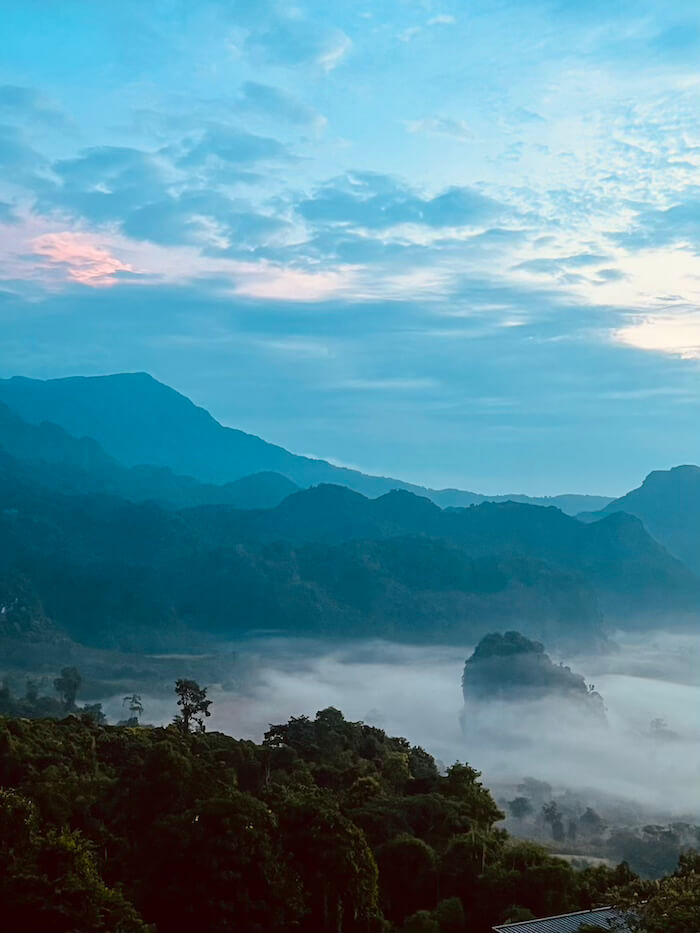
The iconic image of a limestone block floating above a sea of mist in a mountain valley appears again and again in Thailand travel literature. And for good reason: it’s an incredibly evocative scene, one that perfectly captures the atmosphere of Thailand’s northern highlands.
The trouble is, almost nobody knows what it’s called or where it is. Fewer still have ever stood there themselves. That’s a shame, because it’s something genuinely special. This is how we joined the small group of people who have experienced a Phu Langka sunrise—and what it takes to get there yourself.
Just joining the trip? Catch up by Exploring the Sky Pagodas of Lampang.
Where to See the Mists of Phu Langka
Figuring out where to find Phu Langka isn’t as straightforward as you might think. A quick Google search will take you to Phu Langka Forest Park or Phu Langka National Park, neither of which is quite where you want to be if you’re chasing the iconic views of the valley mists.
To see the Phu Langka that appears in the photos, you don’t actually want to go anywhere officially named “Phu Langka.” Instead, look for the stretch of Highway 1148 that runs along the western edge of the valley. It’s here that a loose cluster of coffee shops, guesthouses, and campsites has sprung up, catering to travelers who come for one thing: the sunrise over the sea of cloud.
If you’re staying anywhere along this stretch of road, you’re already in the right place. Magic Mountain Camp is great if you travel without kids; See View Homestay is better if you do.
Traveling the Long Road to Phu Langka
Once you’ve found Phu Langka on the map, it becomes immediately clear why so few people have been there. It is remote, which is exactly how the area has managed to maintain its wild charm, but it’s also decidedly inconvenient.
Most foreign visitors make the journey from Chiang Rai, just over two hours away. Nan is closer still—but who flies to Nan?
Thanks to an itinerary miscalculation (I had forgotten to book a place to stay), we’d made a detour to Mae Kampong the night before, adding an extra hour of driving to the day ahead. Not as punishing as the full six-hour drive from Chiang Mai, but still a solid four hours on the road.
We generally try to avoid uninterrupted four-hour stretches when we can, so we started late and stopped for lunch in the lakeside town of Phayao. It’s funny how often we end up here, though not surprising given its location between Chiang Mai and the highlands. No excuse needed for a waterside meal, though. So Good and Aurora Restaurant are both solid options if you want lake views.
Quick Stop at the Splendid Nam Min Waterfall
When the only planned activity after a day of driving is watching the sun go down, it’s best not to arrive too early. Our kids appreciate a good sunset, but they’re nowhere near accepting that it’s something worth building an entire afternoon around. Since the Phu Langka viewpoints are about two hours from where we had lunch in Phayao, we took a short detour to visit the criminally underappreciated Nam Min Waterfall.
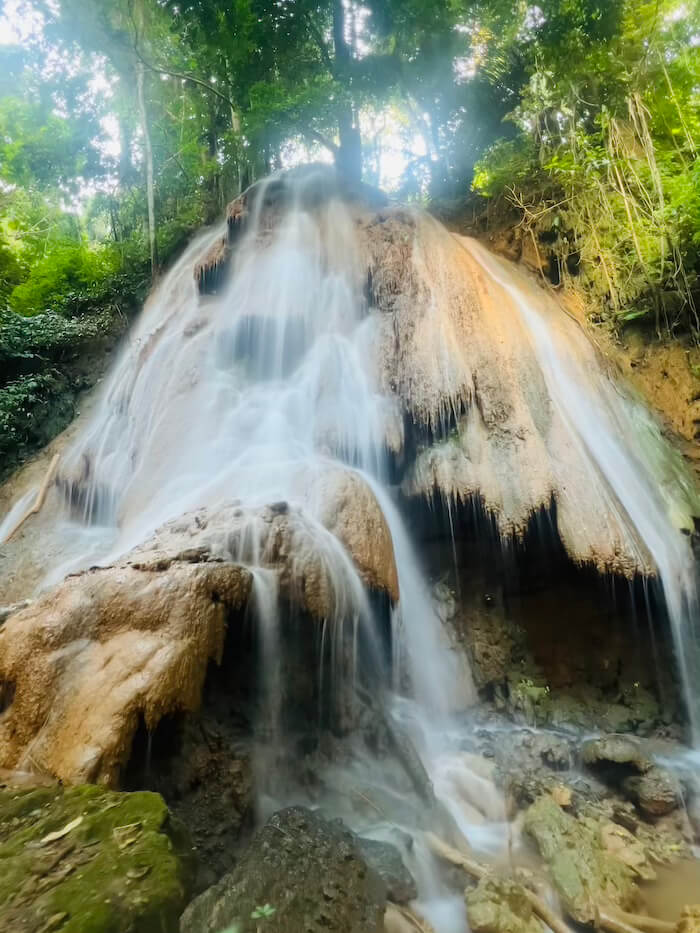
I say underappreciated because I can find almost no evidence of anyone having appreciated it. Google searches redirect to waterfalls in Laos or southern Thailand and outside of Thai-language sources it’s as if the place doesn’t exist. Let me assure you, it does, and it’s only forty minutes north of the Phu Langka ridge. It’s the kind of place you stop at because it’s nearby, and remember because no one else bothered to.
We were the only visitors when we arrived late afternoon at the Namtok Nam Min Forest Park. By that time of day, the mountain ravine where the falls sit was already deep in shadow. A short path winds over a slightly disordered hillside and along the stream that spills out from beneath the falls.
If you visit in mid-October, expect a bit of disarray. Monsoon storms will have uprooted trees, triggered minor mudslides, and generally undone the careful manicuring these sites often receive. The upside is that you can experience the place in a much wilder state.
And it is, indeed, a wonder in a wild setting. Maybe it’s because I grew up in the desert, but if we’d had waterfalls like this, we’d have put them on our money. In the dry season, you might see only a wall of stone; when we arrived, it was a classic limestone jungle cascade—an eruption of water and mineral framed by creeping moss and vine.
Arriving at the Phu Langka Ridge Viewpoints
The drive from Nam Min Waterfall to the ridgetop overlooking Phu Langka is phenomenal. The road twists over forested hills, each turn revealing incredible mountain vistas. The quality of the road, the engineering of the curves, and the surrounding scenery have earned Highway 1148 a reputation as one of the world’s best motorcycle routes. I can confirm that it is also very good for a conservatively driven, oversized Kia.
After about 30 kilometers of exhilarating driving, civilization suddenly reappears. Even before you catch a first glimpse into the valley, you’ll know you’ve arrived by the density of buildings on the roughly one-kilometer stretch of ridgeline road.
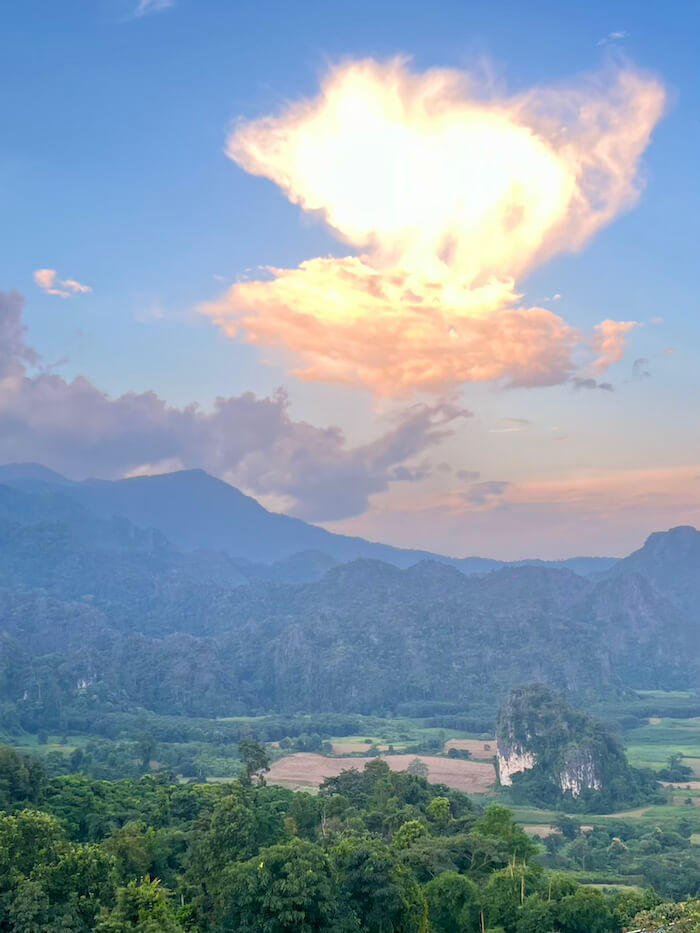
Magic Mountain Café and Camp is the grande dame of the ridge—at least as far as wooden cabins can be grand. It’s perfectly placed, immensely popular, and… doesn’t allow children. We booked instead a few hundred meters down the road at Phu Lanka See View Homestay and had no regrets.
The kids played with the homestay owners’ children while Kat and I settled into spacious tents pitched on elevated platforms with sweeping views over the valley. We ate dinner on the balcony, watching the famous limestone karst slowly turn red with the setting sun. The surrounding fields slipped into shadow long before the last tip of rock finally went dark.
The Mists Roll in to Phu Langka
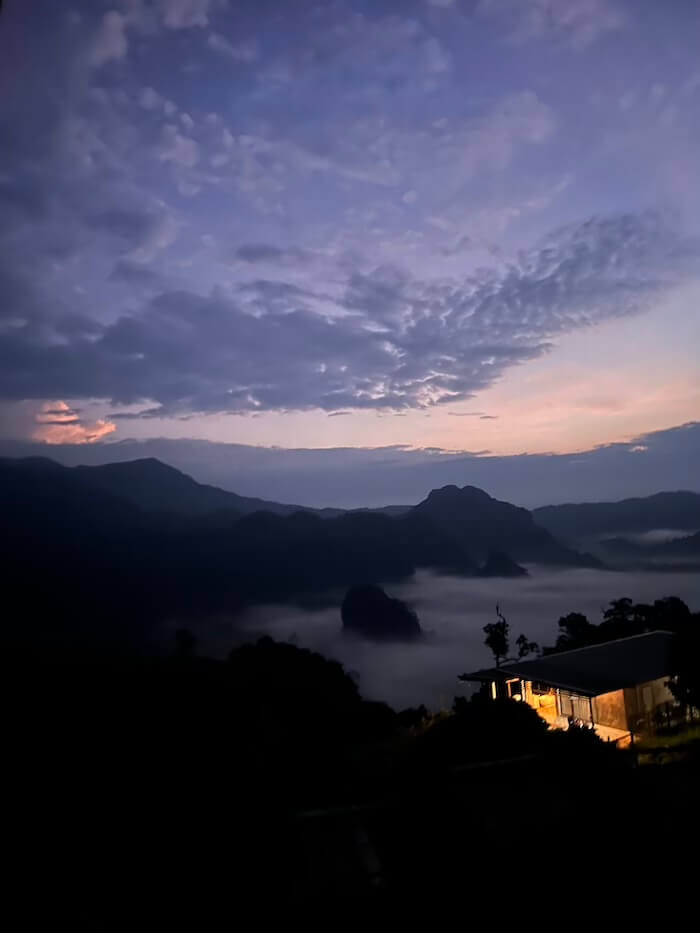
The mists are a nighttime phenomenon. On clear, calm nights, cool air from the surrounding ridges sinks into the valley basin. As the valley floor cools, this air condenses, forming a sea of low-lying clouds.
I wanted to watch the process unfold, so I woke myself several times through the night. Well before the first light of morning, clouds had begun streaming down from the surrounding hills and were pooling in the valley. Under a marvelously starry sky, it was a beautiful thing to watch. I went back to bed, knowing I wouldn’t sleep long.
I was back outside as the first hints of morning appeared over the valley. Always an early riser, Isobel soon joined me, and we quietly chatted in the hour before the sun appeared on the horizon. We had to wake Kat and the boys, and it was a relief to not need to shoosh them too much—to wake people as the sun appeared felt like a service.
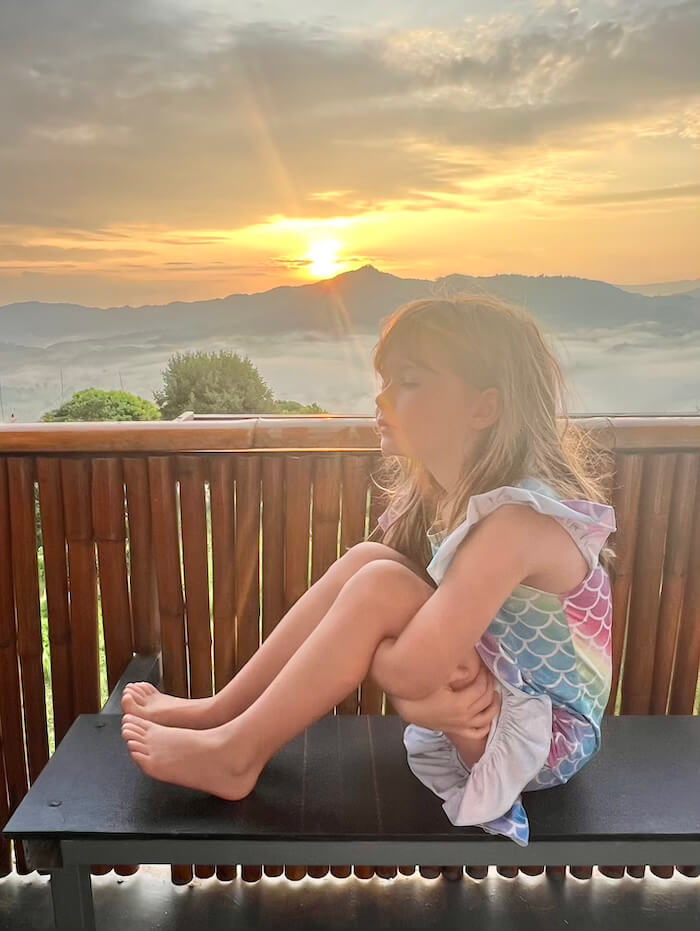
With every degree the sun rose over the Phu Langka valley, the scene beneath us changed subtly. The karst block that had held onto the light longest the evening before was now the first to welcome it. The sea of clouds below us made our little ridge feel like a towering summit. Then, slowly, the mist began to burn away. First a few trees emerged from the haze, then whole fields, as the last wisps of silvery cloud gave way to morning.
It was, I’m delighted to say, even better than the pictures.
Follow us down Highway 1148 as we discover Temple Murals, Rice Fields, and the Pleasure of Taking It Slow in Nan, Thailand.
Plan Your Trip to Phu Langka
Some links below are affiliate links. At no extra cost to you, we earn a small commission if you make a booking, which helps us keep our family on the road. Thank you for your support!
Getting There
By Car: This is the most practical way to reach the ridge. From Chiang Rai, the drive takes about 2 hours and 30 minutes. From Nan, it’s closer to 2 hours.
The final stretch on Highway 1148 is world-class but involves significant curves and elevation changes. The biggest risk is looking at the view instead of the road.
Where to Stay
Accommodation on the ridge is comfortable, but rustic. Don’t expect luxury resorts; instead, you’ll find charming “homestay” style lodgings and glamping setups.
Phu Lanka See View Homestay Our top pick for families. They offer large, sturdy tents on elevated wooden platforms and basic bungalows. It’s friendly, safe for kids, and has excellent unobstructed views of the karst.
Magic Mountain Camp The “Instagram famous” choice. It features beautiful wooden cabins and a highly aesthetic cafe. Note: They generally have an adults-only policy for overnight stays to maintain the quiet atmosphere. Worth getting a coffee here if you can’t otherwise stay. Book directly through social media.
When to Go
The “Sea of Cloud” Season (July to November): This is the peak window for the valley mists. The humidity of the rainy season and early cool season creates the temperature inversion necessary for the clouds to pool in the valley.
Sunrise Timing: You’ll want to be on your balcony by 5:45 AM. The “blue hour” before the sun crests the horizon is often more beautiful than the sunrise itself.
Mid-Week: The ridge is small and can feel crowded on Friday and Saturday nights with local travelers from Phayao and Chiang Rai. Visit Tuesday–Thursday for a much quieter experience.
What It Costs
Accommodation: Tents and basic homestays range from THB 1,200 to THB 2,500 per night, often including a simple breakfast of khao tom (rice soup) and coffee. The cheapest options aren’t on booking platforms, so contact the guesthouses directly.
Meals: There are very few restaurants on the ridge. Most homestays offer Thai BBQ for dinner, which usually costs around THB 400–500 for a set that feeds two to three people.
Nam Min Waterfall: Entry to the Namtok Nam Min Forest Park is currently free, though it is always good to have a few small bills ready in case a local maintenance fee is implemented.
Booking/Tours
Phu Langka is difficult to reach via organized group tours from Chiang Mai due to the distance. It is best enjoyed as a self-drive stop on a loop between Nan and Chiang Rai.