Lampang feels cool the moment you arrive, though explaining why is harder than it should be. Like most cool places, you recognize it long before you can name it. The Wang River and Kad Kong Ta, the main commercial street, give the town its shape. It’s the details that set Lampang apart, though: gingerbread woodwork of old merchants’ houses, genuinely interesting graffiti along the river embankment, and a quietly confident café scene.
Riverside Guest House & First Impressions of Lampang
The Riverside Guest House, our accommodation for the night, is ideal for experiencing all of this. It’s a collection of traditional Thai teak houses set on stilts directly along the river. The houses themselves, along with the gardens and terraces stepping down to the water, offer one of the most pleasant riverfront settings in northern Thailand.
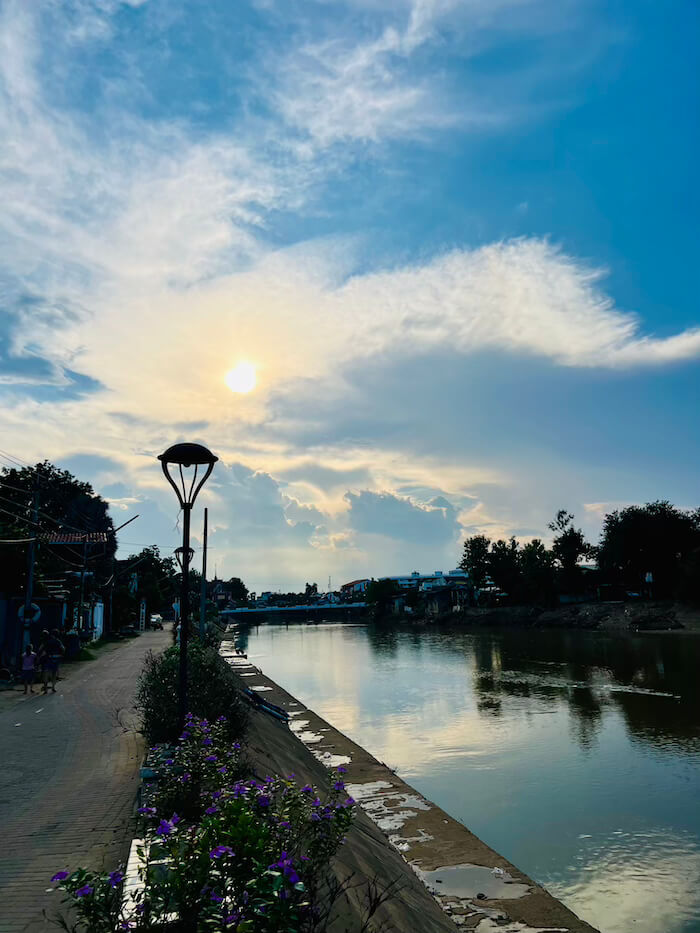
The practical value of those stilts became clear in the weeks before our visit. Northern Thailand had suffered an unusually punishing monsoon season, and the Wang River was among many that had flooded its banks. I wrote to Lorenza, an Italian expat who has managed Riverside Guest House for decades, worried the floods had shut the place down. She assured me that while the river had inundated the gardens, the rooms hadn’t suffered a bit, and all was perfectly well.
She told no lies. We arrived in the late afternoon after hiking for the better part of a day at Doi Khun Tan. It’s only an hour’s drive from there to Lampang, but trekking with toddlers is hungry work. Not long after checking in to our family bungalow, we walked to nearby Tipchang Road for an early dinner at a place I’d been eager to try since first learning of it.
Where to Eat in Lampang: Aroy One Baht
Aroy One Baht is a Lampang institution. Spread over two levels of an old teak house, it’s a khao tom gui (rice porridge) joint where, true to its name, you can still buy a bowl of rice porridge for a single Thai baht—about three cents. It’s a clever move, because nobody ever orders just the rice porridge. The rest of the menu is priced closer to market rates but still offers excellent value.
We recommend ordering a fish or two (the deep-fried snakehead fish is a particular favorite), prepared however you like, then filling out the table with a variety of smaller, shared dishes. Ask for recommendations if you’re understandably lost in the oversized menu. Whatever you choose, try to sit on the open top floor, where the scene more than compensates for the very small bill you’ll be handed at the end of the meal.
Kad Kong Ta: Thailand’s Best Walking Street?
We were lucky enough to be in town on a Saturday, which gave us the chance to look for dessert on Kad Kong Ta Walking Street. I’m already a sucker for local weekend markets, but Lampang’s has a legitimate claim to be among Thailand’s best. It offers the ideal mix for family travelers: stalls that are above average in terms of quantity, variety, and quality, but the street is not in the least crowded. Kad Kong Ta has a good claim to be among Thailand’s best walking streets.
It’s the setting that really clinches it, though. Kad Kong Ta runs through Lampang’s old commercial heart and is lined on both sides with century-old teak houses in an appealing mix of Thai, Chinese, British, and Burmese styles. This is where families that made fortunes in the teak business showed off their wealth. As economic patterns shifted, the money, and the people who had it, left old Lampang. The houses have mostly survived and, as more are adopted for restoration, are beginning to thrive. If the trend holds, this will be one of the most attractive streets in the country.
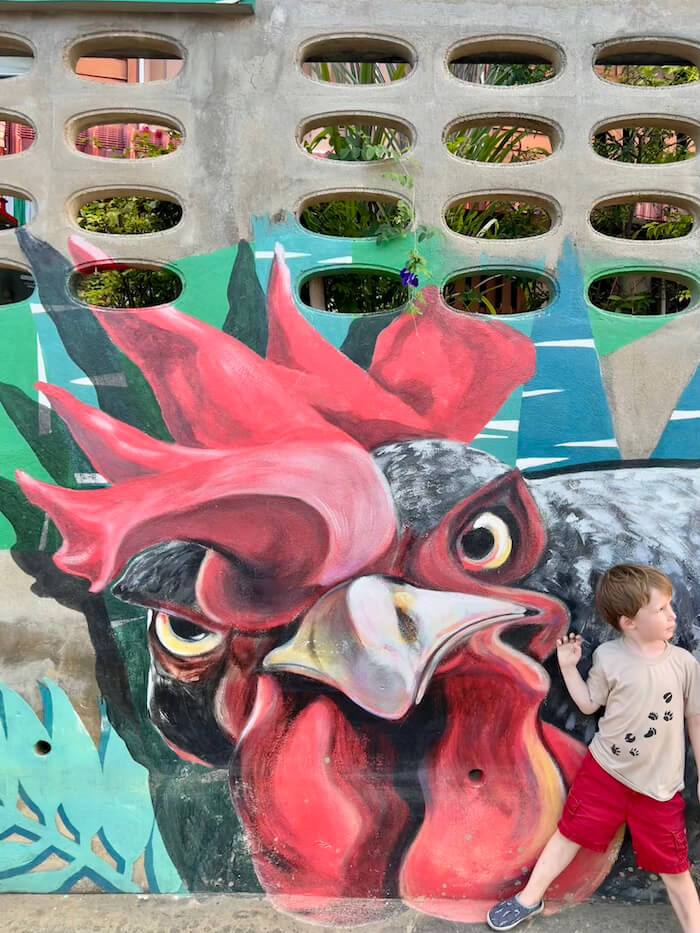
Because the street shuts to motor traffic, visitors can enjoy the wonderful architecture without worrying about a songtaew running them down. Many of the stalls are extensions of the businesses in the building behind, which is what provides the depth and variety to what’s for sale. My favorite buy was a t-shirt with a pointillist image of a rooster made by a local artist. Kat bought one too. I wish we’d bought a dozen more and worn them for the rest of our lives.
Restaurants open their doors and windows to the street and stools and tables spill onto the edge of the road. With proper kitchens attached, the usual street food is supplemented with more complex Northern Thai dishes like gaeng hang le, a rich, slow-simmered pork belly curry that can really only be prepared in a fully equipped kitchen.
We did, finally, find dessert. Henry and Isobel walking down Kad Kong Ta, sharing a coconut ice cream straight from the shell while a group of local music students played khim for tips is one of those scenes that forever fixes in memory. I also got it all on the phone, which helps too.
Dhanabadee Ceramic Museum: Definitely Thailand’s Best Rooster Bowl Museum
My rooster t-shirt took on even more meaning—and left me with deeper regret at having only one—the next morning, when we visited the Dhanabadee Ceramic Museum. In 1955, Simyu Sae-Chin discovered a large deposit of high-quality white clay near Lampang. A porcelain artist in his native China, he immediately recognized this kaolin as ideal for fine ceramics.
His kiln was the first in what would eventually grow into a province-wide industry with hundreds of manufacturers. Panasin Dhanabadeesakul, the son of Simyu Sae-Chin, founded the Dhanabadee Museum in 2012 to preserve his family’s legacy and celebrate the ceramic industry his father helped pioneer.
The product most emblematic of this industry is a simple bowl with a rooster depicted in a few bold orange and black strokes. A traditional Chinese motif intended to symbolize diligence and hard work, these bowls are used across Thailand, from fine-dining restaurants in Bangkok to street-side stalls in Buriram. Once you’ve been introduced to them, you’ll be delighted by how often they appear.
Dhanabadee is easily one of the best educational tours we’ve ever taken with the kids. I expect they’re usually much busier than the mid-week morning when we visited, as they’re clearly set up to welcome large numbers of guests. At each station, dedicated staff patiently demonstrated every step of the production process: from working the clay to shaping it, firing it, and glazing the finished pieces.
The representation of the rooster through only a few spare, confident strokes was my favorite part of the process. I admire how the artist, so confident in their control of the line, risks the bowl on a single flick of the wrist, and never misses. The staff expertly engaged the children, even when there was a language barrier.
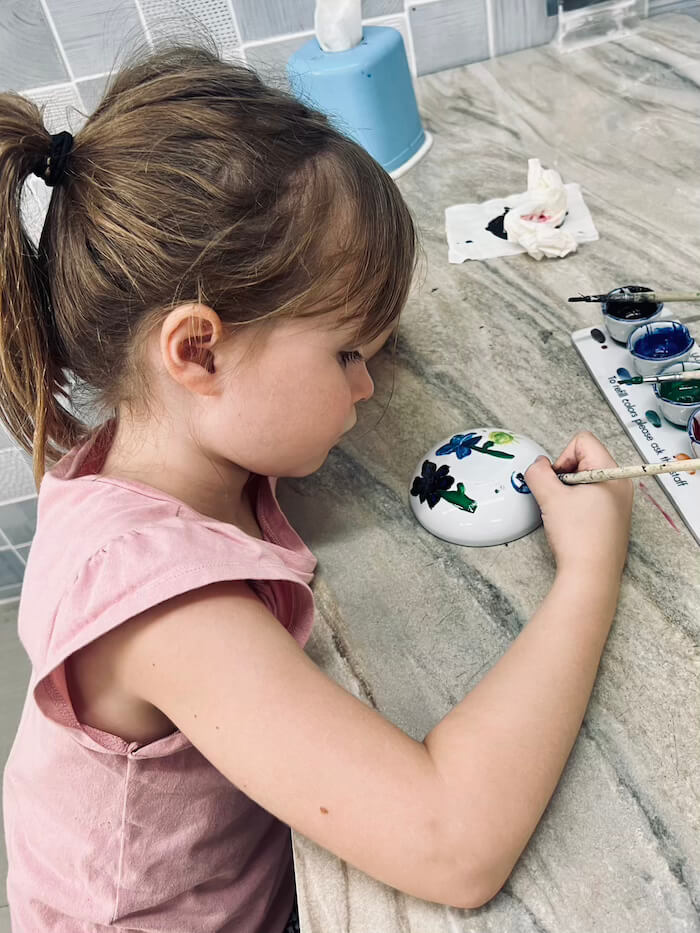
We paid a small additional fee that gave the kids a chance to paint their own ceramics. To the extent these workshops are also talent-spotting exercises, the staff at Dhanabadee will need to keep up the search for a while longer yet. Meanwhile, we came away with a few bowls to keep as souvenirs—now stored deep, deep in the cupboard.
Wat Phrathat Lampang Luang: Lanna Architecture at Its Finest
Wat Phrathat Lampang Luang sits just outside town, surrounded by fields and low hills, and feels much older than Lampang itself. It is among the finest living examples of Lanna temple architecture and stands out for its purity of design and use.
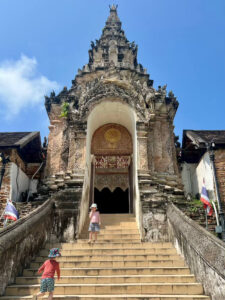
We climbed the stairs leading to the main gate, ornately carved with floral motifs and mythical animals. This is a masterpiece of Lanna decoration and is recognized as such: it’s the official symbol of Lampang province.
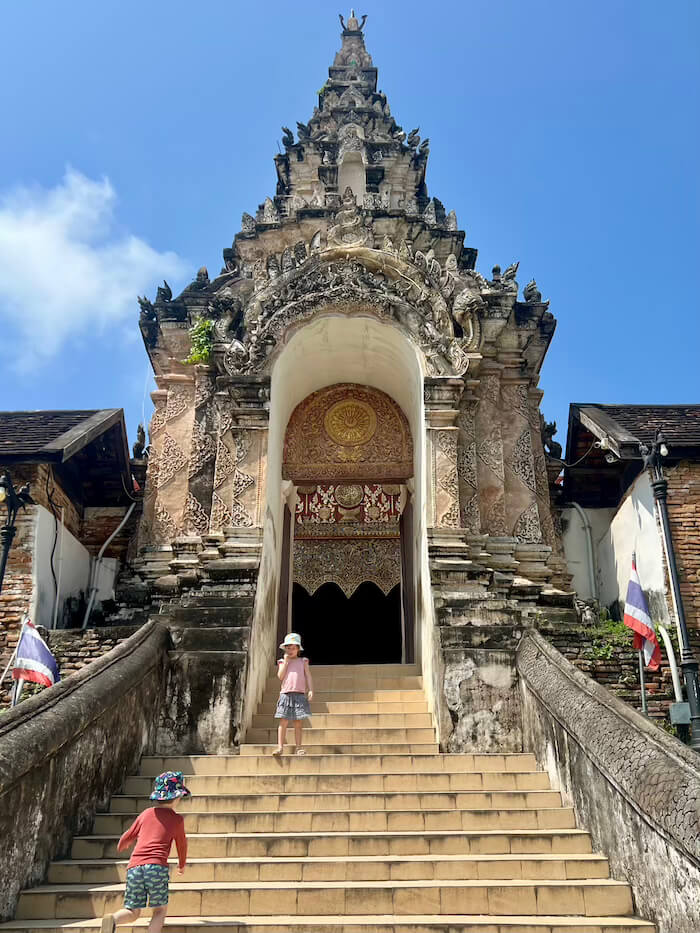
Through the gate is the Wiharn Luang, an open-sided temple hall housing the main Buddha statue. Devotees prostrate themselves before this holy image as they have since it was first cast nearly 500 years ago. Even amid these solemn devotions, the worshipers will almost always glance the children’s way as, for a moment, we too join the congregation.
It’s hard to imagine Wat Phrathat Lampang Luang as anything other than a place of peace, but this is a “fortress monastery” and it has played that role before. Burmese forces once used the complex as a headquarters while occupying the region. To bypass the monastery’s thick brick walls, 300 local men climbed instead through drainage pipes and assassinated the Burmese commander.
Still peppered with bullet holes from the encounter, the antique bronze railings around the main chedi are testament to this past. Our eyes quickly moved beyond the railings and up to a sky dominated by the 45-meter chedi, said to house a hair of the Buddha. It is covered in copper and bronze sheets, now weathered to deep greens and browns.
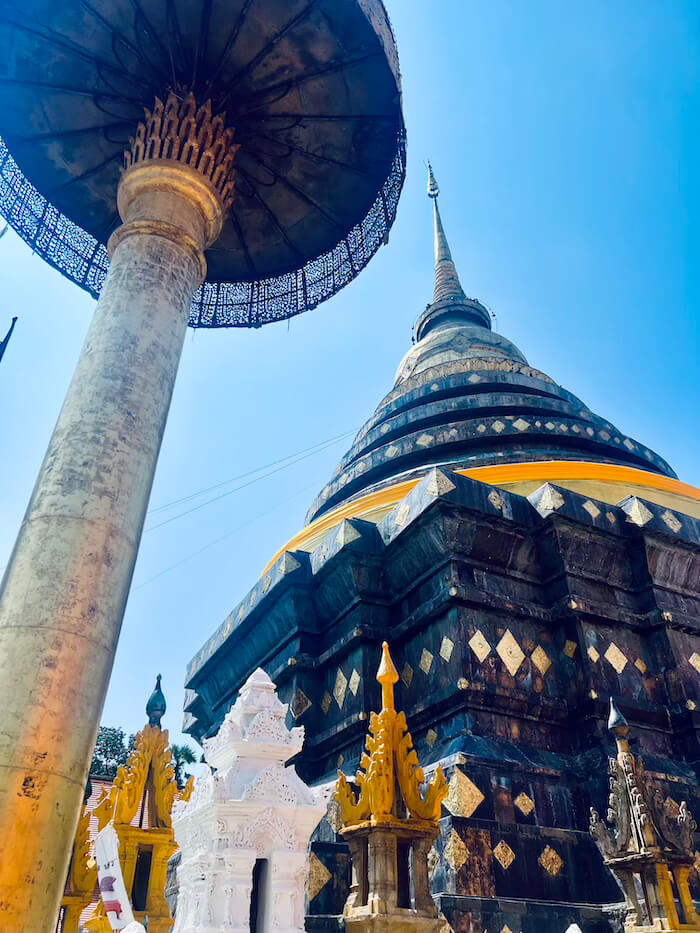
Throughout the rest of the complex, the ancient mingles effortlessly with the living world as well. Some of Thailand’s oldest murals sit next to a bulletin board announcing community activities. This is what I like the most about temples in Southeast Asia: they attract living worshipers while still patiently tolerating tourists like us, even (or especially) when we bring the kids.
Three days in Lampang had not brought me much closer to explaining the city, but Wat Phrathat Lampang Luang did. It simply isn’t trying at all. It instead invites you to share in its deeply rooted rhythms. Its walking street succeeds for the same reason—no overpromotion, just vendors selling what people want. Even the graffiti works because it just looks good. It is, in a word, “cool,” without working at it at all.
Continue the journey with us as we travel north to climb the 300 steps of The Sky Pagodas of Lampang: Wat Chaloem Phra Kiat.
Plan Your Trip to Lampang
Some links below are affiliate links. At no extra cost to you, we earn a small commission if you make a booking, which helps us keep our family on the road. Thank you for your support!
Getting There
By Car: From Chiang Mai, the drive takes approximately one hour and 15 minutes. The road is a well-maintained highway that passes through the beautiful Doi Khun Tan National Park, making it an easy day trip or weekend escape.
By Train: For a more scenic route, the train from Chiang Mai to Lampang takes about two hours. It crosses the picturesque White Bridge (Saphan Khao) and passes through the longest railway tunnel in Thailand at Doi Khun Tan.
Where to Stay
I have a feeling that Lampang’s hotel and guesthouse scene is only just getting started. Meanwhile, there are a couple of truly excellent options. Riverside Guest House in particular is perfect for families.
Riverside Guest House Located directly on the banks of the Wang River, this is a collection of traditional teak houses on stilts. It offers a peaceful, authentic atmosphere with terraces stepping down to the water and is managed by a long-term expat who knows the city’s history intimately.
The Lampang River Lodge Situated slightly further down the river, this lodge offers a resort-style feel with private bungalows set in lush gardens, providing a quiet retreat while still being accessible to the city center.
When to Go
The Weekend (Year-round): To experience the city at its best, you must be in town on a Saturday or Sunday eveningfor the Kad Kong Ta Walking Street.
The Cool Season (November to February): This is the most comfortable time for exploring the open-air temples and walking the river embankment. Evening temperatures are perfect for street food and outdoor music.
The Green Season (September to October): We visited during this window. While the Wang River may be high and the gardens damp, the surrounding countryside and forest parks like Doi Khun Tan are a vibrant green.
What It Costs
Wat Phrathat Lampang Luang: Entry is free, though donations for the upkeep of this 500-year-old masterpiece are encouraged.
Dhanabadee Ceramic Museum: Entry for the guided tour is approximately THB 100 for adults, THB 60 for teens, children under 13 enter for free. There is a small additional fee if you wish to participate in the ceramic painting workshop.
Aroy One Baht: True to its name, a bowl of rice porridge is just THB 1 (about three cents), with side dishes typically ranging from THB 40 to THB 150.
Booking/Tours
No single tour covers all of what Lampang has to offer. Your best bet is to come to town and independently organize your own adventure. There are a few options out of Chiang Mai that arrange temple visits. The best I’ve seen is here:
Private Tour to Lampang’s Unseen Temples
- Duration: 9-10 hours.
- Includes: Round-trip Chiang Mai transfers; lunch and all fees included.
- Vibe: Private tour, only your group joins. Discounts for children under 10.
- Flexibility: Reserve now, pay later. Free cancellation up to 24 hours before the trip starts.
- Cost: From THB 4,320 per person.

Pingback: Chiang Khan: Thailand’s Most Charming Town on the Mekong