Seeing an elephant in Thailand is easy. Seeing one ethically is a different story. An estimated 250-300 elephant camps are dotted along the country’s tourist trails, and many packages offer opportunities to engage with the animals. I certainly don’t want to shame anyone for joining these: the reality is that more than 3,500 former working elephants require expensive lifelong care, and tourism provides that money.
But I want to recommend something else entirely: skip the captive elephants and seek out the wild ones instead. The tension of the search, the excitement of the find, and the sheer exhilaration of watching these extraordinary animals roam, forage, and interact exactly as nature intended is pure magic. This is exactly how I wanted my children to be introduced to them.
Fortunately, Thailand still has at least 3,000 wild elephants. While some of the best places to see them are in national parks like Khao Yai and Khao Sok, the surest, most consistent chance of encountering wild elephants in all of Thailand is to be had at Kui Buri National Park, less than 90 minutes away from Hua Hin.
Kui Buri: The Sure Bet for Spotting Wild Elephants in Thailand
Kui Buri National Park lies among the hills and mountains of the Tenasserim Range, the rugged karst spine that separates Thailand from Myanmar. A part of why elephants and other wildlife thrive here is the sheer size of the protected area, which includes sister parks in Thailand and across the border in Myanmar. Kui Buri is not an island, but an integral part of a vast, continuous forest ecosystem.
It’s remarkable that despite Kui Buri’s vast size, you’re almost certain to see an elephant. I’ve often failed to deliver promised wildlife sightings (and wouldn’t have it any other way), but park officials boast a success rate of around 90 – 95 percent. We visited in the middle of the oppressive hot season, when heat blurs the horizon and the animals retreat to the thick of the forest. The odds were slightly worse, but given that there’s no truly bad season for wildlife viewing here, the risk felt worth taking. At any rate, I thought the kids would appreciate the added sense of suspense.
Guide to Your Kui Buri Park-Led Safari: Cost and Logistics
The first thing to note is that there are no private tours at Kui Buri, all tours are from park-operated trucks. You can certainly book Kui Buri Elephant Safaris from private vendors, but what you’re paying for is simply transportation to and from the park, and maybe an interpreter, as the park rangers do not reliably speak English. These are perfectly useful services, but you should be clear about what you’re getting beyond the standard park tour.
The standard park tour package is quite good, I should say. You can organize one directly upon arrival, which you should do sometime between2:00 PM and 4:30 PM. Wildlife viewing areas are only open from 2:00 PM – 6:00 PM, and the rangers might not accommodate tours too close to closing time. Do be sure to go to the wildlife viewing station and not the park headquarters, which has a separate access road. This is the one you want.
You’ll need to pay the standard Thai national park entry fee of THB 200 per adult, and then an additional THB 1,000 for the safari truck that can carry up to six. This includes a park ranger as a guide, but again, they likely won’t speak much English.
Unusually for us, we booked a tour through a private operator in the hope of getting real wildlife expertise. Kat and I both speak Thai and, even if we didn’t, the universal language of a silencing finger to the lips and another pointing at the animal would probably suffice when it mattered. In the event, our English-speaking guide was so relieved to learn we spoke Thai that she never switched back to English. It was fine and she was lovely, but you needn’t spend the money.
Golden Hour Wildlife Viewing at Kui Buri
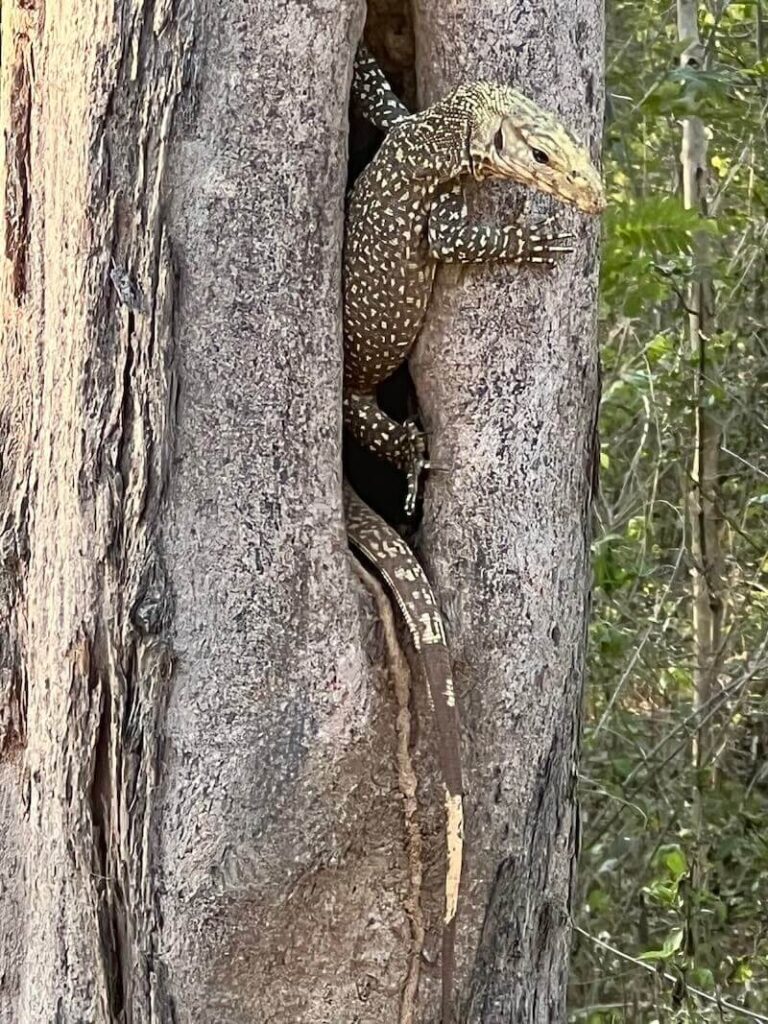
Given the stifling heat, we began our tour at the later end of the window. By 4:00 PM, shadows were lengthening, and the heat has begun to leach out of the air. Between stops, our guide spots a juvenile monitor lizard, still hiding in the hollow of a tree from its cannibalistic elders.
The truck visits several observation towers overlooking promising habitat. We were soon rewarded as out of the scrub lumbered a file of enormous beasts. With their shining dark coats, these weren’t elephants, however, but gaurs, the largest wild cattle in the world.
Standing more than 2.2 meters tall and weighing in at more than 1,000 kgs, these are indeed massive beasts, made more formidable by powerful shoulder humps and broad upward-curving horns. I like a pretty cow even more than a big cow, so admired the sheen of their beautiful brown and black coats, along with distinctive lighter “stockings” on the lower half of their legs.
Someone Has to Be the Unlucky 5-10 Percent, Right?
But as exciting as the gaurs were to see, the light was fading and we were still in search of elephants. From the radio chatter, I could tell that the guides were, if not frantic, at least a bit deflated at the prospect of telling us today was just one of those days. Our guide had an expression that didn’t need translating as she told us we would need to return to the park entrance.
The kids are never, I think, as disappointed as Kat and I are when things like this don’t work out, and they took the news stoically. We’d had a nice drive through the park and seen some interesting animals in a beautiful setting. Suddenly, a voice crackled to life excitedly on the radio: “elephants, just off the road, straight ahead!”
…But It Won’t Be Us
The driver hit the gas, hard. The family tumbled off the songthaew benches and then gripped whatever surfaces they could to pull themselves off the floor. Rooster tails of dust shot from beneath the trucks furiously spinning tires. Pure joy showed on the faces of the kids as we sped around corners and over hills. A fast drive in an open truck is clearly a pleasure that not even a lizard in a tree or a very large cow can provide.
And then there he was. Just off the road, but obscured enough by the forest that we had driven right up to him, was an enormous bull elephant. The driver, more cautious now, backed the truck off to a safe distance. This gave us a less direct view, but I think a sign of a responsible operator is a willingness to disappoint customers a bit if it’s better for the animals and safer for the humans.
We watched, mesmerized as he used the marvel of musculature that is the trunk to strip branch after branch of its leaves and bring them up to a ceaselessly chewing mouth. An elephant this size needs up to 300 kilograms of leaves, twigs, bark, and whatever else gets caught up in the great bunches of plant material it tears from the forest.
While we watched the elephant eat, another one ponderously emerged from the forest, crossing in front of us. He scarcely acknowledged us, only changing path slightly to avoid walking right through us. We watched him, too, as he passed and began slowly making his way down the road and out of sight. We too had a road we needed to travel before the day was over, so, overcome with the giddiness that always follows a welcome sighting, we continued down the road.
Postscript
I’m writing this from my notes a few months after we made the trip, and I just asked Isobel what she remembers about Kui Buri. “An elephant caused a traffic jam, and we had to wait for it leave before we could start driving again,” she tells me, confirming I’d correctly recalled what the kids saw as the highlight of the trip.
Plan Your Trip to Kui Buri
Some links below are affiliate links. At no extra cost to you, we earn a small commission if you make a booking, which helps us keep our family on the road. Thank you for your support!
Getting There
Khao Sam Roi Yot National Park is located about 1.5 hours south of Hua Hin and 4 hours south of Bangkok. If you’re not self-driving, the most reliable and efficient way to arrive is by private taxi or minivan. We recommend pre-booking a comfortable transfer from Hua Hin or Bangkok to ensure your driver is familiar with the Wildlife Viewing Station access road.
Where to Stay
Hua Hin is spoiled for choice when it comes to places to stay. Pranburi is further down the coast and slightly closer to Kui Buri. We’ve stayed in each of these and happily recommend them:
Sheraton Hua Hin Pranburi Villas Secluded, high-end tranquility defined. Relax in your private pool villa south of Hua Hin, perfect for families seeking quiet luxury and deep relaxation after a safari.
Centara Grand Beach Resort & Villas Hua Hin The Grand Dame of Hua Hin. This classic resort offers iconic colonial luxury, lush grounds, and the best central location for families.
The Standard Hua Hin Stylish, modern retreat offering hip, vibrant energy and fun, quirky design. Enjoy the cool pool scene, beachfront dining for a more fashionable family stay.
Namaste Resort Simple, charming, and a true local gem. This budget-friendly resort offers personalized attention and invaluable local expertise for the adventurous, down-to-earth traveler.
When to Go
Kui Buri is worth visiting year-round, but the Cool and Dry Season (November – February) is the most comfortable. Temperatures are pleasant, and the skies are typically clear. The animals are there during the Hot Season (March – May), but you’ll need to start your safari later (around 4:00 PM) to avoid the intense afternoon heat. The Rainy Season (June – October) brings lush greenery and fewer crowds, but can occasionally lead to park road closures.
Viewing Time: 2:00 PM – 6:00 PM. Always plan your entry for the afternoon, as elephants gather at the watering holes as the heat fades. The park closes for entry promptly at 4:30 PM.
Booking/Tours
You cannot pre-book the safari truck. The park requires you to pay the THB 1,000 truck fee directly upon arrival at the Wildlife Viewing Station. This fee includes the official park ranger/spotter. Plan to arrive between 2:00 PM and 4:30 PM.
Guided Tours If you prefer a completely hands-off experience or need a reliable English-speaking interpreter, you can book a package that includes round-trip transfers, neighboring parks like Sam Roi Yot, and a private guide. This is great for peace of mind. Book a reliable, full-day of multiple-day tour here.
Elephant and Wildlife Watching in Kuiburi National Park
- Duration: 7 Hours (Approx.)
- Includes: Round-trip Hua Hin transfers, park fees, and dinner.
- Vibe: Private tour, only your group will join.
- Flexibility: Reserve now, pay later with free cancellation.
- Cost: From THB 4,500 per person, with discounts for kids.