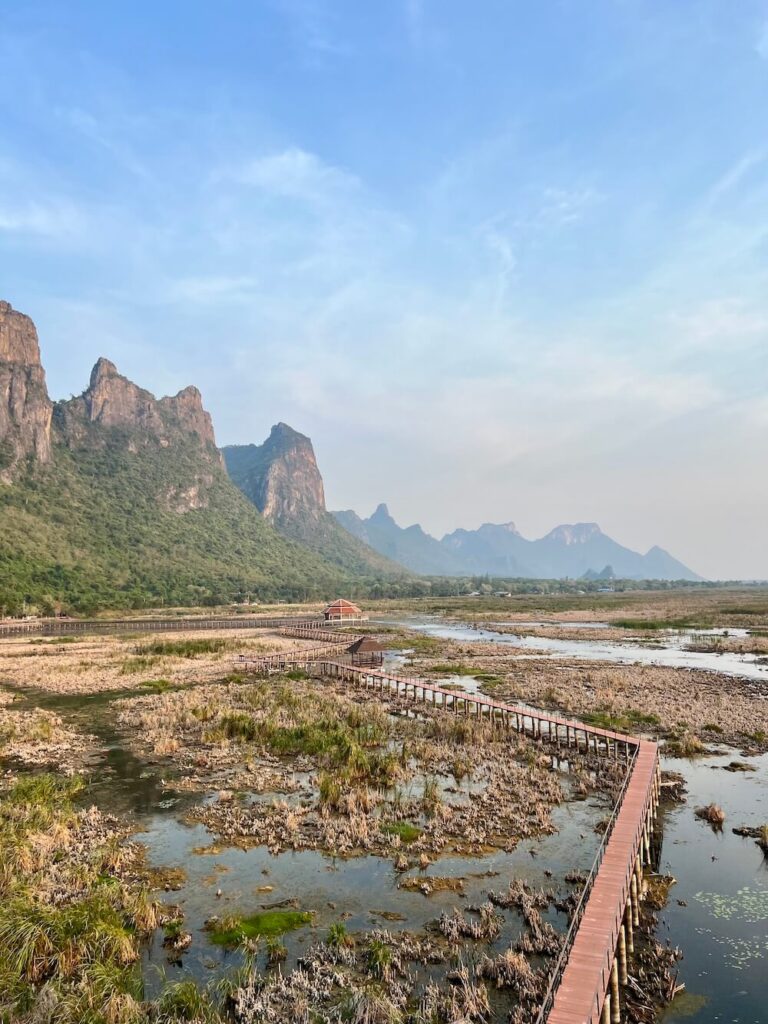
While many visitors come for the much-photographed Phraya Nakhon Cave, there is far more to see inside Khao Sam Roi Yot National Park than its most famous attraction. The Bueng Bua Boardwalk is unbeatable for bird watchers and offers a dramatic setting to watch the sun sink below the Thung Sam Roi Yot Marsh. You’ll have to compete with Thai influencers for a spot, but another popular spot for sunsets is the Kissing Cave (เขาจูบกัน—Khao Joop Gan). Backlit by the setting sun, the silhouettes of two limestone faces appear to lean into a kiss.
The challenge is seeing everything in a single day. The park is bisected by the mountains that give Sam Roi Yot its name. In Thai, Khao Sam Roi Yot means “Three Hundred Peaks,” which perfectly describes the dragon’s spine of limestone karst mountains that sit between you and your destination.
Our solution? Don’t try to do it in a single day. Sure, it’s possible, but involves a lot of transit and means you won’t be able to linger at Laem Sala Beach after descending from Phraya Nakhon or take a boat through the lotus blossoms if you’re lucky enough to visit during the peak lotus season (August to September).
We visited each of these sites on separate visits to the area. Over three trips, we found that integrating one or two key attractions each time has been more enjoyable than a mad dash around the mountains. So, which of these destinations should you choose? We’ll describe each below.
Getting to Sam Roi Yot and Choosing Your Route
Sam Roi Yot is about a 45-minute drive south of Hua Hin, but well before you reach the park, you’ll need to decide whether to take Route 4020 towards Phraya Nakhon Cave or keep to Highway 4 (Phetkasem Road) en route to Bueng Bua. The two areas are less than 10 km apart, but almost an hour’s drive is required to get around the wall of mountains
The Phraya Nakhon Cave Hike and Khuha Kharuehat Pavilion
This is one of Thailand’s improbably magical sights. A series of passages and chambers halfway up the side of a mountain opens onto an enormous amphitheater, a semi-collapsed doline the size of a sports stadium. Centered on the floor of the cave stands the Khuha Kharuehat Pavilion (also transliterated Kuha Karuhas), a small pavilion installed in honor of a visit by King Chulalongkorn (Rama V) in 1890.
Boat Trip to the Phraya Nakhon Cave Trailhead
The journey starts at Bang Pu, a small fishing village serving as the gateway to the park. After purchasing your park tickets (THB 200 per adult), you face your first choice: walk 30 minutes around the headland to start the hike or take a ten-minute trip in a longtail. Hero points if you walk the headland – it looked like a lovely walk, but we took the boat. The longtail costs THB 400 per boat roundtrip, and the captain waits for you on the beach.
Laem Sala is a pleasant beach fringed with casuarina trees, the coastal pines more common than coconut palms along the Gulf of Thailand. Between the beach and the hike, you’ll find all the basics before the walk.
At the very least, stock up on water. It’s not a long hike: just over 400 meters, during which you’ll climb 130 meters up the mountainside, but the walk is exposed and you’ll feel the sun for every step of those last 200 meters. The kids guzzled the stuff; you can never have too much water.
Descending into the Phraya Nakhon Doline
The moment you enter the first of the chambers, the environment changes dramatically. The temperature drops and it becomes much more humid. The shaded path is a welcome break and the sun—which now appears again only through the skylight of a collapsed roof—disappears again as the path passes through another, even darker chamber.
Learn the word “doline,” because it describes what might become your favorite geological feature. As in Hup Pa Tat, the collapsed cave of Phraya Nakhon preserves a lost world. The fallen ceiling lets in enough light to foster the growth of an entire jungle ecosystem. A troop of sweet, spectacled Dusky Leaf Monkeys chewed on leaves from the safety of treetop perches.
But the highlight, of course, is the golden pavilion sitting in the center of the cave. It’s not a religious site, nor is it especially large, and I think that its relative simplicity is a large part of its appeal.
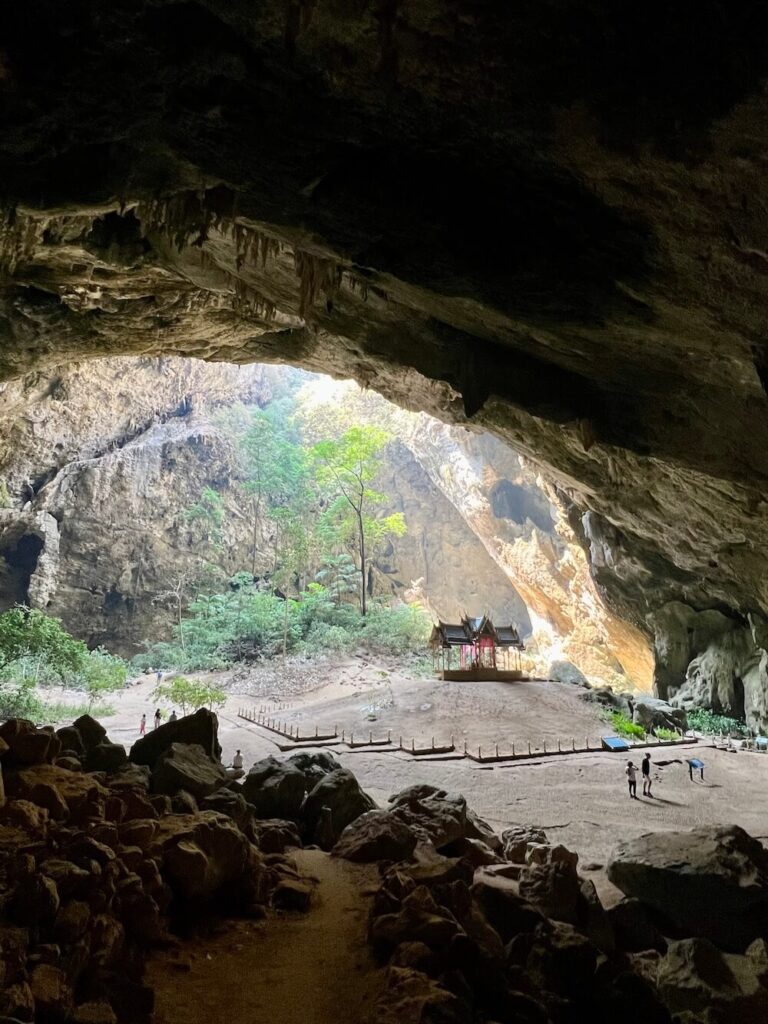
The absolute best viewing time, when the sun’s rays directly strike the golden roof of the Khuha Kharuehat Pavilion, is between 10:00 and 11:30. For parents with young children, this poses a dilemma: should you walk the kids up the mountain when the weather is still manageable, or hold off until the better light of the late morning, knowing that you’ll walk up in blistering heat?
For our early May visit at the height of Thailand’s warmest season, climbing the path in the early morning was the only choice. We may have missed the best photos, but the kids had energy to explore the vast expanse of the jungle cave to their hearts’ content.
As we climbed back down the path, I was a bit jealous of the sweat-slicked photographers we met on their way to capture the shot. Knowing that we were much closer than they were to a dip in the sea significantly eased any regrets.
The Charming Kitsch of the Kissing Cave
On the far end of the park lies a completely different spectacle: the Kissing Cave. More alcove than cave, and without a formal name, local boat operators have discovered and promoted it as a photo stop as part of longer tours. As a quick detour off the main highway, and assuming you already have a Khao Sam Roi Yot park pass, it is entirely worth a visit.
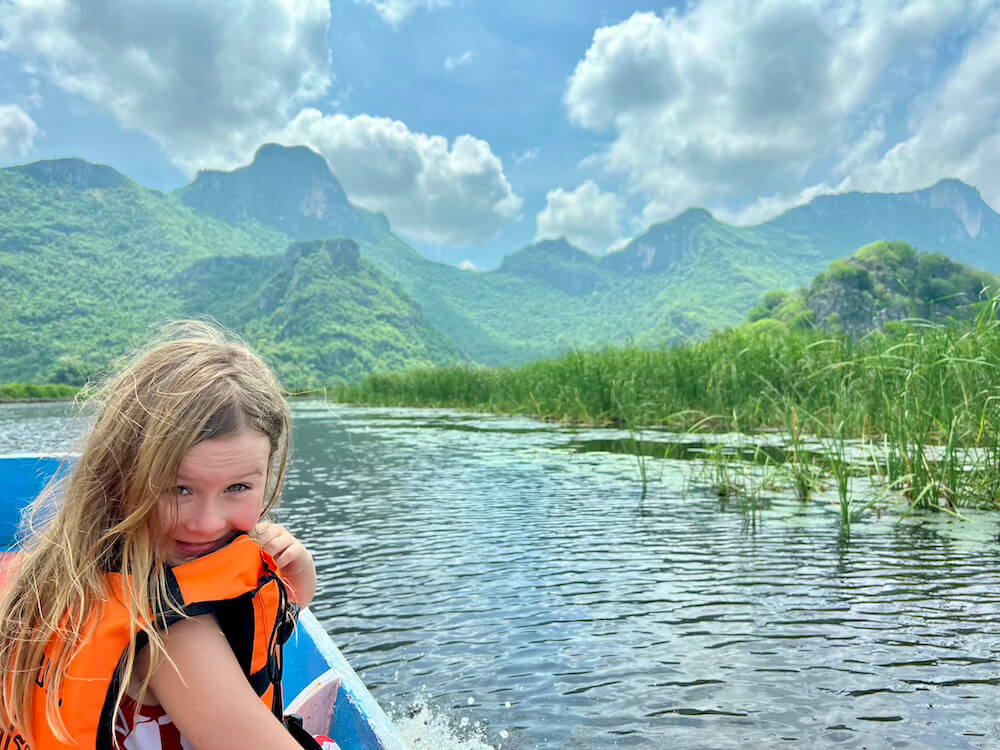
The cave is approached by longtail boat, and the rental of one of these set us back THB 500 per boat. Travel through the marshes is pleasant, and in the early morning or late evening, you can expect to see at least egrets and Purple Swamphens.
Motoring among tall stands of swamp grasses and reeds, slowing only to lessen our wake for passing boats, the trip takes no more than 20 minutes each way. Even though we arrived outside peak sunset hours, we found three or four boats waiting to back into the alcove to take their shots.
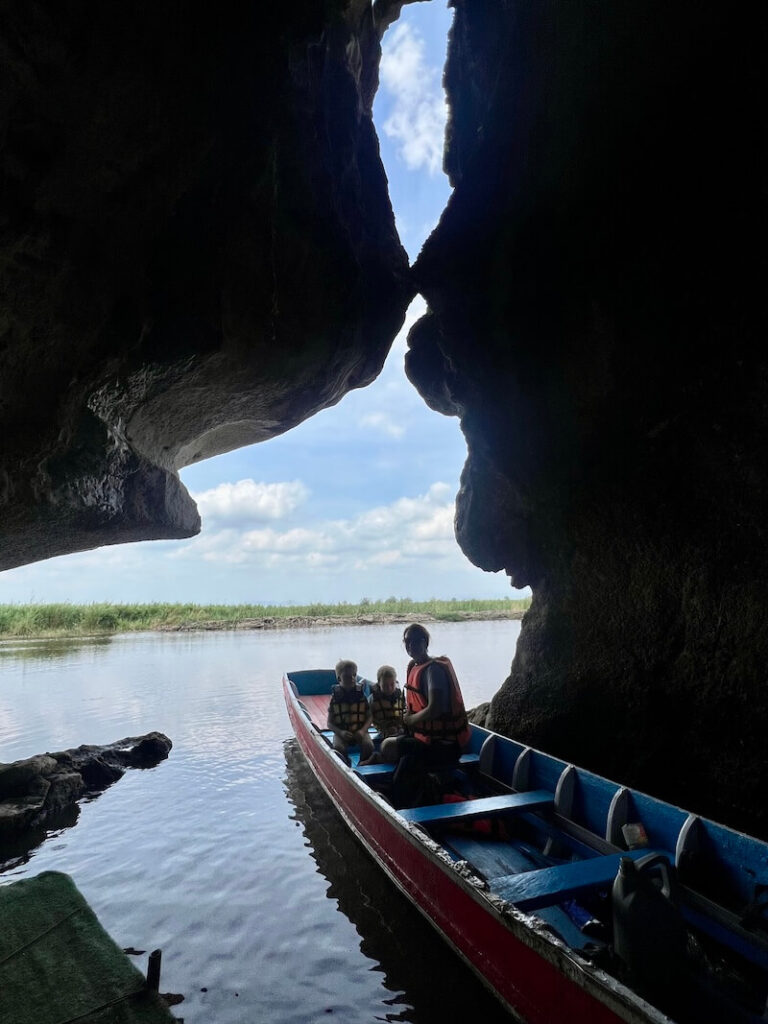
When our turn came, we lined up, hurriedly snapped our obligatory photo, and let the next boat through. I blame our rush for why the silhouettes don’t seem to clearly show a kiss—if anything, the couple appears to have moved on to the next step. It’s still cute, though, and the kids enjoy having accomplished a “mission,” whatever that may be.
Logistics aside, another argument against visiting both caves in the same day is that while they are technically the same kind of geological feature, they produce radically different effects. As unlike as a sparkler and a supernova—which is not to say anything against the charm of a sparkler! Who doesn’t like sparklers?
Bueng Bua Boardwalk: Khao Sam Roi Yot’s Marshland Gem
The Bueng Bua Boardwalk, like the Kissing Cave, lies in the vast Thung Sam Roi Yot Marsh, a shallow basin of fresh water stretching from the mountain wall to the horizon. Here, the park earns its name: ranks of limestone spires extend like the serried tips of spears guarding the coastal plain. Running for over a kilometer beneath this cliff wall, the boardwalk reveals Khao Sam Roi Yot’s full magnificence.
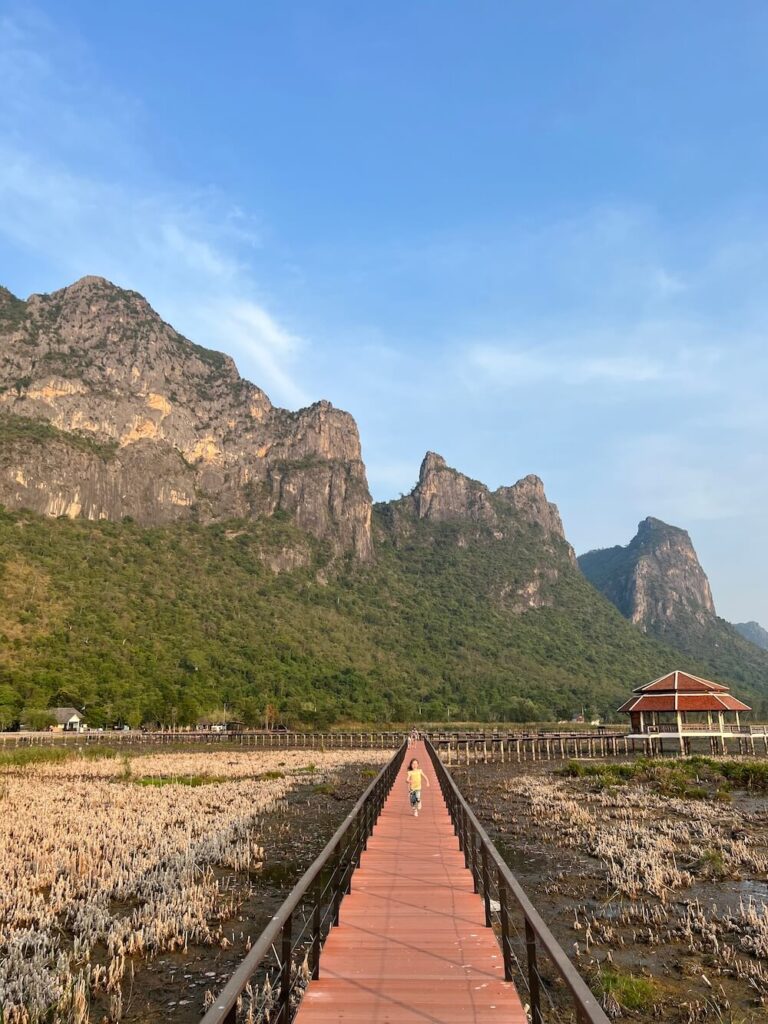
Along the boardwalkstand observation towers that provide an even better vista for taking in the view and for watching the birds. Bueng Bua has a dizzying array of birdlife—more than 300 species are resident or migrate through. Helpful field guides assist novices in identifying the dozens of species visible at any one moment.
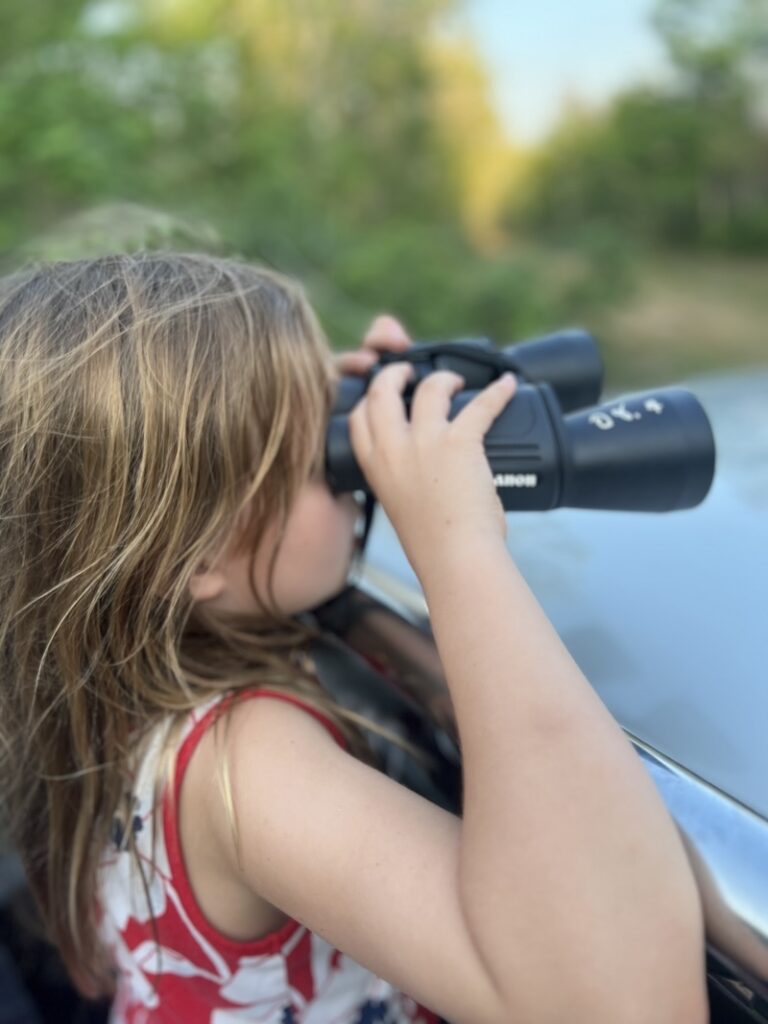
Though I worry I have traits that might someday lead me into birding, it has clearly not yet taken. I did recognize cormorants, Purple Herons, and kingfishers, in addition to ubiquitous egrets, which is what I call all white wading birds. Henry is showing an interest in birds, and I think I’d like to encourage it. I do genuinely enjoy knowing the names of what I see and he has a more promising memory.
The sun turned a deep red as it sank into the marsh. As the limestone palisades behind us reflected the last of the evening light, even an accomplished birder would have lost the ability to identify anything by sight. But ah, the sounds—so many different calls filling the evening air. To walk along the boardwalk in the setting sun and to recognize the different calls and the birds that made them; that would be a marvelous thing.
Plan Your Trip to Khao Sam Roi Yot
Some links below are affiliate links. At no extra cost to you, we earn a small commission if you make a booking, which helps us keep our family on the road. Thank you for your support!
Getting There
Sam Roi Yot is roughly 45 minutes south of Hua Hin and 3.5 hours south of Bangkok. While the park is accessible by motorbike from Hua Hin, the 60-minute drive between the Phraya Nakhon and Bueng Bua sides makes a private car the most practical choice for families. If you aren’t self-driving, we recommend hiring a private driver for the day so you can bridge the mountain gap without the hassle of finding local transport in the more remote sections of the park.
Where to Stay
Most visitors base themselves in Pranburi or Dolphin Bay to avoid the Hua Hin traffic. Both areas are much closer to the park boundaries and offer a quieter, coastal atmosphere. We’ve stayed in each of these and happily recommend them:
Sheraton Hua Hin Pranburi Villas Secluded, high-end tranquility defined. Relax in your private pool villa south of Hua Hin, perfect for families seeking quiet luxury and deep relaxation after a safari.
Centara Grand Beach Resort & Villas Hua Hin The Grand Dame of Hua Hin. This classic resort offers iconic colonial luxury, lush grounds, and the best central location for families.
The Standard Hua Hin Stylish, modern retreat offering hip, vibrant energy and fun, quirky design. Enjoy the cool pool scene, beachfront dining for a more fashionable family stay.
Namaste Resort Simple, charming, and a true local gem. This budget-friendly resort offers personalized attention and invaluable local expertise for the adventurous, down-to-earth traveler.
When to Go
Sam Roi Yot is a year-round destination, but the Cool and Dry Season (November – February) is best for hiking to Phraya Nakhon Cave. If you are a birdwatcher, visit between January and March for peak migratory species. For those wanting to see the famous lotus blossoms at the Bueng Bua Boardwalk, plan your trip for August or September.
Viewing Time: For Phraya Nakhon Cave, aim to be inside the chamber between 10:00 a.m. and 11:30 a.m. to see the sunbeams hit the pavilion. For the Kissing Cave and Bueng Bua Boardwalk, sunset is the undisputed golden hour.
Booking/Tours
Park Fees: You must pay the entrance fee (THB 200 for adults / THB 100 for kids) at your first point of entry. Keep your ticket! It covers all sites in the park (Phraya Nakhon, Bueng Bua, and the caves) for the entire day.
Boat Transfers: Longtail boats at Bang Pu (for the cave) and the marsh (for Kissing Cave) are paid directly to the operators. Expect to pay THB 400–500 per boat for a round trip.
Guided Tours If you want to skip the logistics of navigating around the “Three Hundred Peaks,” booking a private charter from Hua Hin is the easiest way to see both sides of the park in a single day.
Phraya Nakhon Group Tour
- Duration: 7 Hours (Approx.)
- Includes: Round-trip Hua Hin transfers, park boat, and local lunch.
- Vibe: Small group (Max 9) with a focus on timing the cave light shafts.
- Flexibility: Reserve now, pay later with free cancellation.
- Cost: From THB 2,500 per person